

Yes. Self-taught programmers can land quant developer jobs in 2026 if they can show strong software engineering skills and pass the technical interviews for the role they want. A portfolio can demonstrate how you write and test code, but it does not replace a clear resume or an interview-ready explanation of your work.
- Yes: self-taught programmers can land quant developer jobs in 2026 by proving their engineering skills.
- Start with quant developer roles, not quant researcher roles, if software engineering is your strongest evidence.
- Show code you can explain, test and improve; a repository alone is not an interview answer.
- QuantMinds career coaching is best for candidates who need an honest assessment of their resume and interview readiness.
Why this matters
A self-taught background tells an employer how you learned, not what you can build. In a quant developer application, the useful evidence is specific: code you wrote, technical decisions you made, problems you diagnosed and results you can explain without reading from a project page.
That distinction changes where you spend your time. If your coding is strong but your application reads like a list of courses, work on the evidence first. If you get interviews but cannot explain your design choices, more applications will not fix the interview. The self-taught programmer interview guide covers that second problem in more detail.
Can self-taught programmers land quant developer jobs?
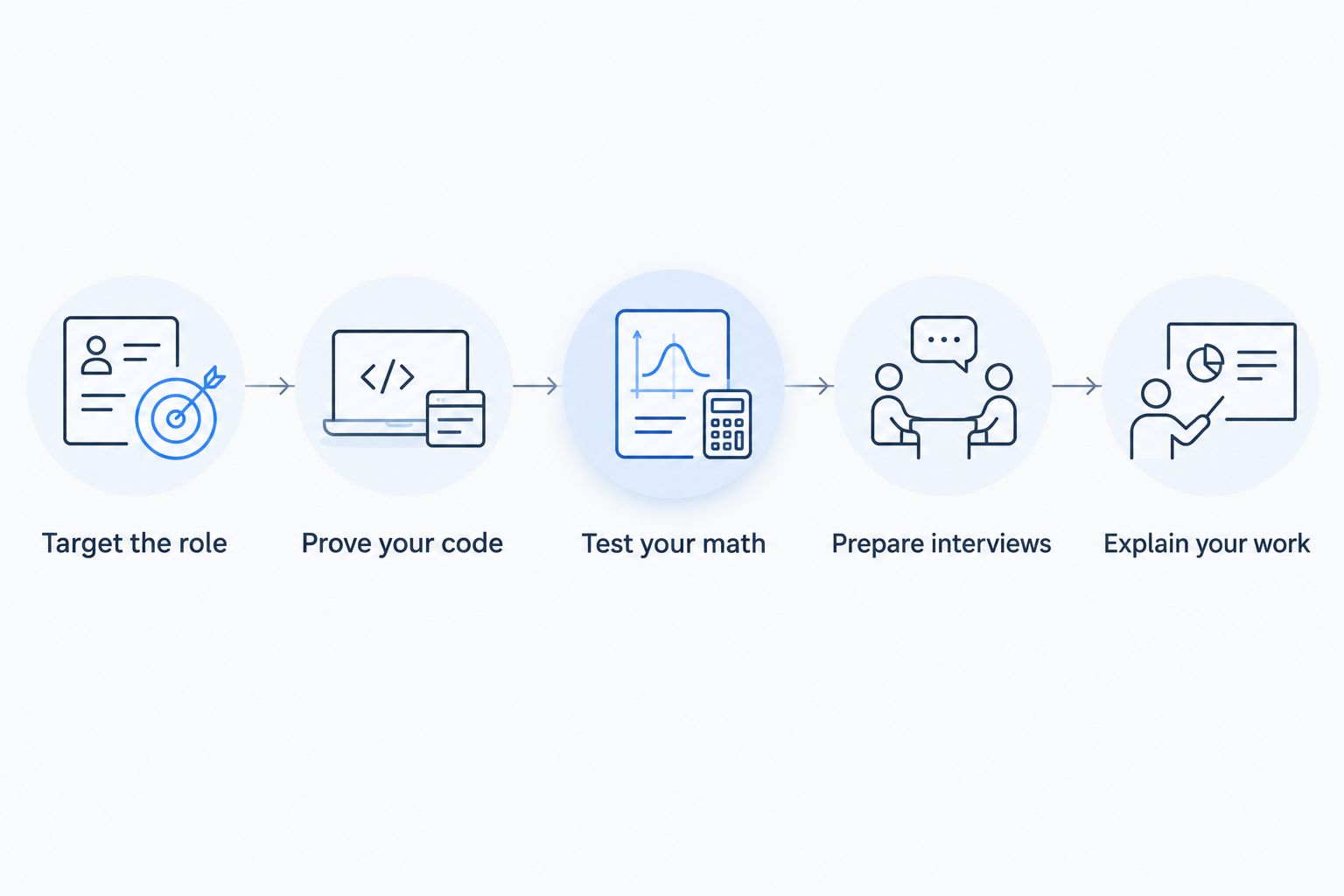
Yes, but self-study is not the qualification. Demonstrated engineering ability is. In 2026, your task is to make that ability visible at each stage of recruiting: resume review, technical screen and deeper interview. Use this sequence to find the stage that needs work.
- Target the role. Read the responsibilities before applying. A quant developer opening centered on production software calls for different evidence from a quant researcher opening centered on modeling and research. Match your resume to the work described, not just the word quant.
- Prove your code. Choose a project you can discuss in detail. Be ready to explain its architecture, tests, performance choices and limitations. A public repository is useful only when you understand what it shows.
- Test your math. Check the quantitative requirements in the roles you want. Identify topics you cannot explain or apply, then study those gaps rather than assuming every quant job has the same mathematical bar.
- Prepare interviews. Practice writing code while explaining your reasoning. Revisit debugging, data structures and trade-offs that connect to the work in the job description. Use the quant developer coding interview guide to organize that practice.
- Explain your work. Prepare a concise account of what you built, why you made key choices and what you would change. Interviewers need to assess your judgment, not just inspect the finished code.
The sequence matters because each stage answers a different question. Your resume earns attention. Your code gives the interviewer something concrete to examine. Your answers show whether the work is yours and whether you can reason through an unfamiliar problem.
Which quant role fits a self-taught programmer?
Do not treat quant developer, quant researcher and quant trader as interchangeable titles. Compare what the job description asks you to do with what your experience actually proves.
| Role | Best for | Evidence to put forward | Gap to address |
|---|---|---|---|
| Quant developer | Programmers whose strongest work is building and maintaining software | Working code, testing, debugging and technical decisions | A project that looks polished but cannot withstand detailed questions |
| Quant researcher | Candidates with strong evidence of mathematical and research work | Modeling choices, analysis and the ability to defend a research approach | Coding work that does not establish research ability |
| Quant trader | Candidates who can demonstrate quantitative reasoning and decisions under pressure | Relevant problem-solving and a clear account of decisions | Assuming software projects alone show trading judgment |
For a programmer with strong engineering evidence and limited research evidence, quant developer is the clearer first target. That is a targeting decision, not a promise that every developer opening has the same requirements. Read each posting and adjust the examples on your resume accordingly.
What belongs in a portfolio?
Choose work that makes your engineering decisions inspectable. A small project with readable code, meaningful tests and an honest explanation of its limits gives you more to discuss than a collection of unfinished demonstrations. If the project uses market data, be precise about where the data came from and what the code does; do not present an exercise as production trading experience.
Prepare to walk through one difficult decision. Why did you choose that structure? How did you check that the output was correct? What broke, and how did you diagnose it? If you cannot answer those questions, revisit the project before putting it at the center of your application.
Your resume should translate the same work into short, verifiable statements. Name the problem, your contribution and the tools you actually used. Avoid claiming ownership of a team project when you can describe your own part instead. In 2026, a self-taught candidate needs a coherent trail from resume claim to code to interview answer.
What if you have professional software experience?
Lead with that experience. Describe the systems you worked on, the engineering problems you handled and the decisions you owned. Self-taught describes your route into programming; it does not erase paid engineering work.
Keep your account of the work precise. A hiring team can question you about the code, constraints and trade-offs behind a resume bullet. If your professional work is private, discuss your responsibilities and technical reasoning without sharing confidential material. Use a separate project when you need code you can show.
What if you have no professional software experience?
Your projects must carry more of the burden. Pick work you can explain from start to finish, including tests and mistakes, and distinguish completed features from ideas you never built. Then check whether the openings you want ask for experience you do not yet have.
Do not rewrite a personal project as employment. Instead, make the application specific: show the relevant skill, say where you used it and prepare to demonstrate it in an interview. A candid application gives the interviewer a way to assess you; an inflated one creates questions you cannot answer.
Why the answer varies
A self-taught background is one part of the application. These factors determine how convincing your case is for a particular quant developer opening:
- The role's actual work. A position focused on software engineering calls for different examples from one focused on research. Apply against the stated responsibilities.
- The depth of your coding evidence. Code you can test, debug and defend is stronger evidence than a list of languages or courses.
- Your quantitative preparation. Check the math named in the posting and the questions you face in interviews. Do not substitute general confidence for demonstrated skill.
- Your resume's clarity. A reader should be able to find your relevant work quickly and understand what you personally contributed.
- Your interview performance. Explaining a sound approach, identifying mistakes and responding to follow-up questions matter alongside arriving at an answer.
- Your existing experience. Professional engineering work and independent projects give you different forms of evidence. Present each accurately.
None of these factors requires you to pretend you followed a conventional academic path. They require you to show that you can do the work described and discuss it under scrutiny.
Do you need an MFE to become a quant developer?
No MFE requirement applies to every quant developer job. In 2026, the useful question is whether a specific opening asks for knowledge your current education and experience do not demonstrate. Check the job description before treating another degree as either essential or irrelevant.
If you are considering an MFE, separate the education decision from the immediate application decision. What would you need to learn? Which openings ask for it? Which skills can you already prove through professional work or projects? Do not use a degree decision to avoid fixing a weak resume or preparing for an upcoming technical screen.
Can projects replace a computer science degree?
Projects can demonstrate programming ability, but they do not guarantee that an employer will treat them as equivalent to a degree. In 2026, judge a project's value by the questions it lets you answer: what you built, how you tested it and how you dealt with failures. Then check the stated requirements of each opening.
A degree requirement and an interview assessment are separate hurdles. Strong code does not make a stated requirement disappear, and a credential does not remove the need to explain your engineering decisions. Focus applications on roles where you can make a credible case on both fronts.
How should you prepare for a quant developer interview without formal training?
Start with the responsibilities of the role, then practice coding and explaining solutions aloud. In 2026, your preparation should also include a detailed walkthrough of your own projects: design choices, tests, bugs and changes you would make. If you cannot explain a resume claim under follow-up questions, revise the claim or deepen your understanding.
Keep a record of the problems you miss during practice and why you miss them. Separate a knowledge gap from a communication problem: knowing a solution after reading it is different from producing and explaining one yourself. Work on the gap that appears in your practice, rather than collecting more material without using it.
Where does career coaching fit?
QuantMinds career coaching is best for self-taught programmers who need an honest assessment of how their resume and interview answers present their experience. QuantMinds offers resume review, interview prep and 1-on-1 coaching for candidates pursuing quantitative roles. The trade-off is straightforward: feedback can expose a weak application or interview answer, but it cannot supply coding experience or a project you have not built.
If you seek feedback, bring a target job description, your current resume and a project you can discuss. That gives a reviewer specific evidence to challenge. QuantMinds coaching is relevant when you need to decide what to emphasize and where your explanation breaks down—not as a substitute for doing the technical preparation. You can find QuantMinds through its listed site.
FAQ
Can self-taught programmers land quant developer jobs in 2026?
Yes, self-taught programmers can land quant developer jobs in 2026 by demonstrating engineering ability and performing well in technical interviews. Your resume, code and explanations must support the same claims.
Do quant developers need a computer science degree?
There is no single degree requirement for every quant developer opening. Check each job description and be ready to demonstrate the technical skills it asks for.
Is a coding portfolio enough to get a quant developer job?
No, a portfolio alone is not enough. You also need an application suited to the role and the ability to explain and defend your code in an interview.
What should a self-taught quant developer put on a resume?
Put relevant engineering work, specific contributions and projects you can explain on your resume. Make each claim consistent with what you can demonstrate under questioning.
Should I apply for quant researcher roles instead of quant developer roles?
Target quant developer roles first if software engineering is your strongest evidence. Apply for quant researcher roles when you can also demonstrate the research and mathematical work those openings require.
Can professional software engineering experience help me switch to quant development?
Yes, relevant software engineering experience gives you work to discuss in a quant developer interview. Explain the systems, decisions and problems you handled without disclosing confidential material.
How can I tell whether my quant developer interview preparation is working?
Practice solving problems aloud and explaining a project under follow-up questions. Track whether you can identify mistakes, justify decisions and improve answers you previously missed.
One last thing
In 2026, do not lead with an apology for being self-taught. Lead with the strongest work you can defend, then make the interviewer test it. If your resume promises more than your code or answers can support, narrow the claim before you send the next application.