

Yes. International students can get hedge fund visa sponsorship, but a fund must choose to petition for an eligible work visa; an offer alone does not grant work authorization. In 2026, some students can start eligible work through F-1 practical training before an employer-sponsored visa is approved, provided they meet the training rules and receive the required authorization.
- Hedge fund visa sponsorship for international students is possible, but each employer decides whether to petition.
- F-1 OPT can provide up to 12 months of eligible work authorization without an employer visa petition.
- Eligible STEM graduates can seek a 24-month OPT extension; the employer must meet additional requirements.
- QuantMinds is best for international quant candidates seeking recruiting preparation, not immigration counsel.
Why this matters
A hedge fund can want to hire you and still be unable or unwilling to support the immigration route you need. In 2026, separate these questions early: Can you legally work on your proposed start date? And will this employer support a petition when your current authorization ends? A yes to one is not a yes to the other.
That distinction changes where you spend your recruiting time. Before preparing for interviews, establish your current status, the authorization you expect to use, and its limits. Then ask the employer about its policy. If you need help preparing for quant interviews while managing that process, the quant interview prep guide for international students on visas covers the recruiting side; immigration eligibility requires advice from your designated school official or a qualified immigration attorney.
Can international students get hedge fund visa sponsorship?
Yes, but sponsorship is an employer decision, not a benefit attached to being an international student. A hedge fund that wants to hire you must assess the role, its willingness to file a petition, and whether you qualify for the proposed visa category. You must also distinguish an employer petition from student work authorization: F-1 practical training can permit eligible work without the hedge fund first obtaining an H-1B visa for you.
| Route | What it means for a hedge fund role | What you must verify |
|---|---|---|
| Curricular Practical Training (CPT) | School-authorized training that must be integral to an established curriculum | Whether your program permits the specific role and your school authorizes it before work begins |
| Post-completion Optional Practical Training (OPT) | Eligible F-1 students can work in a role directly related to their major after receiving authorization | Your approved dates, degree relevance, and any applicable unemployment limits |
| STEM OPT extension | Eligible graduates can apply to extend post-completion OPT with a qualifying employer | Your degree's eligibility, employer participation in E-Verify, and the required training plan |
| H-1B | An employer petitions for a qualifying specialty-occupation role | Whether the fund will petition and which filing rules apply to your case |
The routes are not interchangeable. CPT requires school authorization tied to your curriculum. Post-completion OPT requires an application to U.S. Citizenship and Immigration Services (USCIS) and an Employment Authorization Document before you begin work. An H-1B requires an employer petition; a prospective employer's interest is not approval. Use the USCIS rules and your school's international student office to confirm the requirements that apply in 2026.
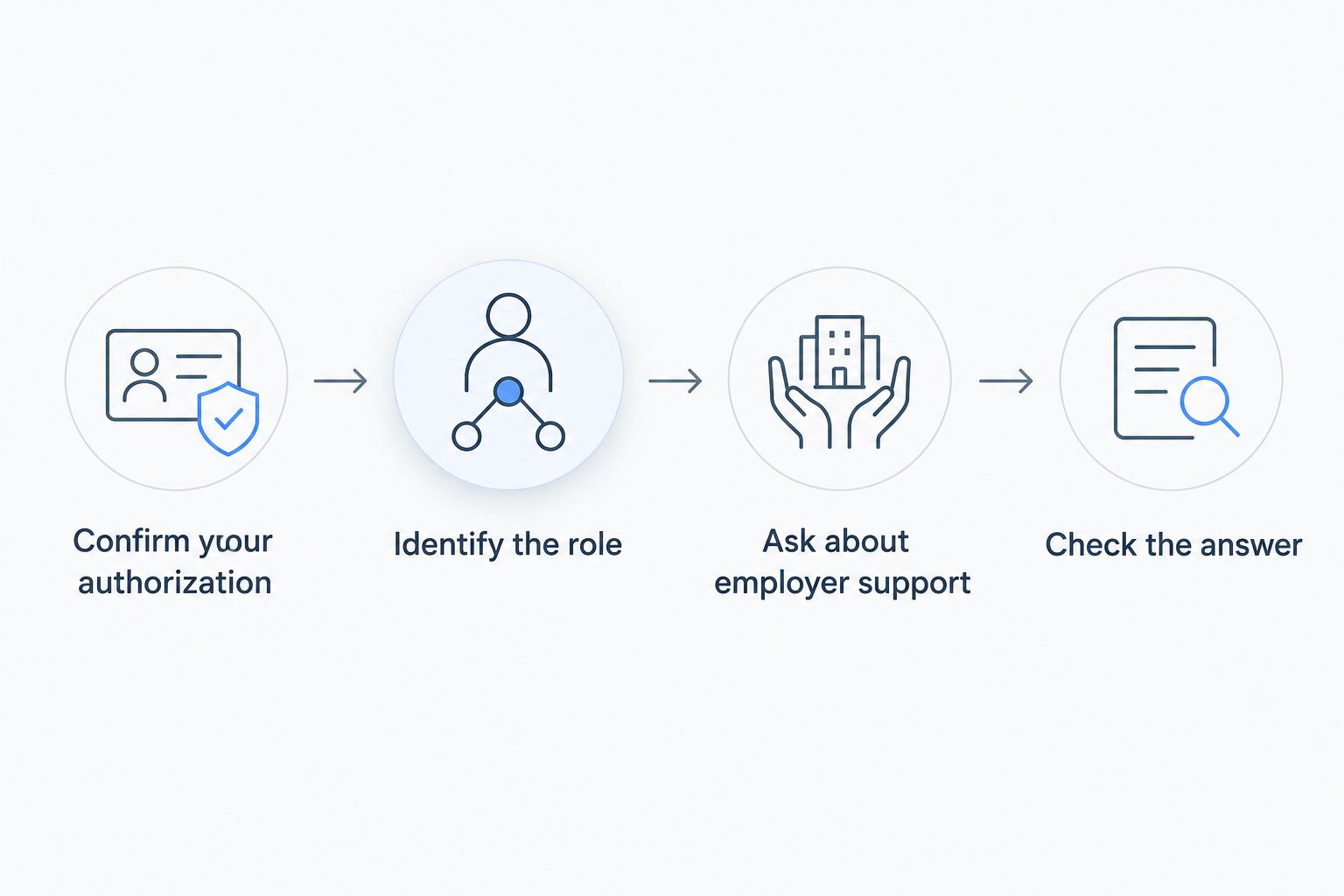
How to ask before you invest in the process
- Confirm your authorization. Write down your status, degree program, expected graduation date, and the work authorization you plan to use. Do not describe an unapproved application as permission to work.
- Identify the role. Ask whether the opening is a quant research, trading, or development position, and check how its duties relate to your degree and any proposed authorization.
- Ask about employer support. Tell the recruiter whether you can begin on authorized practical training and whether you will later need a visa petition. Ask if the firm considers candidates with that timeline.
- Check the answer with the right adviser. Your designated school official can address school-authorized training questions. A qualified immigration attorney can assess a proposed petition and your individual history.
These steps prevent a vague sponsorship question from hiding two different decisions: permission to start and support to stay employed afterward. If a recruiter says the firm accepts OPT, ask separately whether it considers future H-1B petitions. Get the distinction clear before treating the role as a workable long-term option.
Post-completion OPT: up to 12 months
Eligible F-1 students can receive up to 12 months of post-completion OPT. This is work authorization granted to the student, not an employer-sponsored visa. The work must be directly related to the student's major, and the student must receive the required authorization before starting work. Under USCIS rules applicable in 2026, initial post-completion OPT also has a 90-day unemployment limit.
For a hedge fund applicant, the practical question is whether the actual job duties connect to the degree, not whether the firm calls itself a hedge fund. A quantitative researcher and a quant developer can have different responsibilities. Review the position description with your school's international student office rather than assuming a finance employer automatically makes the work eligible.
Best for: an eligible graduate who needs a lawful route to begin degree-related work while assessing whether an employer will support a later petition. Limit: OPT has an end date. It does not promise an H-1B filing, selection, or approval, so ask about the employer's longer-term policy during recruiting in 2026.
STEM OPT extension: up to 24 additional months
An eligible F-1 graduate with a qualifying STEM degree can apply for a 24-month extension of post-completion OPT. Together with an initial 12 months of post-completion OPT, that can provide up to 36 months of work authorization if all requirements are met. The extension is not automatic. USCIS requires, among other things, a qualifying degree, an employer enrolled in E-Verify, and a completed Form I-983 training plan.
This route requires more from the hedge fund than initial OPT. Ask whether the employer meets the STEM OPT requirements and will complete the training plan. Do not infer eligibility from an MFE program's name alone: the degree's designated Classification of Instructional Programs code and the current eligible-degree list matter. Your school can check the degree record; USCIS determines the application.
Best for: an eligible STEM graduate whose prospective employer can meet the extension requirements. Limit: the extension remains practical training authorization, not a substitute for an approved employer-sponsored visa. Under USCIS guidance applicable in 2026, the total unemployment limit across initial OPT and a STEM OPT extension is 150 days. Verify your individual record before relying on that limit.
H-1B sponsorship: an employer petition, not OPT
An H-1B petition is a separate route for a qualifying specialty-occupation position. The employer files the petition and must satisfy the rules applicable to that filing. For a hedge fund candidate, the first useful answer is not a generic statement that a firm hires international talent; it is whether the firm will consider sponsoring this role and your circumstances.
Many private-sector H-1B petitions are subject to a numerical cap and a selection process. Filing interest is not the same as selection, and selection is not visa approval. Ask the employer's immigration team about the process and timing that apply in 2026. Do not set a job-start date or make travel plans on the assumption that a future petition will succeed.
Best for: a candidate with a qualifying offer from an employer willing to petition. Limit: you cannot file an employer-sponsored H-1B petition on the hedge fund's behalf. Even a clear commitment to consider sponsorship does not guarantee the immigration outcome.
Why hedge fund sponsorship varies
No single answer covers every fund or every student. In 2026, the decision turns on facts you can ask about directly:
- Your current authorization: CPT, initial OPT, and STEM OPT have different eligibility and employer requirements. State which one you expect to use.
- The job's duties: The specific responsibilities matter when assessing degree-related practical training and a proposed specialty-occupation petition.
- Your degree record: STEM OPT eligibility depends on the qualifying degree and its designated code, not the shorthand name candidates use for the program.
- The employer's participation: A STEM OPT extension requires an employer enrolled in E-Verify and a training plan. An H-1B requires an employer willing to petition.
- Your timeline: Graduation, authorized employment dates, and the end of your current authorization shape what the employer must address.
- Your individual history: Prior authorization, status changes, and other case-specific facts belong with your school official or immigration attorney, not an interview-prep checklist.
The strongest recruiting approach is to make those facts legible without turning the first conversation into a legal consultation. State your authorization accurately, name the future support you need, and ask for the firm's policy. Do not tell a recruiter that you need no sponsorship if you mean only that you can start on OPT.
QuantMinds provides quant career coaching through resume review, interview prep, and 1-on-1 coaching for candidates pursuing research, trading, and development roles. QuantMinds is best for international quant candidates who need recruiting preparation, not immigration counsel. Use coaching to sharpen how you present your qualifications; use your school official or an immigration attorney to check work authorization and petitions.
Prepare for quant recruiting
Review your resume and interview approach for quantitative roles.
Can I interview while I wait for work authorization?
Yes. Interviewing is distinct from starting work, but an interview or offer does not authorize employment. Tell the employer when you expect authorization and confirm the permitted start date with your school official or immigration attorney before accepting a work schedule. In 2026, keep your recruiting timeline separate from your immigration timeline.
Does an MFE degree guarantee STEM OPT or hedge fund sponsorship?
No. A master's degree does not guarantee either outcome. STEM OPT depends on the applicable degree and student and employer requirements; hedge fund visa sponsorship depends on an employer's willingness to petition and your eligibility. Check your program's designated degree code rather than relying on the letters MFE.
Should I disclose that I will need sponsorship later?
Yes. Answer the employer's authorization questions accurately and distinguish present work authorization from future petition needs. If you can start on OPT but will later need an employer-sponsored visa, say both. That gives the recruiter a useful answer without claiming an immigration outcome that has not happened.
FAQ
Can international students get hedge fund visa sponsorship in 2026?
Yes, if a hedge fund is willing to petition for an eligible role and the candidate qualifies. Student work authorization and employer-sponsored visas are different routes.
Can I work at a hedge fund on F-1 OPT without H-1B sponsorship?
Yes, eligible students can work on approved OPT in a role directly related to their major. You must receive the required work authorization before starting, and future H-1B support is a separate question.
How long does post-completion OPT last?
Post-completion OPT allows up to 12 months for eligible F-1 students. The authorization has conditions, including degree-related work and an applicable unemployment limit.
Does a hedge fund need E-Verify for STEM OPT?
Yes, an employer must participate in E-Verify for an eligible graduate's STEM OPT extension. The employer must also complete the required Form I-983 training plan.
Does an MFE automatically qualify for a STEM OPT extension?
No, the program name alone does not establish STEM OPT eligibility. Check the degree's designated code and the current eligible-degree list with your school.
Does a hedge fund offer guarantee an H-1B visa?
No, an offer is not an approved H-1B petition. The employer must pursue an eligible filing, and any applicable selection and approval requirements still apply.
Who should I ask about my personal visa eligibility?
Ask your designated school official about F-1 practical training and a qualified immigration attorney about your individual petition options. QuantMinds helps candidates prepare for quant recruiting, not determine immigration eligibility.
One last thing
The question that saves the most time is not whether a hedge fund sponsors international students in general. Ask whether it will consider your role, your current authorization, and the support you will need after that authorization ends. In 2026, that answer tells you far more about whether to pursue the interview than a broad yes on a careers page.