

Yes. Economics majors can become quant researchers when they can demonstrate the mathematics, programming, and empirical research skills the role requires. In 2026, the degree title is less useful than evidence that you can formulate a testable question, work with data, and explain where your result might fail.
- Yes, economics majors can become quant researchers; the degree alone does not establish technical readiness.
- Probability, statistics, linear algebra, coding, and careful empirical research are the evidence to build in 2026.
- QuantMinds is best for economics majors who need feedback on how they present existing work, not a substitute for technical preparation.
Can economics majors become quant researchers?
Yes, if your economics background includes demonstrable quantitative work and you can perform under technical interview conditions. A transcript showing econometrics helps establish the starting point; it does not show how you write code, test a hypothesis, or respond when an interviewer challenges your assumptions. If you are unsure which evidence belongs on your resume, QuantMinds offers resume review and interview preparation for candidates pursuing quantitative research roles.
Build your case in this order:
- Check your mathematical foundation. Identify the probability, statistics, linear algebra, and optimization topics you can explain and use, not just courses you completed.
- Show working code. Be ready to discuss how you cleaned data, implemented an analysis, checked your output, and found errors.
- Present a research question. State the hypothesis, data, method, result, and limitations of a project you actually completed.
- Match your evidence to the role. Read each research job description for its methods and technical requirements. Do not assume every quant research position asks for the same things.
- Practice defending the work. An interviewer can ask why you chose a method, what would invalidate the result, and what you would change with different data.
This is a readiness test, not a promise of an interview. In 2026, an economics major with strong econometrics but no coding evidence still has a gap to close. An economics major with a well-documented research project has something specific to discuss, but still needs to meet the requirements of the position.
Why this matters
Quant research is not a single job description. A role focused on market data, a role centered on statistical modeling, and a role asking for specialized mathematical methods can reward different preparation. The practical question is not whether economics is an acceptable label. It is whether your coursework and projects let an interviewer inspect how you reason with data.
Economics can give you relevant habits: defining a question, thinking about confounders, interpreting estimates, and distinguishing correlation from a causal claim. Those habits are useful only when you can apply them precisely. If you list a research paper on your resume, expect to explain the variables, assumptions, data restrictions, and decisions behind it rather than recite its abstract.
That distinction also changes how you spend your time in 2026. Adding another broad finance credential does not automatically address a weak probability foundation or a project you cannot reproduce. Start with the gap you can identify, then choose coursework, practice, or project work that closes it.
Which route fits an economics major?
There is no required route from economics to quant research. Choose based on the skills you already have, the requirements of the roles you want, and the quality of your existing research evidence.
| Route | Best for | Advantage | Limitation |
|---|---|---|---|
| Apply with an economics degree | Candidates with strong quantitative coursework, coding, and research work | Uses evidence you already have | A degree label will not fill missing technical skills |
| Build skills through coursework and projects | Candidates with a specific math, coding, or research gap | Gives you work to explain in an interview | Independent work needs clear methods and honest limitations |
| Consider an MFE or related graduate program | Candidates whose target roles call for deeper formal training | Provides a structured path for technical study | Admission and a degree do not guarantee a research role |
Best route: use your existing degree if your work already meets the role’s technical demands. Choose further study to solve a documented gap, not because you assume economics is disqualifying. If you cannot yet explain a research project end to end, fix that before treating an additional credential as the answer.
An undergraduate economics major and a professional economist also start from different places. A professional with substantial empirical research can lead with methods and findings, then address any missing tools. An undergraduate with limited research experience needs to build a smaller, defensible piece of work rather than describe an interest in markets as if it were research experience.
How to turn economics work into quant research evidence
A strong project account shows what you did and what the evidence supports. Use this sequence for a thesis, class project, research assistant assignment, or independent analysis you actually completed:
- State the question. Describe what you tested in language an interviewer can understand without reading your paper.
- Describe the data. Explain its source, what observations it contains, and the exclusions or cleaning decisions you made.
- Defend the method. Say why you chose the model or test and which assumptions matter to the result.
- Explain the checks. Discuss how you looked for errors, sensitivity to your choices, or evidence that your result would not hold outside the sample.
- Separate finding from claim. State what the analysis shows, then name what it cannot establish.
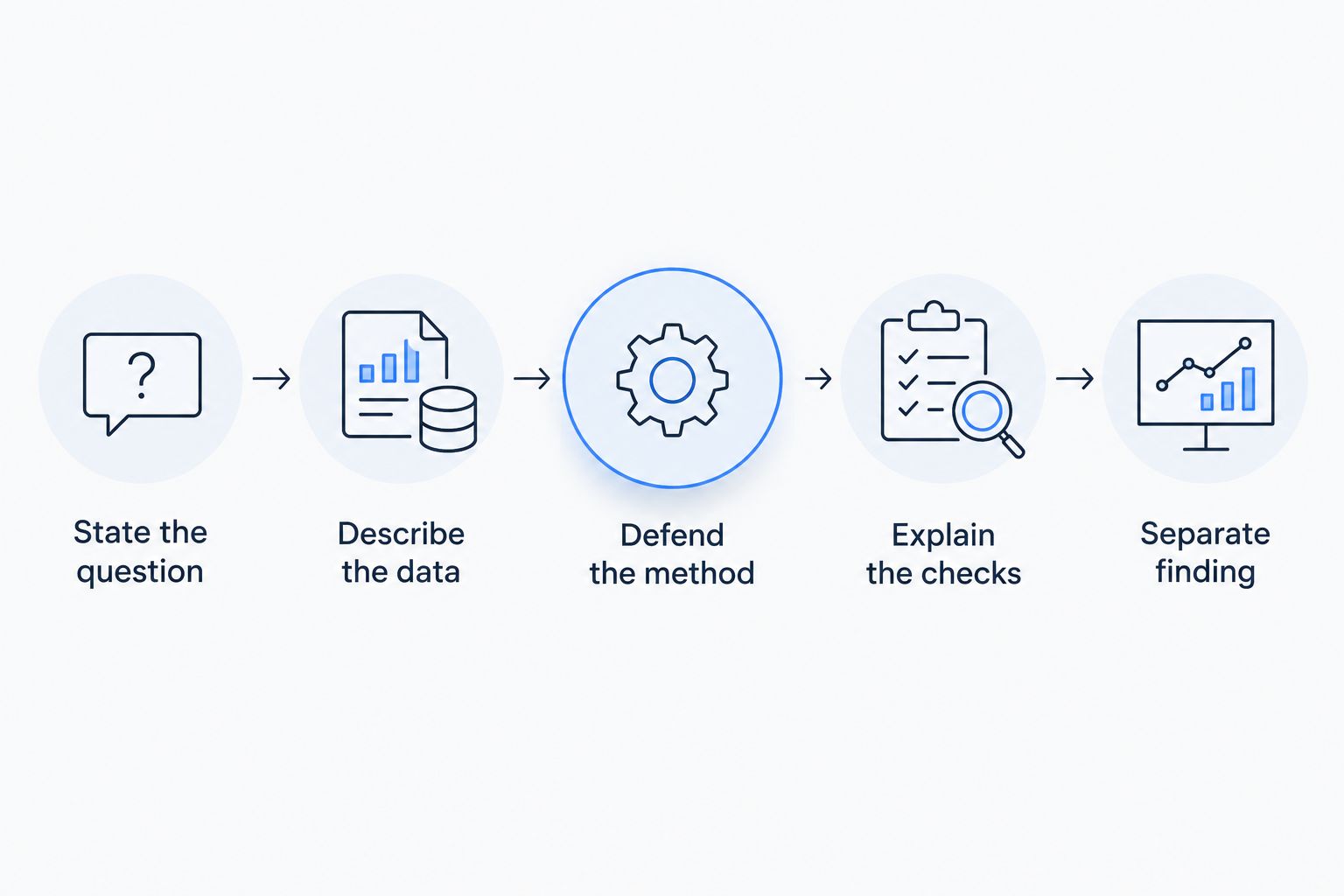
This sequence exposes weak spots before an interview does. If you cannot describe your cleaning decisions, revisit the code or notes. If you cannot defend the method, return to the underlying statistics. If the finding changes sharply when you change a reasonable assumption, report that honestly; hiding it leaves you unable to answer the next question.
Research evidence is more than a polished final chart. Keep enough of the code and methodology to walk someone through the work. Be precise about your contribution when a project was collaborative. An interviewer asking what you personally implemented needs an answer that separates your work from the team’s.
For a 2026 application, the resume version must be shorter than the interview version. A bullet should identify the question, your method or technical contribution, and the result you can defend. Do not add a performance claim because it sounds impressive; include an outcome only when your work supports it.
Which skills should you check before applying?
Use job descriptions as the final filter. The list below identifies areas to examine, not a universal syllabus for every quant research team.
- Probability and statistics: Can you reason through uncertainty, sampling, estimation, and the limits of a test without relying on memorized terminology?
- Linear algebra and mathematical modeling: Can you explain the mathematical tools behind the models you claim to use?
- Programming: Can you write and inspect code that loads data, implements an analysis, and checks its output?
- Empirical judgment: Can you spot a data problem, questionable assumption, or misleading interpretation before someone else points it out?
- Communication: Can you give a direct answer to a technical challenge, then show the reasoning behind it?
The trade-off is depth against breadth. A long list of tools on your resume invites questions about every item. A shorter list backed by work you can reproduce gives an interviewer more reason to trust it. In 2026, use the requirements of each opening to decide what deserves space on the page.
Keep research and interview preparation connected. If you say you used a statistical method in a project, practice explaining why it was appropriate and when it would break. If you list Python, be prepared to discuss the code you wrote, not only the libraries you imported. That preparation tests whether your application and your actual skills tell the same story.
Why economics majors get screened out
The economics major itself is not a complete explanation for a rejection. The application can fail to show the skills a research team needs, or an interview can reveal that a candidate cannot defend work listed on the resume. Fix the evidence you control.
- A course list stands in for proof. Replace vague claims about quantitative ability with a specific project or technical contribution you completed.
- The resume describes a result but not the method. Name the analysis you performed and be ready to explain the underlying choice.
- The project ignores its own limitations. Identify data restrictions and assumptions before an interviewer has to extract them.
- Coding is claimed but not demonstrated. Prepare to discuss implementation, debugging, and checks from your own work.
- One application is sent to different kinds of roles. Adjust the evidence you emphasize to the stated research requirements; do not change the facts of what you did.
This is also where honest feedback has a defined use. QuantMinds career coaching includes resume review, interview preparation, and 1-on-1 coaching for people pursuing quantitative roles. QuantMinds is best for economics majors who already have work to assess and need help presenting it clearly; coaching does not replace missing math, coding, or research experience.
Do you need an MFE to become a quant researcher?
No. An MFE is one possible way to develop technical skills and pursue quant roles, not a prerequisite established by your economics major. Compare the curriculum and outcomes you seek with the skills you lack; do not use a graduate degree as a substitute for identifying that gap.
If you already have strong mathematical training, programming ability, and research work, applying directly can make sense. If your preparation is concentrated in economic theory and you cannot meet the technical demands of your target roles, structured graduate study is an option to evaluate. Neither choice removes the need to explain your work in an interview.
The decision should be concrete in 2026: list the requirements from the roles you want, mark which ones you can demonstrate, and investigate programs only for the remaining gaps. A program name is not evidence that you personally can carry out research.
Can you move from economic research into quant research?
Yes, if you can translate your research experience into the methods and technical work required by the target role. Describe the data you handled, the models you built or evaluated, the code you wrote, and the conclusions you could defend. Do not assume that an economic research title tells a hedge fund or prop trading firm what you actually did.
The distinction between using a model and developing or evaluating one matters in your application. Explain your exact contribution. If your work did not involve a skill the role requires, identify that gap and address it rather than relabeling your experience.
Can an economics major apply without finance experience?
Yes. Read the specific job description: demonstrate its stated technical requirements and explain your research work without inventing market experience. Lack of finance experience and lack of research preparation are different issues. Your application must make the distinction visible.
An economics project unrelated to trading can still demonstrate sound empirical practice. Be ready to explain why its methods are relevant, and do not claim the project proves you can build a trading strategy. In a 2026 interview, that narrower, defensible explanation is stronger than a broad claim you cannot support.
FAQ
Can economics majors become quant researchers in 2026?
Yes. Economics majors can pursue quant research roles when they can demonstrate the mathematics, coding, and research skills a specific role requires. The major alone does not establish those skills.
Is econometrics enough to get a quant research job?
No. Econometrics is relevant preparation, but you also need to meet the programming, mathematical, and research requirements of the role. Be ready to defend an analysis you performed.
Do I need an MFE after an economics degree?
No. An MFE is an option for developing technical skills, not a requirement created by an economics degree. Assess your gaps against the roles you want before choosing further study.
Can I become a quant researcher without a PhD?
A PhD is not a universal requirement for quant research roles. Check each opening's stated requirements and demonstrate the technical depth it asks for.
What should an economics major put on a quant research resume?
Include quantitative coursework and research or coding work you can explain and defend. State your actual contribution, method, and supported finding rather than listing broad interests.
Does economic research experience help with hedge fund applications?
Yes, when it shows relevant empirical methods, coding, and judgment that you can describe precisely. Explain your contribution and the limits of the result instead of relying on your job title.
Can coaching replace missing technical skills?
No. QuantMinds offers resume review, interview preparation, and 1-on-1 coaching, but those services do not replace mathematical, coding, or research preparation. Use feedback to identify what your application demonstrates and where it falls short.
One last thing
Before sending a 2026 application, pick the project you most want an interviewer to ask about. Now write down the hardest honest question about its data, method, or conclusion. If you cannot answer it without retreating to generalities, revisit the work before you add another line to your resume.