

Yes, you can get into quant finance with a liberal arts degree in 2026, but the degree alone will not demonstrate the math, statistics, and coding skills the role requires. Your path depends on whether you want to pursue quantitative research, trading, or development. Build evidence for one role rather than presenting general interest in markets as a qualification.
- Quant finance with a liberal arts degree is possible in 2026 when you can demonstrate role-specific technical skills.
- Quant research demands stronger evidence of statistics and research; quant development demands stronger evidence of coding.
- QuantMinds is best for candidates who want direct feedback on their quant resume and interview preparation.
- An MFE is one route to build evidence, not a substitute for choosing a target role.
Why this matters
A liberal arts degree describes your course of study, not the full set of skills you have now. The harder question is what a recruiter can verify from your transcript, projects, resume, and interview answers. If those materials do not show technical ability, your explanation of why you want to work in quant finance will not close the gap.
In 2026, start with the role, not the industry label. A quantitative researcher, trader, and developer face different technical work and different interviews. The guide to preparing for a quant interview without a finance background is a useful next read once you know which role you are targeting; a missing finance major and a missing technical foundation are separate problems.
Can you get into quant finance with a liberal arts degree?
Yes, if you can show the technical skills for the specific job. A liberal arts degree is neither an automatic rejection nor evidence that you are ready for a quant interview. Compare your current work against the role you want, then address the gaps that appear in that comparison.
| Target role | Evidence to build | Advantage of this route | Gap to address |
|---|---|---|---|
| Quantitative research | Statistics, probability, coding, and a research project you can defend | A clear project gives interviewers something technical to question | Interest in markets does not replace a defensible method |
| Quantitative trading | Probability, mental math, decision-making, and clear reasoning under questioning | You can demonstrate how you think in an interview | Unexplained answers make it difficult to assess your process |
| Quantitative development | Programming, debugging, testing, and code you can explain | Working code makes a technical claim visible | A finance narrative does not replace coding ability |
| MFE or another relevant graduate program | Coursework and an application that address your preparation gaps | Structured study can provide a route to deeper technical work | The degree is not itself proof that you can do the target job |
These are paths to investigate, not interchangeable job titles. If your strongest work is a data analysis, examine research requirements first. If you can build and explain software, examine development. If you enjoy reasoning through uncertain outcomes aloud, examine trading. The decision is about what you can demonstrate now and what you are prepared to learn, not which title sounds most appealing.
Your degree label also hides important differences. A liberal arts graduate who completed substantial math and programming coursework starts with different evidence from someone whose transcript contains neither. Put the actual courses and work in front of the question. Do not ask a recruiter to infer technical preparation from your interest in the field.
How do you build a credible application?
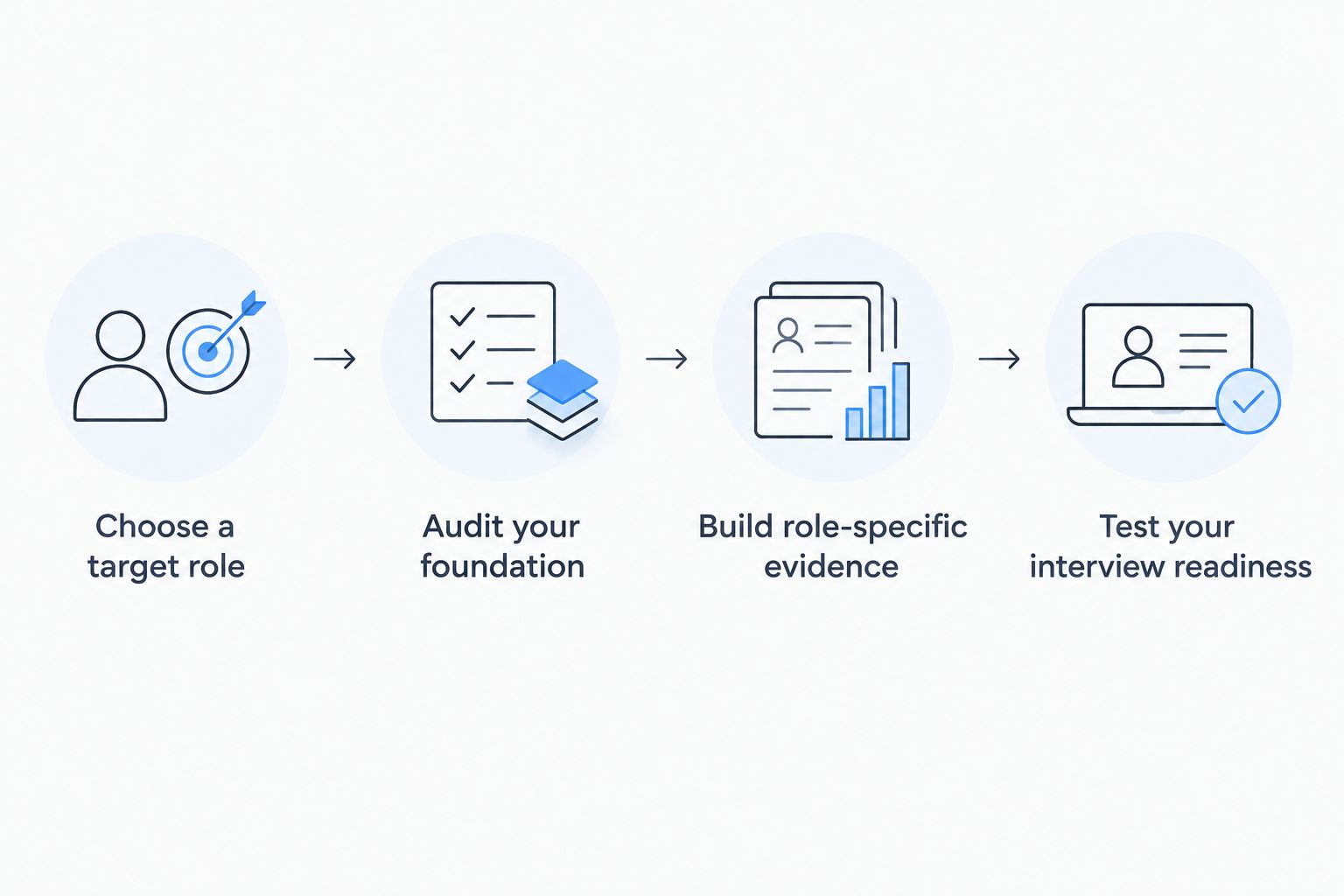
Use this sequence in 2026. It keeps you from spending months polishing a general resume while the central technical question remains unanswered.
- Choose a target role. Read descriptions for research, trading, and development roles separately. Make a list of the skills each description asks you to show, and select the role that best fits the evidence you already have.
- Audit your foundation. Review your coursework and practical work in calculus, linear algebra, probability, statistics, and programming against those descriptions. Mark what you can explain and use, not just what you once studied.
- Build role-specific evidence. Complete one project with a question, method, code or analysis, and limitations you can explain. For development, make the implementation and tests easy to inspect. For research, make your assumptions and validation clear.
- Test your interview readiness. Explain the project without reading from your resume. Solve relevant technical questions aloud and note where your reasoning breaks down. Revise the work or study plan before sending more applications.
A project is evidence only if you can defend it. Be ready to explain why you chose the question, what data or assumptions you used, what the code does, and what would change your conclusion. A polished chart without an explanation leaves the technical gap open.
For a 2026 application, use a one-page resume as an editing exercise if it helps you put the relevant evidence first. Lead with technical coursework, code, research, or other directly relevant work you can substantiate. Do not fill the top of the page with a broad objective about your passion for finance while burying the material an interviewer will ask about.
Why the difficulty varies
The phrase liberal arts degree does not identify a single starting point. These factors determine the size of the gap between your current profile and your target role:
- Your quantitative coursework. Relevant math and statistics classes give you material to list and discuss; an unrelated degree title says less than the courses themselves.
- Your programming experience. Code you wrote, tested, and can explain is stronger evidence than a language listed without supporting work.
- Your target role. Research, trading, and development require different demonstrations of skill. Preparing for all three as though they share one interview wastes effort.
- Your project quality. A project with a clear method and stated limitations supports a technical conversation. A result you cannot reproduce or explain does not.
- Your interview performance. Your resume can earn scrutiny; your answers must show that the listed skills are yours.
- Your application positioning. A resume tailored to the actual role makes relevant evidence easier to find than a general finance resume.
None of these factors changes because you call yourself a career changer. In 2026, the useful question is narrower: which requirement can you already demonstrate, and which requirement currently has no evidence behind it?
Which route fits your starting point?
If you studied math but not finance: do not treat finance terminology as the whole problem. First determine whether you can apply your math to the probability, statistics, and coding tasks in the roles you want. Then learn enough about the target work to explain why your existing training fits it.
If you studied writing, history, or another field without much technical coursework: begin with the missing foundation. Networking and a polished LinkedIn profile cannot stand in for probability or programming when the interview tests them. Work through the technical gaps before treating applications as your primary learning tool.
If you already code professionally: test whether development is a better first target than research or trading. Show work that demonstrates the kind of coding the role asks for, rather than assuming that every programming job prepares you for every quant role. Keep the interview plan specific to development unless the evidence supports another choice.
If you are considering an MFE: check the program's actual prerequisites and curriculum against your gaps. An MFE is a decision about structured technical study, not a default answer to an unconventional undergraduate major. Your application still needs to explain what you have done to prepare for the coursework.
These routes have different costs in time and preparation, even without attaching a universal timeline to any of them. The practical choice is the route that addresses your largest demonstrated gap. Do not apply to graduate programs solely to avoid testing whether you enjoy the underlying math and coding.
What should you put on your resume and LinkedIn profile?
Make the technical case easy to inspect. On your resume, identify relevant coursework accurately, describe projects by the question and method, and state your own contribution. On LinkedIn, use the same target role and technical evidence. A recruiter should not encounter a research-focused resume and a profile that describes only a general interest in finance.
For each project, prepare three short explanations: the question you tried to answer, the method you used, and a limitation. Those are prompts for your own preparation, not a claim that every interview follows the same format. If you cannot give those explanations without the project open in front of you, keep working on it before making it central to your application.
Avoid dressing unrelated experience up as quantitative research. Writing, communication, and independent study can strengthen your account of how you work, but label them honestly. Put technical evidence where it exists, and build it where it does not.
QuantMinds offers quant finance career coaching, resume review, interview preparation, and one-on-one coaching for students and professionals targeting roles at hedge funds and prop trading firms. Its most relevant use here is a direct assessment of whether your application materials and interview answers actually show readiness for your chosen role. Coaching can identify and help you present a gap; it cannot replace the technical work needed to close one.
Do you need an MFE to make the switch?
No, an MFE is not the only route to quant finance with a liberal arts degree. Judge it against your current coursework, the roles you want, and the preparation you can demonstrate independently. If a program addresses a specific gap, examine its prerequisites and curriculum before deciding to apply.
A graduate degree should answer a concrete question about your preparation. If you cannot name the skills you need from the program, you cannot judge whether it fits. If you already have strong technical work, assess that evidence against job requirements before assuming another credential is the necessary next step.
Can you apply before you have a quant internship?
Yes, you can apply without a prior quant internship, but your application still needs role-relevant evidence. Coursework, a defensible project, or applicable programming work gives an interviewer something specific to evaluate. An internship is valuable experience; its absence does not make an unsupported claim of technical ability persuasive.
For undergraduate candidates, separate the question of where to apply from what you can demonstrate. In 2026, improve the latter before sending the same general resume to a longer list of employers. Each application should make clear why your existing work fits that particular role.
How do you explain a liberal arts background in a quant interview?
Explain the transition through evidence, not an apology. Name the target role, the technical work you completed, and the skill you are still developing. Then be prepared to solve the interviewer's question rather than returning to a rehearsed story about your degree.
A concise answer can connect your earlier training to the project you chose and the work you want to do. Keep that connection accurate. If your background helped you frame a research question or communicate a result, say so; do not present those strengths as substitutes for math, statistics, or code.
FAQ
Can I work in quant finance with a liberal arts degree in 2026?
Yes, you can pursue quant finance with a liberal arts degree in 2026 if you can demonstrate the technical skills for your chosen role. Evaluate research, trading, and development separately rather than applying to all three with the same evidence.
Is a finance degree required for a quant role?
A finance degree is not the central test for every quant role. Check the specific job's math, statistics, programming, and interview requirements against work you can actually demonstrate.
Can I become a quant researcher without a STEM undergraduate major?
Yes, but you need convincing evidence of research-relevant quantitative and coding ability. A degree title alone does not establish that ability in either direction.
Is quant trading easier to enter than quant research with a liberal arts degree?
Neither is automatically easier because you have a liberal arts degree. Compare the trading and research interviews you are targeting with your own probability, coding, and project experience.
Should I get an MFE to switch into quant finance?
Choose an MFE only if its prerequisites and curriculum fit a gap you need to close. It is one route to technical preparation, not a substitute for identifying your target role.
What should a liberal arts graduate put on a quant resume?
Put relevant technical coursework, programming, and defensible projects where a reviewer can find them. Describe what you did and what you can explain in an interview.
Can coaching replace technical preparation for quant interviews?
No, coaching cannot replace the math, statistics, or coding a role tests. It can help you identify gaps and present the work you have completed clearly.
One last thing
The strongest answer to a question about your liberal arts degree is not a better defense of the degree. It is work that changes the subject: a project you can explain, code you can defend, and an interview answer that holds up under follow-up questions. Choose the role first; make that evidence visible in your 2026 application.