

Yes, you can land a quant research role with no internships in 2026 if you can show credible research work and defend it in an interview. An internship gives employers evidence that you can work on an unfamiliar problem; without one, your projects, academic research or technical work must provide that evidence. The goal is not to disguise the missing internship. It is to make your research ability easier to evaluate.
- A quant research role with no internships is possible in 2026, but research evidence must replace the missing work signal.
- QuantMinds' verdict: candidates without internships should lead with defensible research, not a longer skills list.
- Show your question, method, validation and limitations; prepare to explain each without relying on a polished slide deck.
- Apply where your evidence matches the role, and treat interview gaps as a reason to revise the work first.
Why this matters
An internship is easy for a recruiter to recognize on a resume. A research project takes more explanation. If you have no internships, the first challenge is getting a reader to understand what you actually did; the second is proving that you understand the work when someone starts questioning your choices.
That changes where you should spend your time in 2026. Adding another tool to a skills list does less for your application than making one substantial piece of work clear, inspectable and relevant to the role. If you need help deciding what belongs on your resume and how to discuss it, QuantMinds offers resume review, interview preparation and 1-on-1 coaching for quant candidates. Coaching can improve how you present your work; it cannot supply research you have not done.
Can you land a quant research role with no internships?
Yes. Your application needs an alternative answer to the question an internship would normally address: what can you do with a difficult research problem when the answer is not already known? Build that answer before you send out applications.
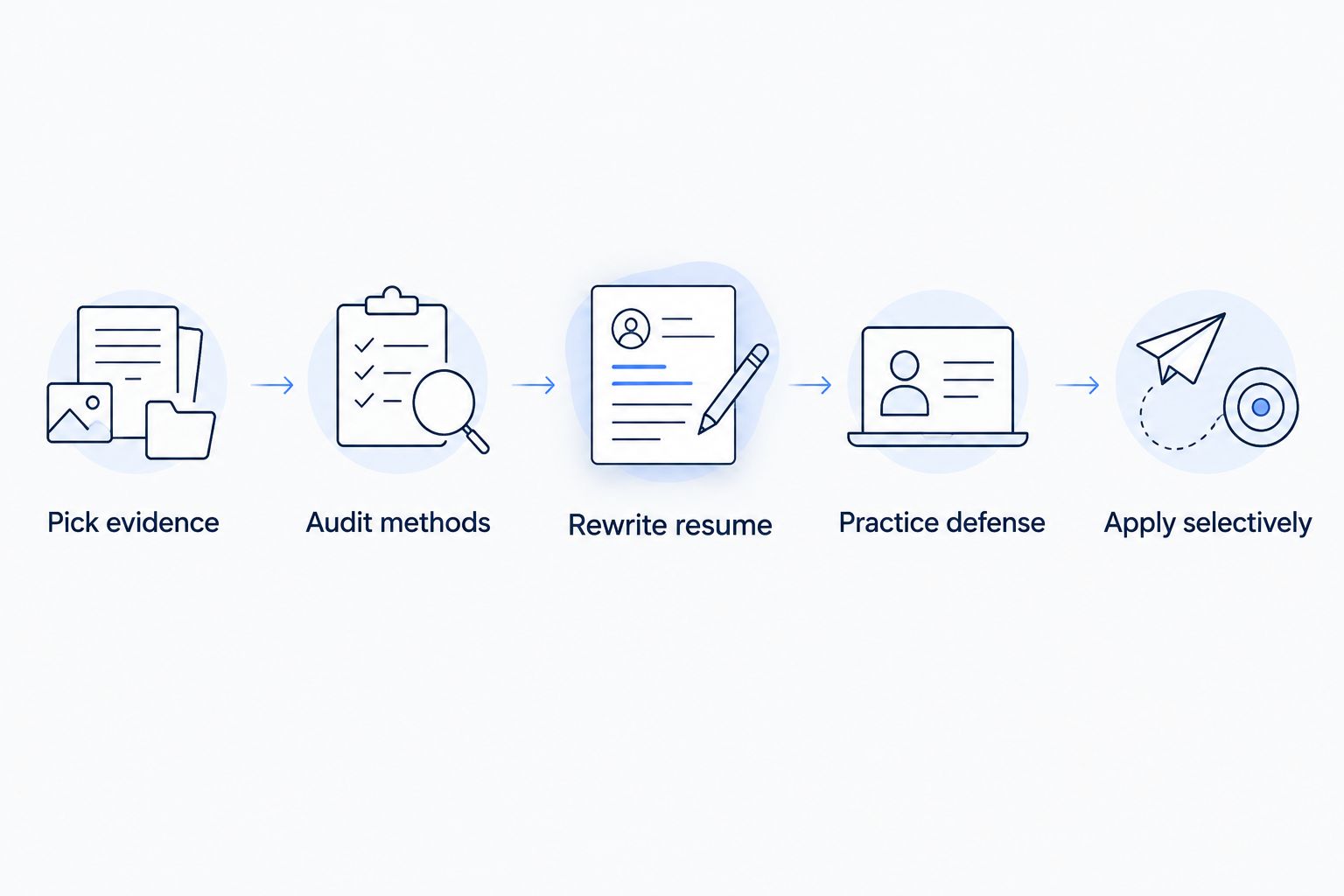
- Pick evidence. Select a project, thesis, research assistant assignment or technical role in which you made decisions about a question, data or method. Your strongest evidence is work you can explain from the initial question through the result.
- Audit methods. Check how you formed a baseline, handled data, evaluated the result and identified failure points. If the project uses a backtest, be ready to explain what information was available at each decision point. A result you cannot scrutinize is weak interview material.
- Rewrite resume. State the question, your contribution and how you evaluated the work. Do not make a team project sound like solo work. If the result was inconclusive, describe what the test ruled out rather than inventing a success.
- Practice defense. Explain the project aloud without slides or code. Expect questions about assumptions, alternative methods and what you would change. Practice saying what you do not know, then describe how you would investigate it.
- Apply selectively. Read the research responsibilities in each posting and choose evidence that speaks to them. A resume built around modeling work is not automatically a fit for every quant research opening.
These steps form a useful test in 2026: if you cannot complete the method audit and defend the work, rewrite the project before using it as the centerpiece of your application. More applications will not fix an unclear research story.
What can stand in for an internship?
There is no substitute that works merely because it has the right label. Compare the work by the decisions it lets you demonstrate and the questions it leaves unanswered.
| Evidence | What it can show | What you still need to address |
|---|---|---|
| Independent research project | How you framed a question, chose a method and tested a result | No supervisor or employer has verified your contribution; make the work inspectable and explain your decisions |
| Academic thesis or research assistant work | Experience working through an extended question or contributing to a research process | Clarify what was yours, what the group provided and which conclusions you can defend |
| Prior technical work | Coding, data handling or problem-solving under practical constraints | Connect the work to research decisions rather than assuming technical experience speaks for itself |
Best for independent projects: candidates who can show their work and discuss its weaknesses. The advantage is control over the question; the drawback is that you must establish credibility without an employer's name doing it for you. Verdict: use one you can defend.
Best for academic research: candidates with a thesis or research assistant contribution they can separate from the wider team's work. The advantage is a sustained research setting; the drawback is that a vague description of the group's output says little about your own judgment. Verdict: specify your contribution.
Best for prior technical work: candidates whose engineering or analytical experience includes decisions about data, models or evaluation. The advantage is evidence that you have completed technical work; the drawback is that implementation alone does not establish research ability. Verdict: connect it to the research question.
In 2026, choose the evidence you can defend most clearly, not the item with the most impressive-sounding title. If none of these examples gives you a question, a method and a candid account of the result, strengthen the underlying work before polishing the resume.
What should a project description actually say?
Start with the question you investigated. Then explain the approach, the comparison you used to judge it, your contribution and the limitation that matters most. This is more useful than a dense list of libraries, mathematical terms or tasks without a research objective.
For example, a resume bullet about building a model leaves a reader to guess why that model was appropriate and whether its output meant anything. A clearer bullet identifies the problem, the alternative you compared it with and what the evaluation showed. Use the result you actually observed; do not add a performance figure merely to make the bullet look more impressive.
Keep the detailed explanation available outside the resume, such as in a project write-up or code repository you control. Check what a stranger can understand without access to private data or a conversation with you. If the project cannot be shared, describe your decisions and limitations without revealing material you are not permitted to disclose.
How do you prepare to defend it?
A strong project description earns questions. Practice answering them as a discussion, not as a memorized pitch. Begin with why the question mattered within the project, then explain your baseline and why you chose the method you did.
Press on the uncomfortable parts. What would invalidate the result? Did you test a reasonable alternative? Which decisions depend on assumptions rather than observed evidence? What would you investigate next if the first explanation failed? If you cannot answer, return to the work and find out rather than rehearsing a more confident-sounding sentence.
Interview preparation should also cover the skills named in the role, including relevant mathematics, statistics and coding. A polished project discussion does not excuse a gap in a core requirement. Equally, solving practice questions does not tell an interviewer whether you can conduct research. Prepare for both conversations.
Why your chances vary without an internship
These factors determine whether a no-internship application gives a reader enough to evaluate. Use them to decide what to improve, not to assign yourself a score.
- Research ownership. Say which decisions you made. If the work was collaborative, distinguish your contribution from the team's output.
- Evidence quality. Show how you checked the result and what the test cannot establish. A striking conclusion without a credible evaluation is hard to defend.
- Role match. Tailor the evidence to the research described in the posting. Do not treat trading, research and development as interchangeable labels.
- Resume clarity. Put the relevant work where a reader can find it. A technical skills section cannot explain the question you answered.
- Interview readiness. Be able to discuss assumptions and revise your reasoning when challenged. A rehearsed summary is not a substitute for understanding.
- Networking context. When you contact someone about a role, make it clear why your work relates to their team's stated focus. A generic request gives them little to assess.
The limiting factor is different for every candidate. If your research is sound but nobody understands it from the resume, fix the presentation. If your resume earns interviews but the project falls apart under questions, work on the research and your explanation before increasing application volume. That is the distinction to make in 2026.
Can a personal project replace a quant internship?
A personal project can provide research evidence, but it does not become an internship. Show the question, your method, the comparison you used and the limitations; expect a reader to examine it more closely because no workplace has established your contribution. In 2026, choose a project you can defend over several projects you can only summarize.
Should you apply for internships before full-time research roles?
Apply for internships when you are eligible and they fit your situation; do not treat them as the only path to a full-time application. The immediate decision is whether your current evidence matches the role you want. If it does not, an internship is one way to gain relevant experience, while a substantial research project or academic work provides a different route to evidence.
Does an MFE make up for having no internships?
An MFE does not, by itself, make up for missing internship evidence. Use any relevant coursework or research to show decisions you made and results you evaluated. If you are considering a program in 2026, judge it against the skills and experience you still need rather than assuming the degree title will answer an interviewer's questions.
FAQ
Can I get a quant research job straight out of school without an internship?
Yes, if your application gives employers credible research evidence they can evaluate. Make your own contribution, method and limitations clear, then prepare to defend them in an interview.
What should I put on a quant research resume instead of internships?
Put your strongest relevant research, thesis or technical work on the resume. Explain the question, your contribution and how you evaluated the result rather than filling the space with a skills list.
Is a GitHub project enough for a quant research application?
A GitHub project is useful when its work and explanation let someone assess your research decisions. Code without a clear question, evaluation or account of limitations leaves the central issue unanswered.
Do I need an MFE to apply for quant research roles with no internships?
An MFE is not a substitute for evidence of research ability. If you have relevant work from another route, present and defend that work against the requirements of the role.
How do I explain no internships in a quant research interview?
Answer directly, then discuss the research or technical work you completed instead. Do not frame an academic or personal project as employment; explain what you decided, tested and learned.
Should I apply for quant trading jobs if my projects are research-focused?
Apply when your evidence matches the responsibilities in the posting. Quant research and quant trading are different targets, so read the role before sending the same resume to both.
Can coaching help me land a quant research role without internships?
QuantMinds career coaching can help you review your resume and prepare to discuss your work. It cannot replace the research evidence or technical understanding you need to bring to an application.
One last thing
A negative or inconclusive result can still give you a strong interview discussion if you can explain the question, the test and what the evidence ruled out. In 2026, do not replace that honest account with a bigger claim you cannot defend. QuantMinds' advice for a candidate with no internships is to make one piece of real work understandable before trying to make the resume look crowded.