

Quant developers should prioritize Python for research tools and data workflows, C++ for performance-sensitive systems, and SQL for querying structured data. For your 2026 applications, the job description determines the order: Python alone does not demonstrate systems-programming ability, and C++ alone does not demonstrate research-data fluency.
- What programming languages do quant developers need? Prioritize Python, C++, and SQL according to the target role.
- Python fits research tooling; C++ fits performance-sensitive trading infrastructure. Neither replaces software engineering fundamentals.
- SQL supports data retrieval and validation; it is not a substitute for a general-purpose programming language.
- QuantMinds offers quant finance career coaching for candidates seeking help with resumes and interview preparation.
Why this matters
A quant developer builds software around quantitative research, trading, or financial modeling. Those responsibilities overlap, but they do not demand identical language skills. A research platform and an execution engine present different engineering problems.
Choose a role before choosing another language. Otherwise, you risk collecting introductory knowledge without developing the depth needed to explain, test, and maintain real code. The next step is connecting your language preparation to the quant developer coding interview, rather than treating a completed course as evidence of readiness.
For a 2026 application, describe the software you built and the decisions you made. A resume line listing languages leaves the reader to guess your level; a project explanation shows where that knowledge holds up.
What programming languages do quant developers need to know?
Python, C++, and SQL form a practical preparation base, but there is no universal language checklist for every quant developer position. Read the responsibilities alongside the required skills: research support, execution, data engineering, and pricing infrastructure point toward different priorities.
| Language | Best for | Main strength | Main limitation | Preparation decision |
|---|---|---|---|---|
| Python | Research tooling and data workflows | Fast iteration and scientific-computing libraries | Python-level loops and dynamic behavior complicate performance-sensitive work | Prioritize for research-facing development |
| C++ | Execution and performance-sensitive infrastructure | Control over memory, data layout, and resource management | More demanding lifetime, concurrency, and debugging problems | Prioritize for systems-facing development |
| SQL | Structured-data retrieval and validation | Expressing joins, filters, and aggregations | Does not replace application or systems programming | Learn alongside your primary language |
| Java or C# | Teams with an existing managed-language stack | Application development with managed runtimes | Runtime behavior still needs performance analysis | Prioritize when the role specifies the language |
| R or Julia | Teams with an existing statistical or numerical workflow | Tools designed around analysis or numerical computing | Does not establish readiness for a different production stack | Add when the role requires it |
This table is a preparation framework, not a survey of employer demand. A team's actual requirements take precedence over a generic list, including this one.
Do not treat language names as interchangeable credentials. Writing a Python script, maintaining a Python package, and designing a concurrent C++ service demonstrate different capabilities—even when all appear under the same quant developer title.
Python: best for research-facing development
Python is a strong starting point when your target work involves datasets, research tools, numerical analysis, or backtesting infrastructure. Its scientific-computing ecosystem includes NumPy for array operations and pandas for tabular data manipulation. Learn what those operations do, not just which function to call.
Your preparation should cover:
- Core language behavior: mutability, references, iteration, exceptions, and function design.
- Data handling: missing observations, duplicate records, timestamp alignment, and joins.
- Numerical work: array shapes, broadcasting, floating-point behavior, and reproducibility.
- Software delivery: modules, dependency management, tests, logging, and readable interfaces.
Python's strength is making analysis and experimentation accessible. Its limitation is that convenient code can hide expensive operations, unnecessary copies, or incorrect assumptions about the data. Vectorized code is not automatically correct or memory-efficient.
For 2026 preparation, build a small tool that another person can run without editing your notebook. Separate data loading, transformation, and output. Explain how you would detect a broken input instead of silently producing a plausible result.
Recommendation: prioritize Python for research-facing development, but demonstrate engineering beyond notebooks. A polished chart does not explain whether your pipeline handles bad data or whether your calculation uses information that was unavailable at the time.
C++: best for performance-sensitive development
C++ is the priority when the target role emphasizes execution systems, market-data processing, memory management, or performance-sensitive infrastructure. It gives you control over resource ownership and data representation. That control also gives you more ways to introduce defects.
Start with object lifetime, references, pointers, containers, and resource acquisition is initialization, usually shortened to RAII. Then study move semantics, allocation behavior, and concurrency. These topics are connected: moving an object, sharing it across threads, and destroying it all involve ownership decisions.
A useful practice project accepts a stream of events and updates an in-memory state. You should be able to explain:
- Who owns each object and when its lifetime ends.
- Which operations allocate memory.
- What happens when input is malformed or out of order.
- Which state is shared and how access is coordinated.
- How you measured the behavior before changing the implementation.
C++ does not make a poor algorithm efficient by itself. Nor does replacing Python with C++ fix a flawed measurement method. Profile the program before claiming a performance improvement.
For a 2026 systems-focused application, emphasize the engineering question your project answers. Explain why you selected a container, where contention arises, or how you tested an ownership boundary. Those explanations establish depth more clearly than describing yourself as proficient in modern C++.
SQL: best for structured-data work
SQL belongs alongside your primary programming language when the role involves relational datasets. You need to retrieve the intended records, join them without accidental duplication, and aggregate them at the correct level. Syntax is only the beginning.
Practice joins, grouping, window functions, null handling, and query plans. Pay particular attention to table grain: whether a row represents an event, an instrument, an account, or a daily observation changes which joins and aggregates are valid.
SQL's strength is expressing operations on structured data directly. Its limitation is that a query can run successfully while answering the wrong question. A many-to-many join, for example, can multiply records and distort an aggregate without producing an execution error.
Recommendation: learn SQL as a supporting engineering skill, not as your entire quant developer preparation. Be ready to reconcile query results against a small example whose expected output you can calculate manually.
When should you add Java, C#, R, or Julia?
Add another language when it appears in the responsibilities of a role you intend to pursue, or when your existing experience already matches the team's stack. Do not restart from zero merely because a generic quant-language list includes another option.
Java and C# provide managed runtimes and application-development ecosystems. They still require attention to allocation, concurrency, and runtime behavior. Garbage collection changes memory management; it does not eliminate performance engineering.
R supports statistical analysis, while Julia supports numerical programming with features such as multiple dispatch. Both deserve attention when they are part of the target workflow. Neither needs to become an additional prerequisite for a role that asks for something else.
Recommendation: deepen the required stack before broadening your language collection. Existing Java experience is useful evidence for a Java role; introductory knowledge of several unrelated languages is not a substitute for it.
Why language requirements vary across quant developer roles
Language requirements follow the work and the existing system. Use these factors to interpret a posting rather than assuming that every hedge fund or prop trading firm recruits the same developer profile.
- Research proximity: tools used to explore data and support models favor different workflows from execution infrastructure.
- Performance constraints: requirements around allocation, concurrency, and predictable execution make systems knowledge relevant.
- Data responsibilities: retrieval, validation, storage, and transformation bring SQL and data-engineering skills into focus.
- Existing codebase: maintaining a team's software requires working within its actual language and interfaces.
- Role boundaries: a position combining modeling and implementation differs from one centered on infrastructure.
For your 2026 shortlist, separate mandatory requirements from preferred ones. Then compare the responsibilities with your strongest evidence. A missing preferred language and a missing core engineering capability are not the same gap.
How should you choose what to learn first?
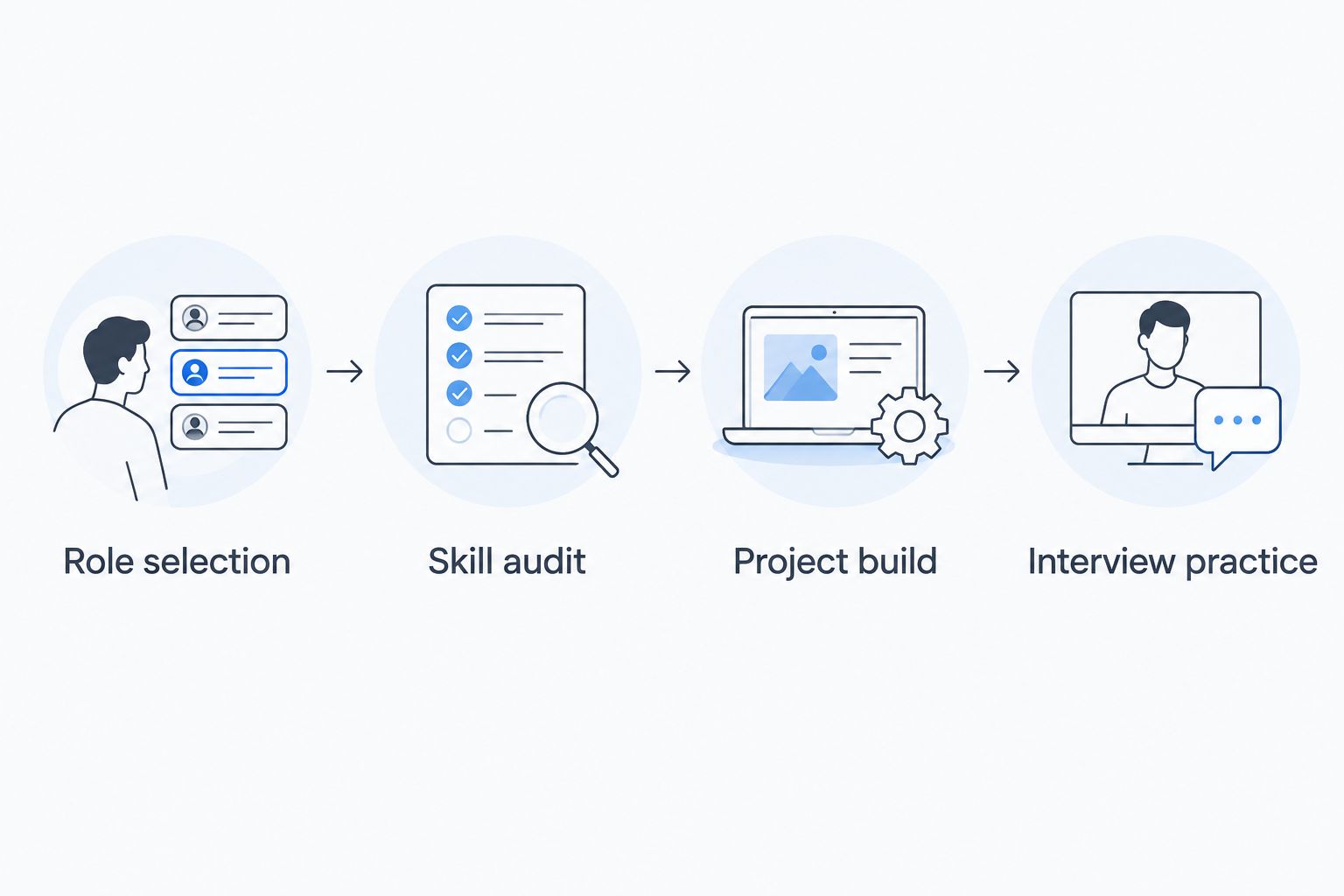
Use 1 target role to anchor your preparation. That means a specific developer profile, such as research-platform development or execution infrastructure—not every position with quant in the title.
- Role selection: identify the responsibilities and mandatory language requirements in your target postings.
- Skill audit: mark each requirement as demonstrated, partly demonstrated, or not yet demonstrated.
- Project build: create a focused project that exercises the most important missing capability.
- Interview practice: explain your implementation, test it, and solve unfamiliar problems in the required language.
Do not choose projects solely for impressive terminology. A small, inspectable implementation with clear tests is a better preparation exercise than a large repository you cannot explain.
If you are moving from general software engineering, preserve the evidence you already have. Testing, debugging, deployment, and maintaining shared code remain relevant. Identify the role-specific gap instead of rewriting your entire professional story around a new language.
What project demonstrates Python and C++ skills together?
Build 2 implementations of the same small calculation or event-processing task, one in Python and one in C++. Use identical inputs and compare the outputs before comparing execution behavior.
The purpose is not to manufacture a speed claim. It is to understand where implementation choices change memory use, execution, and maintainability. Record the environment and measurement procedure whenever you report results.
Include 4 test cases at minimum: ordinary input, empty input, malformed input, and a boundary condition relevant to your task. Explain the expected behavior of each. Add more cases when the specification requires them.
Keep financial claims separate from engineering claims. A working backtest demonstrates software behavior only to the extent you validate it; it does not establish that a strategy will earn money.
Do quant developers need C++ if they already know Python?
Quant developers need C++ when the target role requires C++ or systems capabilities tied to that codebase. Python expertise does not demonstrate understanding of object lifetime, memory ownership, or C++ concurrency.
For a Python-focused research-tools position, deepen Python engineering first. For a C++ execution role, start building and explaining C++ programs rather than assuming your Python experience covers the requirement.
Is learning languages enough to pass a quant developer interview?
No. Language knowledge must be paired with algorithms, data structures, testing, debugging, and the engineering topics relevant to the position. Correct syntax does not rescue an incorrect approach.
Practice explaining assumptions before coding. Then discuss complexity, edge cases, and alternative designs. If your solution changes, explain why; an interviewer needs to understand your reasoning, not just see a finished function.
When does career coaching help?
Career coaching addresses how you present and prepare your candidacy; it does not replace technical study. Bring a target job description, your resume, and a project you can explain so the discussion stays concrete.
QuantMinds is for quant developer candidates seeking career coaching, resume review, and interview preparation. The firm was founded by a former UC Berkeley MFE program executive director and works with professionals and students pursuing quantitative research, trading, and development roles.
QuantMinds provides quant finance career coaching, not a substitute for hands-on programming practice. Use coaching to work on your application and interview preparation while you build the technical evidence yourself.
FAQ
What programming languages do quant developers need in 2026?
Quant developers should prioritize Python, C++, and SQL according to their target role. Python supports research tooling, C++ supports performance-sensitive systems, and SQL supports structured-data work; the job description determines which is essential.
Is Python enough for a quant developer job?
Python is enough as the primary language for a role whose requirements center on Python development. It does not establish readiness for a C++ systems role, and you still need testing, debugging, algorithms, and software-design skills.
Should I learn Python or C++ first for quant development?
Learn Python first for research-facing tooling and C++ first for a role centered on C++ systems development. If you already have substantial experience in the required language, deepen that experience before starting another.
Do quant developers need SQL?
Quant developers need SQL when their responsibilities include querying relational data. Practice joins, aggregations, window functions, and validation rather than stopping at basic filtering.
Can I use Java or C# to become a quant developer?
Java or C# is relevant when the target team uses that language. Demonstrate the required stack and its engineering trade-offs instead of assuming every quant developer position requires the same languages.
Do I need finance knowledge before learning quant programming?
You can learn programming fundamentals without finance knowledge. Add the financial concepts needed to understand your target system, including the meaning of its inputs, outputs, and failure conditions.
How many languages should I list on my quant developer resume?
List the languages you can defend through projects, work experience, or interview performance. Separate substantial experience from introductory exposure instead of presenting every language at the same level.
One last thing
For your 2026 preparation, check the result before checking the runtime. A program that is fast and wrong is still wrong—and a successful database query can still duplicate the observations you intended to count.
Your next move is to choose a target developer role, identify its required language, and produce one inspectable example of relevant engineering work. That is more useful than adding another language name to your resume.