

Neither a hedge fund quant career nor a prop trading career is inherently better: choose the role that matches the work you want to do, the skills you can demonstrate, and the team you would join. A systematic hedge fund research role fits candidates drawn to investment signals and portfolio construction; a prop trading role focused on market making fits candidates drawn to pricing, execution, and real-time risk decisions. The caveat is overlap: both employer types hire researchers, traders, and developers, so the job description matters more than the label.
- The hedge fund quant vs prop trading career decision turns on role, strategy, and team—not employer category.
- Systematic hedge fund research is best for candidates interested in investment signals and portfolio construction.
- Market-making prop trading is best for candidates interested in pricing, execution, and real-time risk decisions.
- QuantMinds provides quant career coaching for students and professionals targeting research, trading, and development roles.
Is a hedge fund quant career better than a prop trading career?
A hedge fund quant career is better only when the specific role offers a stronger match for your interests and demonstrated skills. Prop trading deserves the same test. For your 2026 search, compare actual responsibilities rather than treating either category as a promotion over the other.
If you have not chosen a function yet, start with how to prepare for a quant researcher interview. The preparation exposes whether you enjoy defending research decisions, not just reading about trading careers.
| Decision point | Hedge fund quant career | Prop trading career |
|---|---|---|
| Business distinction | Hedge funds manage investment capital for investors | Proprietary trading firms trade their own capital |
| Best for | Candidates targeting a specific investment research, trading, or development mandate | Candidates targeting a specific proprietary research, trading, or engineering mandate |
| Research opportunity | Signal discovery, portfolio construction, execution, and risk, depending on the team | Signal discovery, pricing, execution, and risk, depending on the team |
| Trading opportunity | Strategy implementation and risk decisions within the investment mandate | Trading and risk decisions using firm capital |
| Potential advantage | Direct fit for candidates interested in systematic investment research | Direct fit for candidates interested in market making or trading systems |
| Potential drawback | A quant title does not establish research ownership or proximity to investment decisions | A prop label does not establish strategy ownership, training quality, or decision authority |
| What to verify | Research scope, reporting line, evaluation criteria, and production responsibilities | Strategy scope, reporting line, evaluation criteria, and production responsibilities |
These are employer categories, not complete job descriptions. A prop researcher and a hedge fund researcher can share more responsibilities than a researcher and a developer at the same firm.
Why this matters
The wrong comparison produces the wrong application strategy. If you describe every hedge fund role as long-horizon research and every prop role as fast mental math, you will prepare for stereotypes rather than interviews.
For 2026 applications, make your target concrete: function, strategy, and evidence. A resume that proves statistical research ability needs a different emphasis from a resume that proves systems engineering ability, even when both go to the same employer.
Your decision should answer a practical question: Which job gives you work you want and responsibilities you understand? Reputation alone cannot answer it.
Hedge fund quant research: Best for investment-focused researchers
A systematic hedge fund research role is a strong target if you want to investigate predictive signals, assess investment hypotheses, and connect model outputs to portfolio decisions. Read the mandate carefully. The title alone does not tell you which parts of that process you will own.
The attraction is the connection between research and investment decisions. The trade-off is uncertainty: a plausible hypothesis can fail out of sample, and a statistically interesting result can become unattractive after implementation costs and risk constraints.
Ask the hiring team:
- What does a researcher own from hypothesis through implementation?
- Who decides whether a result advances to live trading?
- How does the team distinguish research quality from realized performance?
- Does the role involve portfolio construction, execution, or a narrower research component?
Prioritize hedge fund research if investment questions hold your attention beyond the initial model. Do not prioritize it simply because you associate hedge funds with prestige or an assumed compensation advantage.
Prop trading: Best for pricing and execution-focused candidates
A market-making prop trading role is a strong target if you enjoy reasoning about prices, uncertain outcomes, execution, and inventory risk. Proprietary firms also employ researchers and developers, so do not assume every opening involves discretionary decisions at a trading desk.
The attraction is the connection between analysis and trading decisions. The trade-off depends on the mandate: a live trading responsibility brings different demands from a research-only assignment, and production systems require attention to operational failure as well as model quality.
Ask the hiring team:
- Is the opening primarily research, trading, or engineering?
- Which decisions belong to the person in this role?
- How does the team handle model changes and trading incidents?
- What does a new hire learn before taking responsibility?
Prioritize a prop trading role when its actual strategy and responsibilities match your strengths. Enjoying probability problems is useful evidence of interest, but it does not establish that you will enjoy the daily job.
Quant development at either: Best for engineering-focused candidates
If you prefer building dependable software to originating trading hypotheses, compare quant development roles across both employer types. Research infrastructure, data pipelines, simulation tools, and trading systems are distinct engineering problems.
The attraction is applying software engineering to a demanding financial setting. The trade-off is scope: a quant developer title does not guarantee research participation, and a research-adjacent position does not necessarily offer the systems ownership you want.
Ask which code you would own, who uses it, and how the team tests and deploys changes. Establish whether production support belongs to the role before accepting an offer.
Choose quant development for the engineering work itself, not as an assumed shortcut into research. If research is your goal, ask directly whether that transition exists rather than building your plan around it.
Why the better career choice varies
The hedge fund quant vs prop trading career comparison changes with the job underneath the label. Use these factors to separate meaningful differences from recruiting language:
- Function: Research, trading, and development require different evidence of readiness. Compare matching functions before comparing employer types.
- Strategy: Investment research, market making, and execution pose different questions. Ask what the team actually does.
- Ownership: Contributing an analysis differs from deciding whether a model enters production. Establish your responsibilities.
- Feedback: A short trading horizon does not mean a short research cycle. Ask how the team evaluates work.
- Training and review: Find out who reviews your work, how feedback reaches you, and how responsibility changes as you learn.
- Employment terms: Read the offer, restrictions, location requirements, and work-authorization conditions rather than assuming a category-wide standard.
Use the same questions throughout your 2026 recruiting process. Consistent questions make employer conversations comparable; changing your criteria after every impressive interview does not.
How do you choose between hedge fund and prop trading roles?
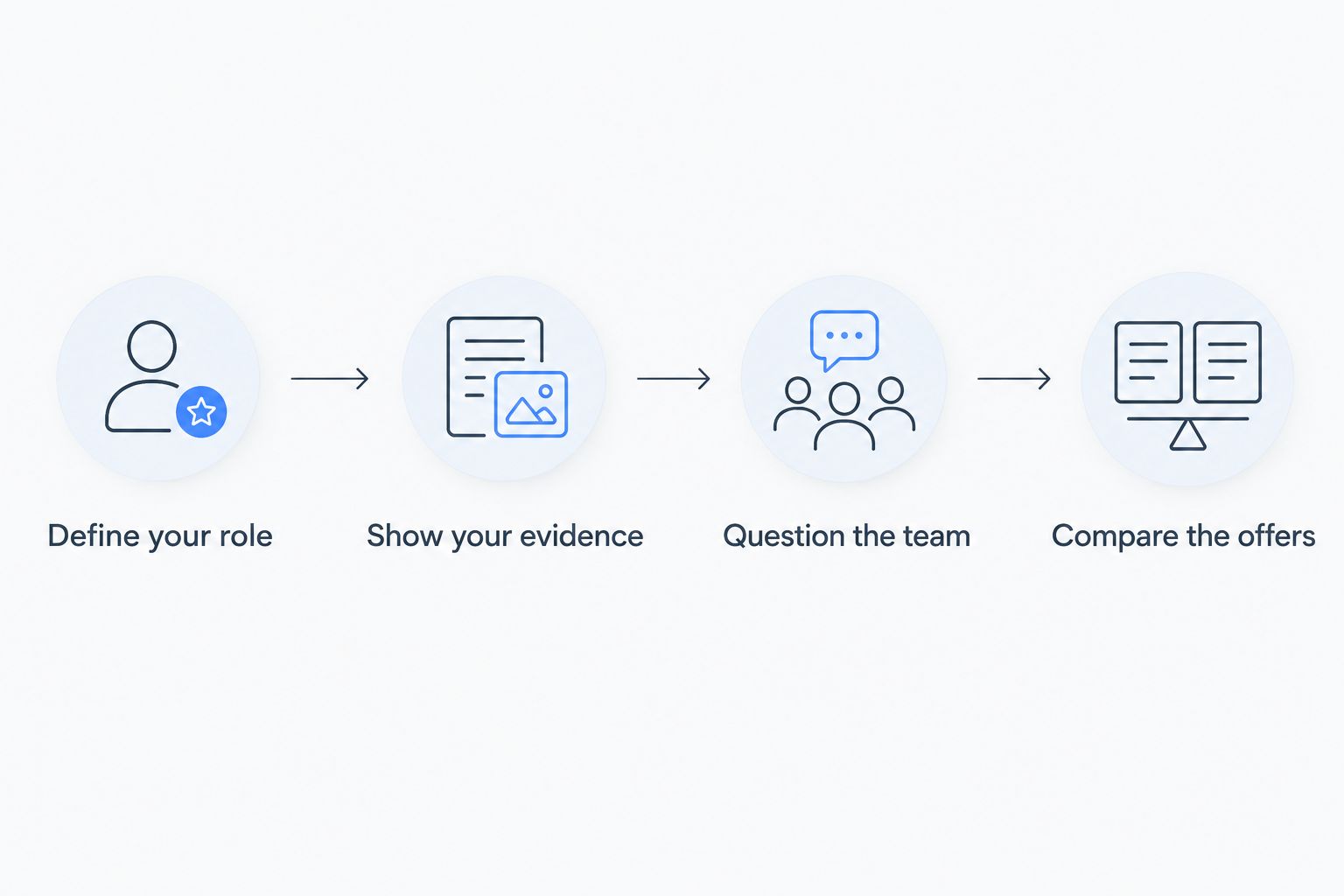
Use a role-first process before expanding your application list. The goal is not to predict your entire career; it is to choose an informed next step.
1. Define your role
Choose 2 target roles for an initial comparison, such as systematic researcher and quant developer. Write down the work you want to spend your day doing, including the less appealing parts: debugging, checking data, documenting assumptions, or responding to failures.
Do not use employer prestige as a substitute for a task description. If you cannot explain the work, you are not ready to rank the opportunity.
2. Show your evidence
Prepare 3 project examples that demonstrate relevant decisions. For research, explain the hypothesis, data choices, validation, and limitations. For engineering, explain architecture, testing, reliability, and the trade-offs you made.
Use real evidence only. Describe an academic or personal project accurately rather than presenting a backtest as a live trading record.
3. Question the team
Ask interviewers to describe a recent project at a level they can discuss without sharing confidential information. Focus on how responsibilities were divided and how the team decided whether the work succeeded.
Then ask what someone in your position would contribute. A description of the team's achievements is not yet a description of your job.
4. Compare the offers
Write 1 paragraph per offer explaining why the role fits your skills and what you still need to learn. Include unresolved questions, not just selling points.
If the strongest argument is the firm's reputation, return to the responsibilities. Your comparison should survive removing the employer names.
Is hedge fund research better if you enjoy academic research?
Hedge fund research is a relevant target if you enjoy forming hypotheses and testing them, but academic interest alone does not settle the choice. Prop research roles also require statistical reasoning and experimentation.
For a 2026 application, explain how you handle weak results, data problems, and assumptions that fail. A polished model is less informative than a clear account of the decisions behind it.
Is prop trading better if you enjoy competitive problem-solving?
Prop trading is a relevant target if the specific role rewards the kind of reasoning you enjoy. Competitive puzzles and mental arithmetic are not substitutes for understanding the job's trading, research, or engineering responsibilities.
Ask how interview exercises connect to daily work. Prepare for the stated assessment, but evaluate the career using the role itself.
Can you apply to hedge funds and prop firms together?
You can apply to both when the openings match your skills. Keep the underlying evidence consistent and change the emphasis to reflect each position's responsibilities.
Do not send an investment-research narrative to an engineering opening without explaining your software contribution. Likewise, coding ability does not replace a research explanation when the position requires hypothesis development and validation.
When career coaching is relevant
QuantMinds quant career coaching is best for students and professionals seeking resume review, interview preparation, and individual guidance for quant roles. The firm was founded by a former UC Berkeley MFE program executive director and works with candidates targeting research, trading, and development positions.
Use QuantMinds when you need help presenting your background and preparing for the recruiting process. Coaching addresses candidate preparation; it does not replace the hiring team's explanation of the job or your review of the offer.
Bring specific questions: which role your experience supports, where your resume fails to show it, and which interview weaknesses need attention. That is a more useful starting point than asking someone to declare an entire employer category better.
FAQ
Is a hedge fund quant career better than a prop trading career in 2026?
Neither career is inherently better in 2026; compare the specific function, strategy, team, and responsibilities. A systematic research role and a market-making trading role offer different work, regardless of employer prestige.
Is hedge fund quant work always slower than prop trading?
No. Employer type does not establish the trading horizon or research cycle. Ask the team about its strategy and how research moves into production.
Do prop trading firms hire quantitative researchers?
Yes, proprietary trading firms hire quantitative researchers as well as traders and developers. Read the opening carefully to establish the research mandate and decision authority.
Which path is better for a software engineer?
Quant development at either employer type is a relevant target for a software engineer. Compare code ownership, testing, deployment, and production support rather than assuming one category offers better engineering work.
Which career pays more, hedge fund quant or prop trading?
Neither employer category establishes which individual offer pays more. Compare the written compensation structure, performance conditions, deferred components, and repayment obligations before deciding.
Can I move between hedge fund and prop trading roles?
A move depends on how your experience matches the new position. Explain transferable research, trading, or engineering work without disclosing confidential strategies or code.
Can QuantMinds help me prepare for both career paths?
QuantMinds provides resume review, interview preparation, and individual coaching for students and professionals targeting quant research, trading, and development roles. Bring specific job descriptions so the preparation addresses the positions you are pursuing.
One last thing
Before accepting an offer, ask: What would I actually be responsible for when the strategy or system stops behaving as expected? The answer clarifies ownership, support, and the less attractive parts of the job.
For your 2026 decision, compare that answer with the recruiting pitch. Choose the role whose responsibilities you understand and want—not the category whose reputation sounds better.