

No. A top MFE program is one route into quantitative research, trading, or development, not a universal requirement for a quant job in 2026. The better question is whether your current degree, projects, experience, and interview preparation give an employer enough evidence to assess you for the role you want.
- No: a top MFE program is not required for every quant job in 2026.
- An MFE is most useful when it closes a specific training or recruiting gap; the degree alone is not an interview answer.
- Without an MFE, build evidence for the role: research work, trading-oriented problem solving, or development projects.
- QuantMinds is best for candidates who need direct feedback on their quant resume, interviews, and recruiting plan.
Does landing a quant job require attending a top MFE program?
No. Choose the route that helps you demonstrate the skills required for your target role. If you are deciding whether to apply to an MFE, start with the gap between your current background and the jobs you want, not a school ranking. The guide to whether an MFE degree is worth it is a useful next read if the degree itself is your decision point.
| Route | Best for | What it helps you show | What it does not solve |
|---|---|---|---|
| Top MFE program | Candidates who need structured quantitative training and a graduate recruiting route | Graduate coursework and a focused explanation of the move into quant finance | Weak projects, an unfocused resume, or poor interview answers |
| Other graduate or undergraduate degree | Candidates whose existing coursework and work already align with a target role | Relevant mathematical, statistical, research, or engineering work | A missing connection between that work and the role |
| Work and project route | Candidates with substantial technical work they can explain and defend | Direct evidence of research, coding, or problem-solving ability | Gaps that become clear when an interviewer probes the work |
These are routes, not guarantees. The MFE route is best when you can name the gap it fills. The alternative route is best when you can already point to relevant work and explain it under questioning. Both routes still require you to choose a role, make your evidence visible, and prepare for interviews.
Why this matters in 2026
The question can send you into the wrong decision. You might commit to another degree when the immediate problem is an unclear resume. Or you might dismiss graduate study when your current training does not cover material central to the roles you are pursuing. Neither decision improves because you call a program top-ranked.
Start with the job rather than the credential. A quantitative researcher, a quant trader, and a quant developer are not interchangeable targets. Each gives you a different way to test whether your background is relevant, and each changes what you should emphasize in an application. In 2026, the practical question is not whether you attended a particular school; it is what evidence you can present for the work you want to do.
When does a top MFE program help?
A top MFE program makes sense when its training and recruiting path address a gap you have identified. If you want to move into quant finance but cannot yet connect your education or work to the roles you are targeting, a focused graduate program offers a way to build that connection. It also gives you a defined setting in which to develop work you can discuss in applications and interviews.
That is a reason to investigate a program, not a reason to enroll automatically. Look at the curriculum against the skills in the roles you want. Then look at what you would need to show by graduation: work you understand, a resume that states your contribution clearly, and interview answers that hold up when someone asks how you reached a result.
Best for: candidates with a specific training or transition gap. An MFE is a weaker answer when you already have relevant technical work but have not presented it well. A stronger school name does not explain a project you cannot explain yourself.
When is an MFE unnecessary?
An MFE is unnecessary as a default next step when you already have credible evidence for your chosen role. A researcher with relevant statistical work, an engineer with pertinent development experience, or a student with technical projects has material to assess before deciding to pursue another degree. The task is to show how that material relates to a quant job.
Do not turn this into a claim that any project substitutes for graduate training. A project matters when you can state the question, describe what you did, explain your choices, and discuss the limits of the result. A job title matters when your actual work connects to the work you are seeking. Listing tools without demonstrating their use leaves the same gap a degree would not fix.
Best for: candidates whose existing work is relevant and defensible. The drawback is that you must make the connection explicit. A reader should not have to infer from an unrelated title why you belong in a quantitative research, trading, or development interview.
Why the answer varies by candidate
- Target role. Research, trading, and development calls for different evidence. Pick one before deciding whether more education is the priority.
- Current training. Compare the mathematics, statistics, programming, and finance in your background with the work you want to pursue. Name the gap rather than assuming one exists.
- Quality of existing work. A project you can explain and defend is more useful than a project listed only by title.
- Resume clarity. Put the most relevant work where a reader can find it. State your contribution instead of relying on a degree name to supply the explanation.
- Interview readiness. If you cannot reason through your own methods or respond to follow-up questions, another credential alone will not fix the answer.
- Reason for graduate study. Pursue an MFE for a defined training or career-transition purpose, not because every quant candidate supposedly needs one.
Each factor points to a different next action. If the gap is training, investigate programs. If the gap is presentation, revise your application materials. If the gap is interview performance, practice explaining the work already on your resume. In 2026, treating those as the same problem wastes effort.
How do you decide whether to apply to an MFE?
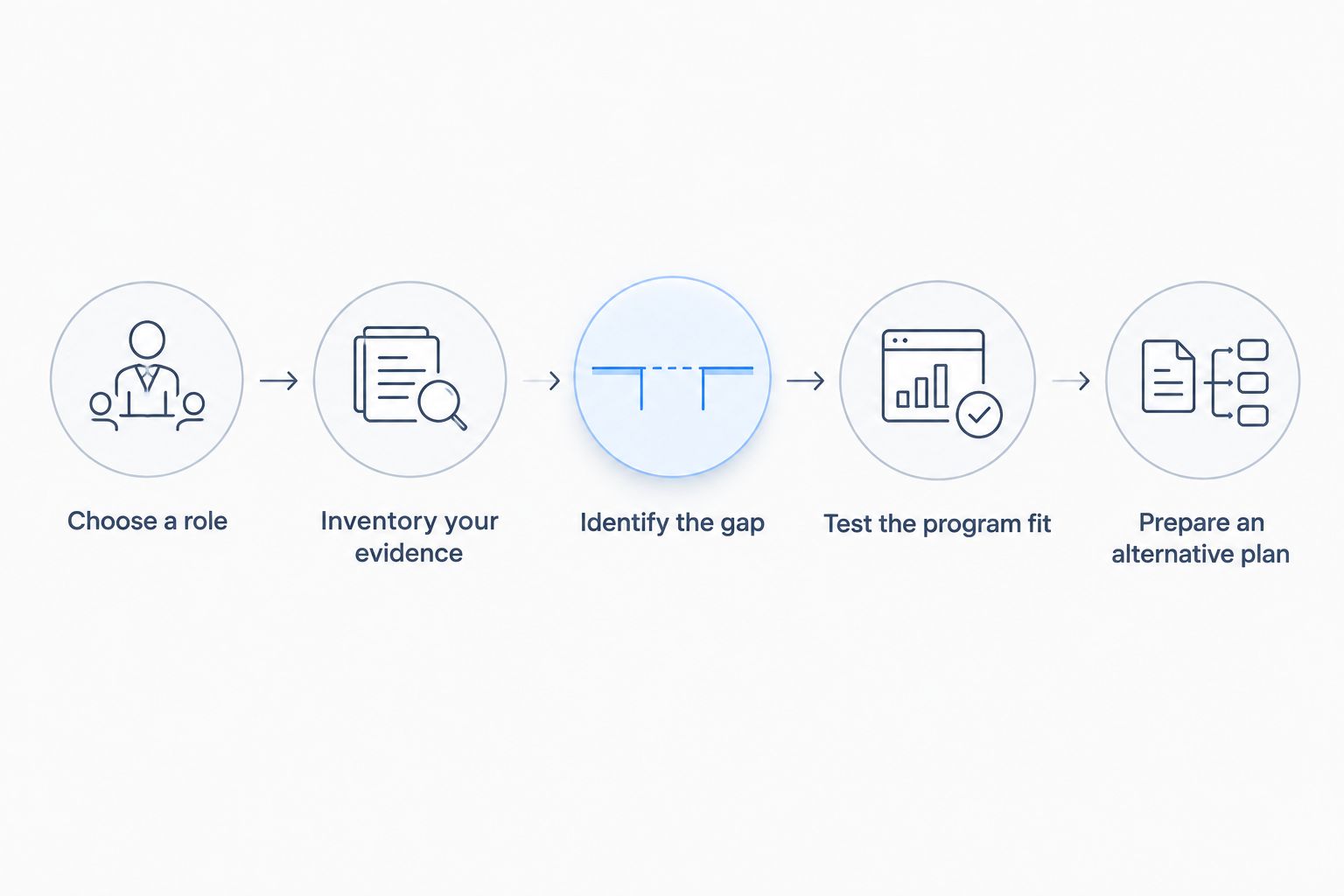
Use the jobs you actually want as the starting point. A general ambition to work in quant finance is too broad to tell you whether a graduate program is necessary. Make the decision in this order:
- Choose a role. Decide whether you are targeting quantitative research, trading, or development. You can explore more than one path, but evaluate each separately.
- Inventory your evidence. Write down the coursework, research, projects, and employment you would put on an application today. Describe what you personally did.
- Identify the gap. Separate missing technical training from weak presentation and weak interview preparation. They require different responses.
- Test the program fit. Review whether an MFE would address the gap you named. A recognized program is not automatically the right program for every candidate.
- Prepare an alternative plan. If you do not apply, decide what work will make your resume and interview answers stronger. Do not leave the decision at simply skipping the degree.
This process produces a clearer answer than a yes-or-no rule about school reputation. It also gives you a way to revisit the decision: after strengthening your existing evidence, ask whether the original training gap still exists.
Can you get a quant research role without a top MFE?
Yes. A top MFE is not a universal condition for a quant research role in 2026. Your case is stronger when you can present relevant research or statistical work, explain your methods, and answer questions about what your results do and do not show.
Start with a piece of work you know well. Be ready to describe the problem, your contribution, the choices you made, and what you would change. If you cannot do that yet, the next step is to strengthen the work or your explanation of it, not to assume a school name will speak for you.
Can you get a quant trading job without an MFE?
Yes. An MFE is not a blanket requirement for quant trading in 2026. Focus on the abilities the role asks you to demonstrate and practice explaining your reasoning clearly, including when you need to revise an initial approach.
Do not treat research and trading interviews as the same preparation problem. Decide which roles you are pursuing, then shape your examples around those roles. Your application should make that choice apparent rather than presenting quant finance as a single undifferentiated job.
Does a top MFE guarantee a quant job?
No. A top MFE does not guarantee a quant job in 2026. You still need relevant work you can discuss, application materials that make your fit clear, and answers that stand up in an interview.
This is the part of the decision that matters whether you attend graduate school or not. Ask what evidence you will have at the point of application. If the answer is only the name of the program, your plan is incomplete.
What should you do instead of relying on a school name?
Build a role-specific case. For research, make the question and method behind your work clear. For development, show what you built and how you handled technical decisions. For trading, be prepared to explain your reasoning rather than recite an answer. These are directions for presenting your own work, not substitutes for checking the requirements of a particular role.
Your resume and LinkedIn profile should tell the same basic story. Lead with the work most relevant to the role. Remove claims you cannot defend in conversation, and prepare to explain every project you keep. If you are applying to different types of quant roles, check whether the examples you lead with fit each one.
That is where career coaching can serve a specific purpose. QuantMinds is best for students and professionals who need direct feedback on how their background reads to quant employers and how they explain it in interviews. QuantMinds offers resume review, interview prep, and 1-on-1 coaching for quantitative research, trading, and development candidates. Coaching can help you examine the case you are presenting; it cannot replace the technical work behind it.
FAQ
Do I need a top MFE program to get a quant job in 2026?
No. A top MFE program is one route, not a requirement for every quant job. Decide whether it fills a training or transition gap for the role you want.
Is an MFE useful for someone with a technical degree?
An MFE is useful when it addresses a gap your technical degree and work experience have not addressed. Compare the program with your target role before applying.
Can projects help me apply for quant roles without an MFE?
Yes. Relevant projects give you work to discuss if you can explain your contribution, methods, decisions, and limitations. A project title alone does not make that case.
Should I apply for an MFE if my quant resume is weak?
Not solely for that reason. First determine whether the problem is missing training or an unclear presentation of work you already have. An MFE does not automatically fix the second problem.
Does a top MFE guarantee a quant interview?
No. A program name does not guarantee an interview. Your application still needs to connect your work and skills to the role.
Can career coaching replace an MFE?
No. QuantMinds career coaching addresses resume presentation, interview preparation, and recruiting decisions; it does not replace technical training. Use the training gap to decide whether graduate study is necessary.
Should I target research, trading, and development with the same resume?
No. Make the most relevant evidence for each target role easy to find. Keep every claim accurate and ready to defend in an interview.
One last thing
The most useful MFE question is not whether a program sounds impressive. It is whether you can name what you will be able to show after attending that you cannot show now. If you cannot answer that in 2026, define the gap before making the degree your plan.