

AI will change quant researcher jobs, but it does not make the researcher’s job disappear in 2026. Tools can help write code, explore approaches, and summarize results; a researcher still has to decide whether a signal is valid, whether a test is misleading, and whether a finding deserves to influence a trading decision.
- Will AI replace quant researcher jobs? Not outright in 2026; routine work changes, but research judgment remains the job.
- AI assistance is best for drafting and exploration; a quant researcher must verify assumptions, tests, and conclusions.
- QuantMinds is best for candidates who need direct feedback on a quant research resume or interview explanation.
Why this matters
If you are choosing an MFE program, preparing for quant interviews, or deciding whether to move from software engineering into research, the useful question is not whether AI can write code. It is whether you can identify a research problem, test a claim without fooling yourself, and explain what you would do with the result. That distinction should shape your preparation in 2026.
QuantMinds offers quant finance career coaching for candidates pursuing research, trading, and development roles. Coaching can help you present your experience and prepare for interviews; it cannot make an untested research claim convincing. Build the evidence first, then work on how you communicate it.
Will AI replace quant researcher jobs?
No blanket replacement verdict follows from AI’s ability to perform individual research tasks. A quant researcher does more than produce code or a plausible explanation. The work also involves choosing a question, checking data and methods, interpreting uncertain results, and defending a decision when the evidence is weak.
| Part of the work | Where AI assistance fits | What the researcher still has to check |
|---|---|---|
| Drafting research code | Best for: producing a starting point and suggesting ways to structure an analysis. Limit: generated code can contain errors or reflect the wrong assumptions. | Whether the code implements the intended test and handles the data correctly. |
| Exploring a hypothesis | Best for: listing possible explanations or tests. Limit: a plausible suggestion is not evidence that a signal exists. | Why the hypothesis makes sense and what result would count against it. |
| Reviewing results | Best for: organizing outputs and surfacing questions to investigate. Limit: a tidy summary can hide a flawed test. | Whether the result survives appropriate checks and supports the stated conclusion. |
| Explaining a finding | Best for: clarifying language in a draft. Limit: polished wording can make uncertainty sound resolved. | What the finding means, what remains unknown, and whether it is relevant to a trading decision. |
The table describes a division of work, not a hiring forecast. Without hiring and workflow data from a specific firm, no one can tell you how many quant researcher positions that firm will have because of AI in 2026. You can, however, prepare for the responsibilities that do not disappear when drafting becomes easier: asking precise questions and defending your answers.
Which parts of quant research change first?
The first pressure falls on work that is easy to specify and easy to review: drafting code, organizing notes, and generating initial explanations. AI assistance is useful there because you can inspect the output against a clear task. The risk is treating that output as if inspection were unnecessary.
Research becomes harder to delegate when the real problem is deciding what to test. A generated analysis can look coherent while answering the wrong question. If you cannot explain the data, the assumptions, and the reason for each check, faster production gives you more output, not stronger evidence.
That distinction matters in an interview. A candidate who says a tool built the analysis but cannot explain its choices has shown a gap in research ownership. A candidate who used assistance, found a weak assumption, changed the test, and can explain why has a research story to discuss. The point is not to avoid tools; it is to remain accountable for the result.
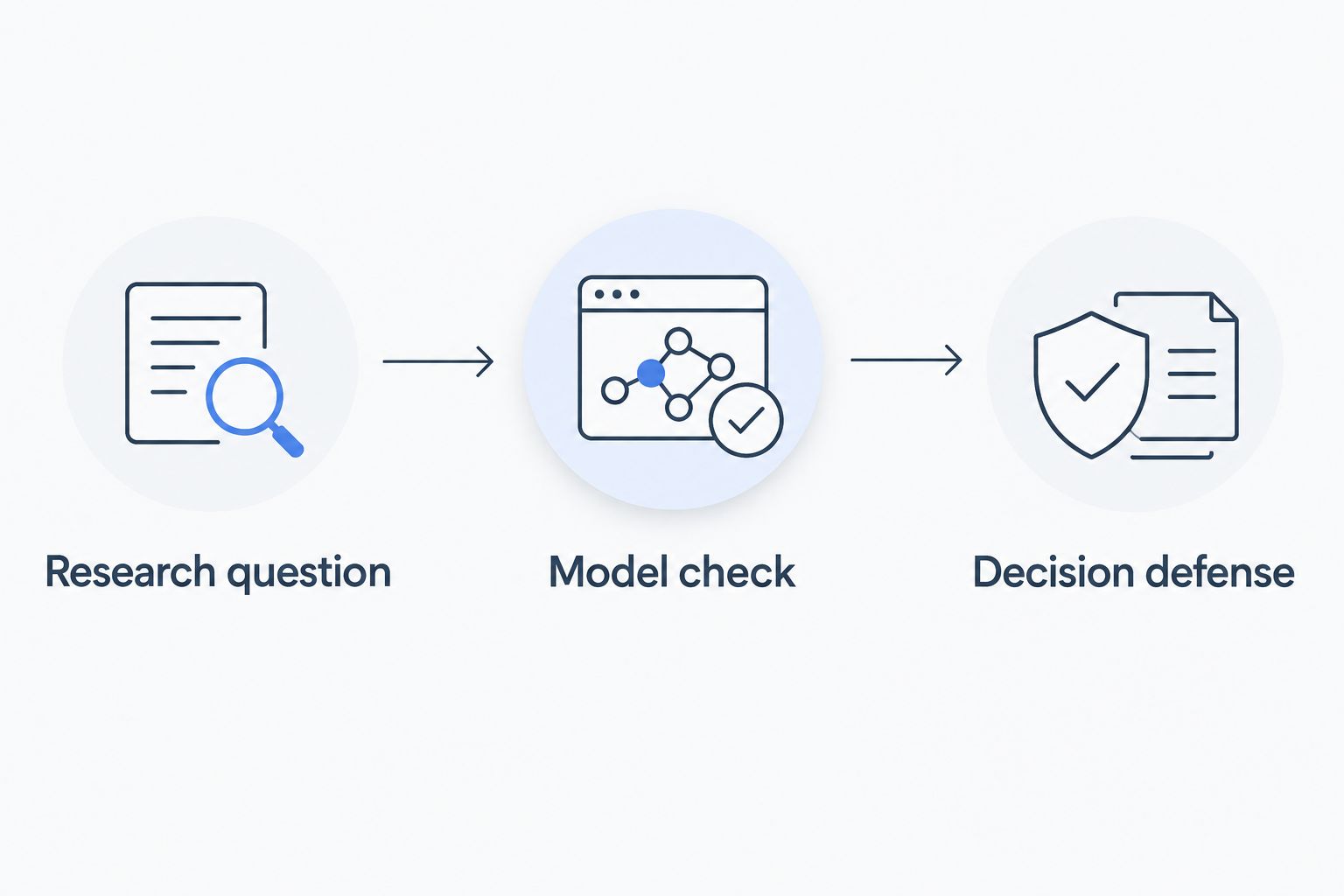
Research question
Start with a claim narrow enough to test. State what you expect to observe and what observation would weaken your view. If the claim changes every time a test fails, you have not established much about the original idea.
Model check
Examine the inputs and the test before interpreting the output. Look for data that would not have been available at the decision point, assumptions the model depends on, and choices that change the result. A chart is an illustration of a result, not a substitute for checking how it was produced.
Decision defense
Explain the limits of the finding in plain language. Say which conclusion the evidence supports, which conclusion it does not support, and what you would test next. That explanation is where a researcher’s judgment becomes visible to an interviewer or colleague.
Why the answer varies by role
The label quant researcher does not tell you which tasks a particular employer assigns to the role. Before treating an AI prediction as career advice, check the actual job description and ask what the team expects a researcher to own.
- Research versus development: A role centered on forming and testing hypotheses presents a different question from one centered on implementing systems. Both require technical skill, but the work you must explain in an interview differs.
- Research versus trading: A researcher may be asked to justify an analysis, while a trading-focused role may put more weight on decisions made from changing information. Read the responsibilities rather than assuming every quant title means the same work.
- Data and test ownership: If the role requires you to select data and challenge results, generating code is only one part of the assignment. Prepare to explain why the test is credible.
- Communication: A finding that you cannot explain or qualify is difficult for anyone else to evaluate. Practice describing a project without hiding behind technical vocabulary.
- Your starting background: An MFE student, a software engineer, and a researcher moving from another field bring different evidence to a hiring conversation. Choose examples that prove the part of the role you want to do.
For 2026 applications, use these factors to compare roles rather than trying to find one answer for every hedge fund or prop trading firm. A job description and an interview process tell you more about the work than a broad prediction about AI.
How should you prepare for a quant researcher interview?
Prepare to defend your own work, including any part you completed with AI assistance. The strongest project discussion is a chain of choices you can explain, not a list of tools you used. Pick a project you know well enough to discuss without a prepared script.
- Write down the question. State the hypothesis, why you chose it, and what evidence would have changed your mind. Do this before rehearsing the polished result.
- Audit the method. Review the data, implementation, assumptions, and checks. If a tool drafted code, trace the logic yourself and identify what you verified.
- Challenge the conclusion. Explain alternative interpretations and the limits of the result. Distinguish a promising observation from a decision you would stand behind.
- Practice the spoken version. Give a concise account of the question, test, result, and limitation. Then invite questions about the choices you made.
For a resume, describe the work you owned rather than claiming that a tool made the project sophisticated. On LinkedIn, use the same discipline: make your research interests and technical experience legible, but do not present an exploratory exercise as a validated trading result. In networking conversations, ask about a team’s research process and how it evaluates ideas. Those answers help you prepare for the actual role.
QuantMinds provides resume review, interview preparation, and 1-on-1 coaching for people seeking quant roles. QuantMinds is best for candidates who want direct feedback on how they present and defend their research experience; it is not a substitute for doing the research or a forecast of hiring. Bring a project, a resume, and the questions you struggle to answer. Feedback is most useful when there is specific work to examine.
Is learning AI tools enough to stay competitive?
No. In 2026, using a tool to draft code does not establish that you understand the research question or trust the output for the right reasons. Pair tool use with statistics, programming, careful testing, and a clear explanation of your choices.
If you are new to finance, do not mistake unfamiliar terminology for the whole barrier to entry. First make sure you can explain the technical work you have actually done. Then study how a research question connects to a trading context. An interviewer can ask about both, and memorized language will not repair a project you cannot defend.
If you are switching from software engineering, show where your experience applies and where you still need evidence. Writing reliable code is relevant; it does not, by itself, demonstrate that you can frame and evaluate a research hypothesis. Choose a project that lets you show both skills rather than stretching an engineering example into a claim about research results.
Should you still pursue quant research in 2026?
Yes, if you want to do the underlying research work, not just produce its visible outputs. AI changes how you can draft and explore, but it does not give you a reason to skip probability, statistics, programming, or critical review of your own results.
Do not make a career decision from a claim that every quant research job is safe or that every role is about to vanish. Neither claim tells you what a specific employer expects. Read roles closely, build a project you can defend, and assess whether you enjoy questioning results when the answer is less impressive than you hoped.
FAQ
Will AI replace quant researcher jobs in 2026?
AI does not replace the full quant researcher role simply by generating code or analysis in 2026. Researchers still need to choose questions, check tests, interpret results, and defend conclusions; firm-specific hiring outcomes require firm-specific evidence.
Which quant research tasks can AI help with?
AI can help draft code, suggest tests, organize notes, and clarify a written explanation. You still need to verify the implementation and decide whether the evidence supports the claim.
Do quant researchers still need to know how to code?
Yes, a researcher who uses generated code still needs to understand and check what it does. In an interview, be ready to explain the implementation and its assumptions.
Is quant research a good career to pursue with AI tools available?
Quant research is a sensible pursuit if you want to test ideas and take responsibility for the results. Do not choose it solely because a tool can produce code or a polished project summary.
Should I mention AI use in a quant researcher interview?
Explain how you used AI if it was part of the project, then describe what you checked and changed yourself. A clear account of your decisions is more useful than claiming either that the tool did everything or that it played no part.
Can a software engineer move into quant research?
A software engineer can present relevant programming experience, but needs separate evidence of research judgment. Discuss a project that shows how you framed a question, tested it, and handled uncertainty.
Can QuantMinds predict whether a hedge fund will replace research roles with AI?
No firm-specific hiring prediction follows from career coaching. QuantMinds offers resume review, interview preparation, and 1-on-1 coaching to help candidates present their work and prepare for quant roles.
One last thing
The revealing interview question in 2026 is not whether AI touched your project. It is: What did you decide not to trust, and why? If you can answer with a specific assumption, check, and revised conclusion, you can show the judgment behind the work rather than just its final output.