

Yes. In 2026, quant researchers need enough machine learning to choose a model, test it against a simpler baseline, and recognize when a result is misleading. Deep learning is not a universal requirement; the useful depth depends on the research role and the problems in its description. For a closer look at the broader hiring process, see how to prepare for a quant researcher interview.
- Do quant researchers need machine learning? Yes: learn model selection, validation and error analysis before advanced architectures.
- A simpler baseline is the right choice when a complex model cannot show a credible improvement.
- QuantMinds is best for applicants who need help presenting research on a resume and explaining it in interviews, not a machine-learning course.
Why this matters
A research project can look impressive on a resume and still fall apart when an interviewer asks how you tested it. If the model used information that would not have been available at the time of a decision, its apparent performance does not establish a usable result. The same problem applies when you tune repeatedly on the data you later call a test set.
That is why the 2026 question is not whether you can name more algorithms. It is whether you can explain what you predicted, what information you had, what you compared the model against, and what happened when you tested it on unseen data. Those answers make your machine-learning experience useful in a quant research interview.
Do quant researchers need to know machine learning?
Yes, but start with research judgment rather than model complexity. You need to understand how learning from data works, how models fail, and how to tell a repeatable finding from an artifact of your testing process. Treat the role description as your guide to which methods deserve deeper study.
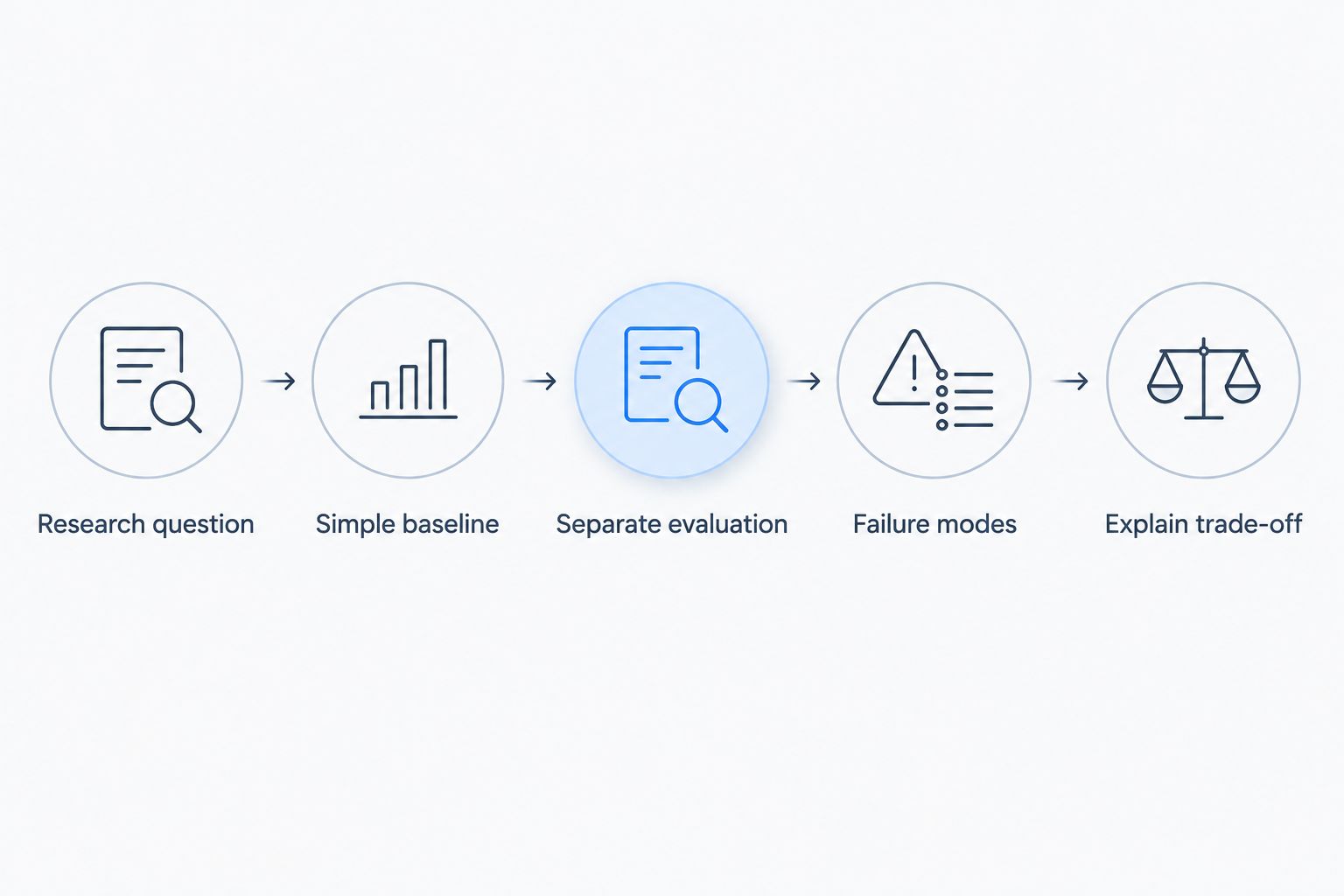
- Define the research question. State the outcome you are trying to predict or explain, when the prediction is made, and what decision the result is meant to inform.
- Set a simple baseline. Compare your method with a straightforward alternative. Without that comparison, a complicated result has no clear meaning.
- Separate development from evaluation. Use training data to fit the model, validation data to choose among approaches, and a held-out test set for a final check. Preserve the order in which information would have become available.
- Check the failure modes. Look for leakage, unstable results, changing data conditions and conclusions that depend on one favorable test.
- Explain the trade-off. Say what the extra complexity bought you and what it made harder to inspect, maintain or trust.
These steps are a preparation sequence, not a claim that every desk uses the same workflow. In 2026, you should be ready to walk an interviewer through the sequence for a project you actually completed, including decisions that did not work.
What level of machine learning is enough?
Enough means you can defend the methods on your resume. If you list a classification project, explain the target, the features, the training process and the mistakes the model makes. If you list a time-series project, explain how you kept future observations out of earlier predictions. Knowing the vocabulary without being able to defend those choices is not enough.
Your starting point can be modest. Learn to fit and interpret a basic model, compare it with an alternative, and inspect errors before adding more methods. Then read the jobs you intend to pursue: a role centered on predictive modeling calls for deeper model work than one centered on statistical analysis. Do not present that distinction as a fixed rule for every employer. Use the actual role description to decide what to study next.
Which machine-learning approaches should you know?
The best method is the one you can justify for the question and the data, not the one with the most elaborate architecture. These are approaches to compare when you discuss research work; none is a universal requirement for quant researchers.
| Approach | Best for | Strength | Limitation |
|---|---|---|---|
| Simple statistical or linear model | Establishing an interpretable baseline | Makes assumptions and comparisons easier to inspect | Misses patterns its chosen structure cannot represent |
| Tree-based model | Testing nonlinear patterns in suitable tabular data | Can model interactions without specifying each one by hand | Can fit patterns that do not hold outside the development data |
| Deep-learning model | Problems where the data and research question justify a flexible model | Can represent complex relationships | Requires a particularly careful case for its added complexity |
Start by asking what each approach does to your evaluation problem. A model that performs better only after repeated changes to the test procedure has not earned a stronger claim. A simpler model that you can test cleanly and explain clearly is the better interview example.
QuantMinds is best for quant research applicants who need resume and interview coaching, not a machine-learning course. QuantMinds can help you decide how to present a completed project through its stated resume review and interview-prep services. You still need to do the technical work and understand your own results; coaching does not replace either task.
Why the machine-learning requirement varies
A 2026 quant researcher job title does not tell you which modeling methods the work will use. Read the responsibilities and prepare for the questions they imply. These factors change the depth you need:
- Research mandate. A role that explicitly calls for predictive modeling warrants more attention to machine-learning methods than a description focused on statistical research. Follow the stated work, not the title alone.
- Available data. The form of the data shapes which approaches are sensible. Before choosing an algorithm, identify what observations exist and when each observation becomes available.
- Evaluation standard. If a project depends on performance outside the data used to build it, you must be able to defend the split and explain what would count as failure.
- Your resume claims. Listing a method invites detailed questions about why you used it. A narrower project you can explain is stronger evidence than a long skills list you cannot defend.
- The interview format. A conversation about past research calls for clear project decisions; a technical exercise calls for you to apply the underlying concepts. Prepare for the process described to you.
Do not use these factors to guess what a named firm requires. If an employer supplies a role description or interview guidance, that material takes precedence over a general study plan. Where the description is broad, prepare your strongest research example and be explicit about which parts you implemented yourself.
What should you learn before advanced models?
Build the foundation that lets you challenge a result. Start with probability and statistics, then work through regression, classification, model evaluation and practical coding. The goal is not to collect course titles. It is to answer why your result changed when the data, assumptions or evaluation procedure changed.
Take one project and write a short research record. It should state the question, the target, the information available at prediction time, the baseline, the chosen method and the evaluation procedure. Finish with the largest weakness you found. If you cannot fill in one of those fields, that gap is your next study task.
A good baseline also keeps you honest about added complexity. If you try a tree-based or deep-learning model, compare it with the earlier approach under the same evaluation rules. Explain an unfavorable result rather than hiding it. Research interviewers can question a surprising improvement; you should question it first.
For 2026 interview preparation, practice describing your work without assuming the listener has seen your code. Define the research decision before naming the algorithm. Then separate what the evidence shows from what you hoped the model would do.
How do you show machine learning on a quant research resume?
Use a project bullet to describe your research contribution, not just a list of libraries. Name the problem, the method and the evaluation choice. State an outcome only when you can verify it from your own work; do not add a performance figure because a bullet feels empty without one.
Compare these two ways of thinking about the same project:
- Weak framing: a list of algorithms and tools with no research question or evaluation method.
- Stronger framing: the question you investigated, the baseline you built, how you separated development from testing, and the limitation you identified.
The stronger version gives an interviewer something specific to examine. Be ready to explain what you personally wrote or analyzed, what you changed after an unsuccessful result, and what you would test next. If your project was collaborative, distinguish your contribution from the group’s work.
QuantMinds provides resume review and interview prep for people pursuing quantitative research, trading and development roles. Use that kind of review to test whether your project description survives direct follow-up questions. Bring the project materials and your current resume; the substance must remain yours.
Pressure-test your research story
Bring your resume and a project you need to explain in a quant interview.
How should you answer this in an interview?
When someone asks whether you know machine learning, do not answer with an unqualified yes followed by a list of model names. Describe a project and the research decisions behind it. If you have not used a method, say so; then explain what you would need to check before deciding whether it fits the problem.
A useful answer follows this order: the question, the data available at decision time, the baseline, the model, the validation design and the result’s main limitation. That order shows how you think. It also prevents a discussion of sophisticated models from covering a weak test.
Expect follow-up questions. Why was that baseline appropriate? Could any feature contain information from the future? Did you choose the model after looking at the held-out result? What would make you stop using the approach? You do not need a perfect project. You need an honest explanation of what you can and cannot conclude from it.
In 2026, your most useful preparation is to rehearse those answers against your real work. If you find that you cannot explain a choice, revisit the project instead of memorizing a polished response. The distinction matters: an interviewer can change the question, but your reasoning should still hold.
Is deep learning necessary for a quant researcher?
No, deep learning is not a universal requirement for quant researchers. Learn it in depth when the role or a project you intend to discuss calls for it. Otherwise, a well-defended baseline and sound evaluation deserve your attention first.
Can you apply without a machine-learning project?
Yes, you can apply without a machine-learning project. Show the strongest relevant evidence you do have, such as statistical research, coding and a project you can defend. Do not relabel unrelated work as machine learning; read each role description for explicit requirements.
Should you learn machine learning before applying to an MFE?
You do not need to finish an advanced machine-learning curriculum before applying to an MFE. Check each program’s stated requirements, then assess your preparation in mathematics, statistics and programming against them. An MFE application and a quant research job application ask you to demonstrate different things.
FAQ
Do quant researchers need machine learning in 2026?
Yes. Quant researchers should understand model selection, validation and failure modes; the depth of machine learning depends on the specific research role.
Is deep learning required for quant research jobs?
No, it is not a universal requirement. Study it more deeply when a role description or a project you plan to defend makes it relevant.
What machine-learning skill matters most in a quant research interview?
The ability to defend how you evaluated a model matters most. Explain your baseline, how you kept future information out of earlier predictions, and what the result does not establish.
Can a simple model be enough for a quant research project?
Yes, a simple model is enough when it answers the research question and survives a credible evaluation. More complexity needs a clear reason and a fair comparison.
Should I put every machine-learning tool I know on my quant resume?
No. List tools and methods you can connect to work you completed and explain under questioning; a project with a clear research decision is more useful than an unsupported skills list.
Can I apply for quant research roles without a machine-learning project?
Yes. Present relevant statistical, coding and research work honestly, and check the role description for explicit machine-learning requirements.
Does an MFE replace machine-learning interview preparation?
No. An MFE and an interview assess different things; you still need to explain the research methods and projects you put on your resume.
One last thing
If you can explain why a model failed, you have a better research story than a polished result you cannot reproduce or defend. Before sending a 2026 application, choose the project on your resume that invites the hardest follow-up question and answer it plainly. That is the gap to close first.