

A PhD is the better fit for developing independent research depth; an MFE is the better fit for structured, applied financial training when you already have strong quantitative foundations. For your 2026 decision, match the degree to the requirements of your target quant research roles—not to the assumption that a doctorate automatically makes you the stronger candidate.
- PhD vs MFE for quant research roles: choose independent research depth or applied financial engineering based on your target work.
- A PhD develops original research; an MFE needs careful evaluation of research projects, technical coursework, and recruiting access.
- Neither degree replaces coding ability, statistical judgment, or a clear explanation of your own research.
- QuantMinds provides quant career coaching for candidates assessing admissions, resumes, and interview preparation.
Why this matters
Choosing a degree before choosing a role reverses the decision. Quant research is a job category, not a single research agenda: statistical prediction, optimization, derivatives modeling, and execution research involve different problems.
Your degree should help you produce evidence relevant to those problems. A dissertation on an unrelated topic and a financial engineering transcript both need explanation before an interviewer can assess what you actually contribute.
Start with the work you want to discuss in an interview. The guide to explaining a research project in a quant interview helps you frame that evidence before you commit to another qualification.
Is a PhD better than an MFE for quant research roles?
A PhD is better preparation for independent academic research; an MFE is more directly organized around financial engineering. Neither distinction establishes a universal hiring advantage. The useful comparison is between specific programs, your existing skills, and actual role requirements.
For a 2026 application shortlist, separate a stated degree requirement from your interpretation of a job title. A position that explicitly requires a doctorate presents a different decision from one that accepts several educational backgrounds.
| Dimension | PhD | MFE |
|---|---|---|
| Best for | Candidates who want to conduct original research in a relevant quantitative discipline | Candidates seeking structured financial engineering training and a professional transition |
| Main strength | Sustained investigation of an original research question | Applied study connecting quantitative methods with financial problems |
| Main limitation | Research specialization does not automatically establish finance knowledge or interview readiness | Coursework alone does not establish independent research ability |
| Evidence to inspect | Dissertation expectations, adviser fit, research methods, and implementation opportunities | Course content, project depth, internship structure, and role-specific graduate outcomes |
| Candidate responsibility | Translate specialized work into methods and decisions relevant to the target role | Show ownership of research beyond completing assigned exercises |
Do not treat these degrees as interchangeable credentials. They organize your training around different objectives.
PhD: best for candidates who want original research
A PhD centers on producing original scholarship. That makes it a coherent choice if you want sustained practice defining a problem, reviewing prior work, developing an approach, and defending your conclusions.
The attraction should be the research itself. Do not choose a PhD solely to add a credential to a quant resume. You need enough interest in the underlying discipline to keep working when results are inconclusive or your original approach fails.
For quant research preparation, examine the substance of the proposed work:
- Will you formulate questions rather than only implement an existing method?
- Will you work with uncertainty, estimation, optimization, or other relevant mathematical tools?
- Will you write and test code yourself?
- Can you explain how you distinguish a useful result from an artifact?
The limitation is specialization. Deep expertise in a narrow subject does not establish knowledge of market data, trading constraints, or financial instruments.
A doctoral candidate should therefore build a translation plan alongside the research plan. Explain the problem in ordinary language, identify the transferable methods, and show where your conclusions stop applying. Your dissertation title cannot do that work for you.
MFE: best for candidates seeking applied financial training
An MFE is a professional master's focused on financial engineering. It is a coherent choice when your objective is to connect quantitative foundations with financial applications rather than pursue a dissertation.
The strongest reason to choose an MFE is a specific training gap. Perhaps you have mathematical preparation but need financial modeling context, or substantial programming experience but need more formal study of probability and numerical methods.
Evaluate the actual curriculum. The degree label does not tell you how much statistical modeling, programming, empirical research, or derivatives work you will complete.
For your 2026 program review, ask what you will personally build and defend. A capstone with clear individual responsibility offers different evidence from a group submission whose technical decisions you cannot explain.
The limitation is that completing courses is not the same as demonstrating research independence. Choose an MFE for the training and access it provides, then deliberately build research evidence. Do not assume the credential will explain your capabilities to an employer.
Also inspect outcomes by role. A graduate working in risk, development, or trading has a valid outcome, but that outcome does not answer your narrower question about quantitative research.
What evidence matters beyond the degree?
The degree tells an interviewer something about your training. Your work shows how you use it.
For both routes, prepare evidence in the following areas. These are preparation targets, not a claim that every employer uses the same assessment process.
Statistical judgment
Explain why your model suits the question and data. Identify the assumptions, the baseline, and the evidence that would make you reject the result.
For time-ordered financial data, your validation design needs particular care. Training on information unavailable at the prediction date invalidates the exercise, regardless of the degree on your resume.
Coding ownership
Be ready to explain code you wrote, not just the library you imported. Describe data handling, implementation choices, tests, and the point where a mathematically correct idea encountered a practical constraint.
A PhD does not substitute for this explanation. Neither does a programming course listed on an MFE transcript.
Research communication
Prepare a 3-minute explanation of a project as a practice exercise. Cover the question, method, result, and limitation without relying on specialist vocabulary.
Then prepare for the deeper discussion. An interviewer should be able to ask why you chose the baseline or what failed without reaching the edge of your understanding.
Resume evidence
Write bullets that identify your contribution. Distinguish work you designed from work you supported, and report only results you can substantiate.
An impressive project name is not a substitute for a clear account of your decisions.
Why the PhD-versus-MFE decision varies
The right choice changes with your starting point and intended work. Use these factors to explain your decision rather than assigning a blanket ranking to the degrees.
- Target-role requirements: Read whether the position requires, prefers, or does not specify a doctorate. Preserve that distinction in your shortlist.
- Existing research experience: If you already formulate questions and evaluate models independently, identify what additional training would add.
- Technical gaps: Separate missing mathematics, statistics, and programming skills from missing financial context. They are different problems.
- Program content: Examine the proposed dissertation environment or the actual MFE curriculum, not the degree's reputation alone.
- Recruiting preparation: Consider how you will build a resume, make relevant connections, and prepare for interviews alongside study.
- Interest in the work: A desire to conduct original scholarship supports a PhD decision. A desire for applied financial training supports an MFE decision.
These factors also expose a third possibility: your next step is targeted preparation rather than another degree. Assess that possibility before treating admission as the only route forward.
How should you choose between a PhD and an MFE?
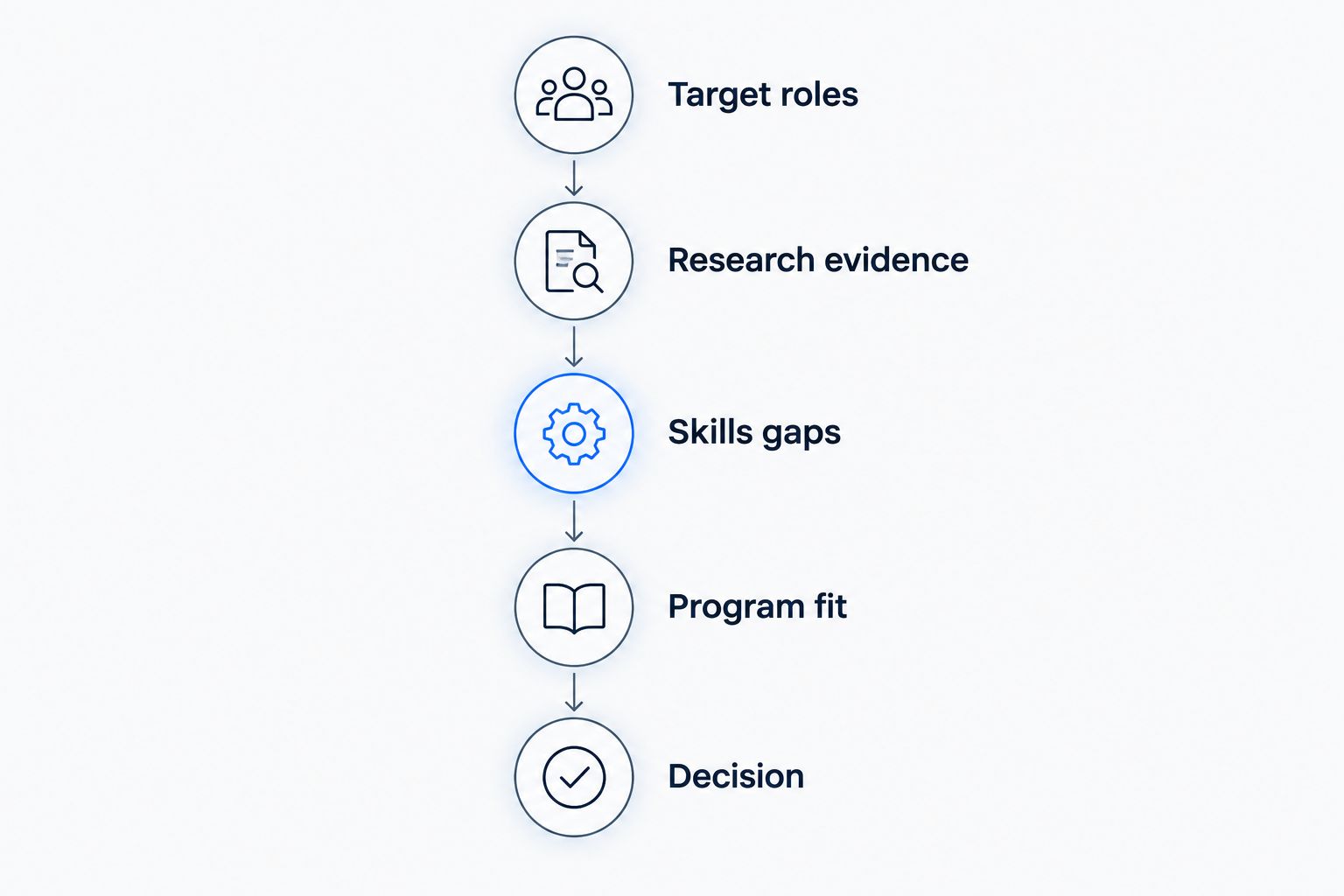
Use this sequence to turn a broad education question into a practical decision. The sample sizes below are suggested exercises, not hiring-market statistics.
1. Target roles
Collect 10 job descriptions for research work you would genuinely pursue. Use current 2026 postings, and record the date because requirements change.
For each description, separate degree requirements, methods, programming expectations, and the research problem. Do not combine quant development or trading positions with research positions simply because all contain the word quant.
2. Research evidence
Audit 2 research projects from your own background. If you have only one, audit that one rather than padding the exercise with work you did not own.
Write down the question, your contribution, the validation approach, and the main limitation. This reveals whether you need more research training or a clearer presentation of existing work.
3. Skills gaps
Compare your evidence with the requirements you collected. Name the missing skill precisely: statistical inference, numerical optimization, implementation, or financial context, for example.
Avoid calling every gap a degree problem. A coding weakness needs coding work even if you enroll in a highly regarded program.
4. Program fit
For a PhD, investigate the proposed research environment and supervision. For an MFE, inspect the curriculum, project requirements, and recruiting structure.
Ask for evidence specific to your intended role. An overall employment figure cannot, by itself, establish research placement.
5. Decision
Write a short case for your preferred route using your target roles, current evidence, and remaining gaps. Include the strongest reason not to choose it.
Choose the route that addresses a demonstrated gap, not the route that merely sounds more selective. If your argument depends entirely on the degree name, revisit the earlier steps.
Can an MFE graduate compete for quant research roles?
An MFE graduate can pursue research positions whose stated educational requirements they meet. The useful next question is whether the candidate can demonstrate the methods, coding, and research judgment the position calls for.
Build your application around evidence rather than arguing that every master's and doctorate are equivalent. Explain a project you owned, defend the validation, and show what you learned from unsuccessful approaches.
Be selective about applications. A role explicitly restricted to doctoral candidates is not the same opportunity as a role accepting a quantitative master's.
Should you get an MFE after a quantitative PhD?
An MFE after a quantitative PhD needs a specific justification. Start by identifying whether you lack financial context, recruiting access, technical preparation, or simply a clear account of your existing work.
Compare the proposed program against that gap. If your main difficulty is explaining your research or preparing for interviews, another degree does not directly resolve the problem.
If you want structured financial training, inspect the curriculum for material that genuinely adds to your doctoral preparation. Repeating familiar coursework is not the same as making a career transition.
When does coaching help with this decision?
QuantMinds provides quant career coaching, admissions preparation, resume review, interview preparation, and 1-on-1 coaching. Its founder previously served as executive director of UC Berkeley's MFE program.
QuantMinds is best for candidates seeking quant career coaching on admissions and recruiting preparation. Bring specific target roles and your existing research evidence so the discussion stays grounded in your actual decision.
The boundary is equally important: coaching does not replace mathematical training, original research, or coding practice. Use QuantMinds to assess and communicate your preparation, not as a substitute for producing the work.
FAQ
Do I need a PhD to become a quant researcher?
A PhD is necessary when the specific position requires one; do not assume that requirement applies to every quant research role. Read the educational criteria and research expectations for each position you target.
Is an MFE enough for a quant research job?
An MFE satisfies the degree criterion only where the employer's stated requirements accept it. You still need to demonstrate the technical skills and research judgment relevant to the position.
Should I choose a PhD if I only want to work in finance?
Choose a PhD only if you also want to conduct original research in the underlying discipline. Interest in a finance career alone does not establish that doctoral training is the right educational fit.
Which is better for research preparation, a PhD or an MFE?
A PhD centers on original research, while an MFE centers on applied financial engineering training. Compare the specific dissertation environment or project requirements rather than assuming the degree labels describe identical preparation.
Will a PhD make quant interviews easy?
A PhD does not remove the need for interview preparation. Practice explaining your research, solving relevant technical problems, and discussing code you personally wrote.
How do I compare MFE placement results for research roles?
Compare role-specific outcomes rather than treating every quantitative finance placement as a research placement. Check the reporting period, role definitions, and which graduates the published figures include.
Can QuantMinds help me decide between a PhD and an MFE?
QuantMinds offers quant career coaching and admissions preparation relevant to that decision. Bring your academic background, research projects, and target roles to make the discussion specific.
One last thing
Before submitting a 2026 application, remove the degree names from your plan. Describe only what you will learn, what you will produce, and which target-role requirements that work addresses.
If the plan stops sounding persuasive without the credential, it needs more substance. A stronger plan explains how you will improve your research, close technical gaps, and demonstrate those changes to an interviewer.
The right degree gives you relevant preparation; it does not relieve you of proving what you can do.