

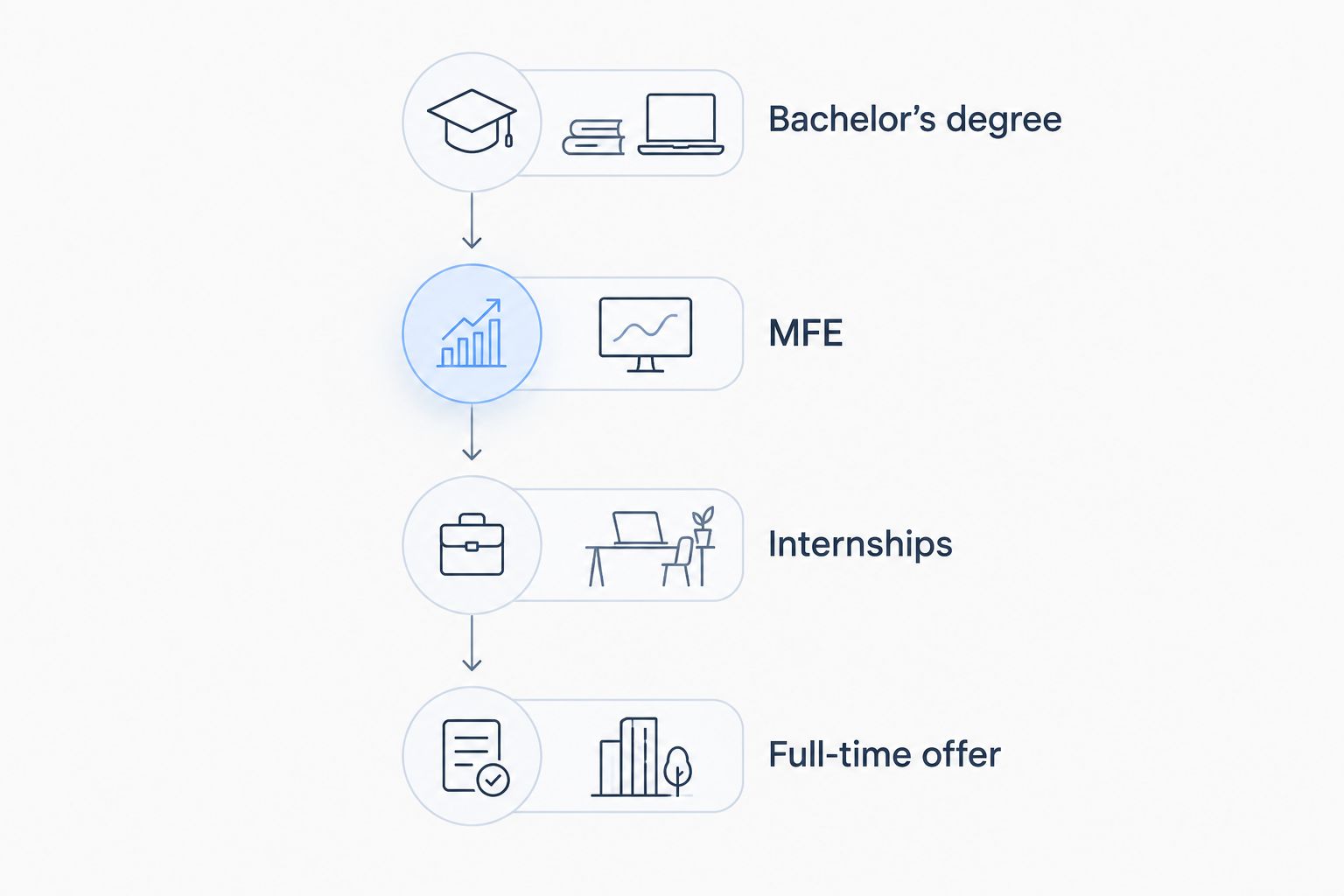
Most people become a quant researcher in 5 to 6 years after high school: a 4-year bachelor's degree followed by a 1- to 2-year master's in financial engineering (MFE) is the most common route into the role in 2026. The full range runs from about 4 years for the rare direct hire straight out of undergrad to 8-10+ years for candidates who go through a PhD first, and that timeline covers the degree only — most candidates also need one or two quant internships locked in before the offer even shows up.
- Most candidates need 5 to 6 years: a 4-year bachelor's degree plus a 1-2 year MFE is the fastest common path in 2026.
- PhD-track candidates typically spend 8-10+ years total before landing a research seat.
- Internship recruiting starts a year or more before graduation, so the degree timeline understates the real clock.
- QuantMinds coaching shortens the parts of the timeline candidates control: resume, networking, and interview readiness.
Why this matters
The degree question is the easy part. What actually decides how fast you get to a quant researcher title is whether you're building the right materials and network during school, not after. A candidate who spends their MFE year applying cold to job boards moves slower than one who starts networking and interview prep in year one — the degree length doesn't change, but the time-to-offer does.
QuantMinds works with candidates at every stage of this timeline — undergrads, MFE students, career switchers — because the bottleneck is rarely the classroom. It's the resume, the LinkedIn presence, and the interview prep that most candidates put off until it's almost too late.
How long does it take to become a quant researcher?
Three paths dominate quant research hiring in 2026, and they don't take the same amount of time.
| Path | Typical timeline | Best for |
|---|---|---|
| Bachelor's only | ~4 years, then a slower ramp into research | Exceptional CS/math grads who land a quant developer or analyst seat first, then transfer internally |
| Bachelor's + MFE | 5 to 6 years | The most common route into an entry-level research seat |
| PhD | 8 to 10+ years (4-6 year PhD after a bachelor's) | STEM PhDs targeting research-heavy buy-side roles |
The bachelor's-only path looks fastest on paper, but it's the least direct. Most firms hiring straight out of undergrad into research want a top-tier math, physics, CS, or stats background and strong competition results — everyone else lands in a developer or analyst seat and works toward research from inside the firm.
Bachelor's + MFE path: 5 to 6 years
This is the default path for a reason. A 4-year undergraduate degree in math, engineering, CS, physics, or a related quantitative field, followed by a 1- to 2-year MFE program, gets most candidates in front of research-track recruiters with a credential built specifically for the job. Programs vary in length and focus, and is an MFE degree worth it is worth reading before committing to one, since the value depends heavily on which program and what you do with the year.
PhD path: 8 to 10+ years
A STEM PhD (math, physics, statistics, or a computational field) typically runs 4 to 6 years on top of a bachelor's degree, which puts PhD-track candidates at 8-10+ years before their first quant researcher role. This path is slower but often lands candidates directly in research-heavy seats at funds that specifically recruit PhDs — some roles genuinely prefer it. Whether it's necessary depends on the fund and the seat: is a math PhD required for quant research roles breaks down where a PhD actually matters versus where it's optional.
Bachelor's-only path: 4 years (rare)
A small number of candidates land research-adjacent roles straight out of undergrad, usually at prop trading firms with strong internship-to-offer pipelines. This is the exception, not the rule, and it depends heavily on competition results, a completed internship at the same firm, and a top-tier quantitative major.
Why the timeline varies
The ranges above are wide because the real variables have nothing to do with the calendar:
- Internship timing. Quant fund recruiting for the following summer often opens more than a year ahead, so candidates who start networking late add a full recruiting cycle to their timeline.
- School and GPA. A non-target school or a low GPA doesn't add years by itself, but it changes how much networking and resume work is needed to get interviews in the first place.
- Buy-side vs. sell-side target. Buy-side research seats at hedge funds are more selective and often take longer to break into than sell-side roles at banks.
- Self-taught vs. formal coursework. Strong self-taught programmers can compress the timeline, but they usually need more proof-of-work (competitions, projects) to offset the missing credential.
- Coaching and networking speed. Candidates who get resume and interview feedback early avoid burning a full recruiting cycle on avoidable mistakes — this is the one variable a candidate actually controls.
- Market hiring conditions. Fund headcount and hiring appetite shift year to year, which can stretch or compress how many cycles it takes to land an offer even with a strong background.
Get a straight answer on your timeline
1-on-1 coaching from QuantMinds on resume, interviews, and recruiting strategy.
Related questions
Is 30 too old to break into quant trading?
Age alone doesn't disqualify a candidate, but it does change which firms and paths make sense at that stage — see is 30 too old to break into quant trading for how career switchers should think about it differently than a 22-year-old MFE grad.
Which MFE programs actually shorten the path?
Program length, recruiting pipelines, and employer relationships vary widely by school, and picking the wrong one can add a full year of job searching after graduation instead of shortening it.
Does a quant developer background speed up the path to research?
Moving from quant developer to quant researcher internally is common and often faster than an external research hire, since the firm already knows the candidate's work.
FAQ
What's the fastest way to become a quant researcher?
The fastest documented path is 4 years: a bachelor's degree with a strong quantitative major, competition results, and an internship that converts to a full-time research offer. This route is rare and depends heavily on school tier and internship access.
Is a PhD required to become a quant researcher?
No, a PhD is not required for every quant research role, but some research-heavy seats at certain funds do prefer or require one. The PhD path takes 8-10+ years total versus 5-6 years for the bachelor's plus MFE route.
Do you need an MFE to become a quant researcher?
An MFE is not mandatory, but it is the most common credential behind entry-level quant researcher hires in 2026. Bachelor's-only and PhD candidates both compete for the same seats without one.
How long does an MFE program take?
MFE programs typically run 1 to 2 years full-time, which is why the bachelor's-plus-MFE path adds up to roughly 5-6 years total after high school. Part-time programs take longer.
How long does a quant PhD take?
A STEM PhD in a field like math, physics, or statistics typically takes 4 to 6 years after a bachelor's degree, putting the full path to a quant researcher role at 8-10+ years.
Can a self-taught programmer become a quant researcher without a formal quant degree?
Yes, but self-taught candidates usually need stronger proof-of-work, like competition results or projects, to offset the missing MFE or PhD credential. The timeline depends more on that proof-of-work than on any classroom.
Is quant researcher the same timeline as quant developer?
No, quant developer roles are generally easier to enter straight out of a bachelor's degree, while quant researcher roles more often require an MFE or PhD, which extends the typical timeline by 1 to 6 years.
One last thing
The degree timeline is the part candidates obsess over, but it's the internship clock that actually determines whether that timeline holds. Recruiting for the following summer's internships often opens well over a year ahead — the kind of urgency behind QuantMinds' own webinar on landing a 2027 summer internship while it's still 2026. Miss that window and the 5-6 year MFE path quietly turns into 7.