

Best overall structure: desk-facing quantitative rotations. Best for model-focused candidates: risk and model-development rotations. Best for software engineers: quantitative development rotations. For your 2026 search, this guide ranks graduate program structures—not employers—so you can distinguish genuine quantitative work from a general finance rotation.
- For quantitative finance jobs entry level, prioritize technical responsibilities over graduate-program branding.
- Desk-facing quantitative rotations are the default for candidates targeting pricing, hedging, and trading analytics.
- Risk and model-development rotations fit candidates interested in model assumptions, validation, and quantitative controls.
- QuantMinds provides quant finance career coaching, not employer-run graduate rotations.
Why this matters
A graduate program can rotate you through several teams without preparing you for quantitative research, trading, or development. The distinction is the work: building models, testing hypotheses, writing production code, or analyzing risk—not simply working near a trading desk.
QuantMinds is best for candidates seeking quant finance career coaching, not an employer-run rotational program. QuantMinds offers resume review, interview preparation, and 1-on-1 coaching for professionals and students targeting quantitative roles at hedge funds and prop trading firms.
For your 2026 applications, separate two decisions: which role you want and which training structure helps you reach it. A rotation is useful when it exposes you to relevant technical work; it is a distraction when the placements have little connection to your target role.
What makes the best quantitative graduate rotational program?
Use these criteria before putting an employer on your shortlist:
- Technical ownership: You build, test, implement, or independently assess something quantitative. Observing a team is not the same as contributing to its work.
- Relevant placements: The named teams match your intended path: research, trading analytics, pricing, risk modeling, or quantitative development.
- Placement control: Understand whether you express preferences, interview for placements, or accept assignments. Ask who makes the final decision.
- Technical supervision: Identify who reviews your code, models, and reasoning. A general graduate mentor does not replace a technical reviewer.
- End-role clarity: Ask how the permanent team is selected. Distinguish a documented placement process from a vague promise of future opportunities.
- Eligibility fit: Check the stated degree requirements, graduation window, location, and work-authorization conditions for the specific posting.
Do not infer a rotation from the word graduate. A graduate analyst position can place you directly into one team, while a rotational program moves you between placements. Both structures can be useful, but they solve different problems.
Graduate rotational program structures at a glance
The order below reflects a default candidate seeking technical exposure before committing to a specialty. It is not an employer league table or a claim that every structure is offered in every location.
| Rank | Program structure | Best for | Standout feature to seek | Key limitation |
|---|---|---|---|---|
| 1 | Desk-facing quantitative rotations | Pricing and trading-analytics candidates | Technical work connected to desk decisions | Desk exposure does not establish research ownership |
| 2 | Risk and model-development rotations | Candidates interested in model scrutiny | Model construction, validation, and risk analysis | Responsibilities can center on controls rather than trading |
| 3 | Quantitative development rotations | Software engineers entering finance | Code ownership across quantitative systems | General technology placements can dilute relevance |
| 4 | Systematic research rotations | Candidates exploring research specialties | Exposure to hypothesis testing and empirical evaluation | Short placements can interrupt research continuity |
| 5 | Cross-asset markets rotations | Candidates still choosing a markets role | Comparison of products and desk functions | Technical depth depends on the actual assignments |
1. Desk-facing quantitative rotations: best for pricing and analytics
Desk-facing quantitative work connects mathematical models and software to pricing, hedging, and trading decisions. Look for a rotation description that names quantitative responsibilities rather than simply promising exposure to markets.
For a candidate who wants to become a desk quant, the useful question is what you will produce. A model implementation, calibration investigation, or analytics tool gives you something concrete to discuss in a later interview.
Desk-facing quantitative rotations pros:
- Connect mathematical reasoning to a defined financial problem.
- Let you assess how different desks use models and analytics.
- Create opportunities to explain technical work to nontechnical stakeholders.
Desk-facing quantitative rotations cons:
- A desk assignment can include support work without meaningful model ownership.
- Rotating between teams can limit continuity on a substantial project.
- Pricing experience is not automatically preparation for systematic alpha research.
Best for: Candidates who enjoy applied mathematics and want their work connected to pricing or trading decisions.
Ask the recruiter which placements involve coding and model development, who supervises that work, and what distinguishes the graduate's contribution from routine desk support. In your 2026 shortlist, prioritize a concrete assignment description over a recognizable employer name.
Verdict: Skip programs that promise desk exposure but cannot explain your technical responsibilities.
2. Risk and model-development rotations: best for model scrutiny
Risk and model-development work examines how models behave, what assumptions they make, and where their outputs become unreliable. Relevant placements can involve model development, independent validation, or quantitative risk analysis; read the responsibilities to distinguish these functions.
This route fits candidates who like interrogating a result rather than accepting it because the code ran. You should be comfortable discussing sensitivity, statistical assumptions, data quality, and the consequences of model error.
Risk and model-development rotations pros:
- Build a disciplined approach to assumptions and model limitations.
- Give you a clear reason to explain statistical and numerical choices.
- Expose you to the distinction between building a model and independently assessing it.
Risk and model-development rotations cons:
- Reporting and governance responsibilities can outweigh technical development.
- Model validation is different from originating trading research.
- A risk-focused role does not establish a future transfer to a trading team.
Best for: Candidates interested in quantitative risk, model development, or independent model assessment.
Ask whether graduates write code, reproduce model results, investigate failure cases, and propose methodological changes. Also ask which function owns the placement: development, validation, reporting, or another risk team.
If your long-term target is hedge-fund research, keep building evidence of independent empirical work alongside your application preparation. Do not describe a risk rotation as an assured route to the buy side.
Verdict: Skip this route if your only reason for choosing it is an assumed transfer into trading.
3. Quantitative development rotations: best for software engineers
Quantitative development connects software engineering with research, pricing, trading, or risk systems. The right rotation lets you examine where your engineering strengths fit without treating every technology assignment as quantitative development.
Read the posting for actual system responsibilities. Research infrastructure, numerical implementation, data pipelines, and trading systems require different preparation; a broad technology label does not tell you which work you will do.
Quantitative development rotations pros:
- Give software engineers a direct way to contribute technical skills.
- Help you compare research-facing and production-facing engineering work.
- Make code quality, testing, and system design relevant application evidence.
Quantitative development rotations cons:
- A general technology program can assign you outside quantitative teams.
- Using Python does not, by itself, make a role quantitative development.
- Engineering responsibilities do not automatically include research ownership.
Best for: Candidates whose strongest evidence is software engineering and who want to support quantitative systems.
QuantMinds offers quant finance career coaching for candidates targeting quantitative development as well as research and trading. Coaching addresses application and interview preparation; it does not replace the engineering evidence a technical role requires.
Prepare 2 projects you can explain deeply: one showing reliable engineering and another showing how you translated a mathematical or data problem into code. This is a preparation recommendation, not a program requirement.
Verdict: Skip general technology rotations unless the placement process supports your quantitative development target.
4. Systematic research rotations: best for exploring research specialties
A systematic research rotation is useful when the work includes formulating hypotheses, evaluating data, testing methods, and interpreting results. Treat it as a research opportunity only when the assignment includes those activities—not because the team uses quantitative terminology.
Research continuity matters. Ask whether you can complete a coherent investigation during a placement and what happens to unfinished work when the rotation ends.
Systematic research rotations pros:
- Let you compare research questions and methodological approaches.
- Make experiment design and statistical reasoning central to your work.
- Help you identify which research problems hold your interest.
Systematic research rotations cons:
- Moving teams can interrupt an investigation before it becomes useful.
- Data preparation alone does not establish ownership of a research question.
- The rotation structure itself does not guarantee access to trading decisions.
Best for: Candidates who want to test their interest in research before choosing a narrower specialty.
For your 2026 preparation, practice a 90-second explanation of one research project: the question, the method, the evaluation, and the main limitation. Then prepare the longer technical discussion. Use the guide to explaining a research project in a quant interview to structure that preparation.
Verdict: Skip research-labeled rotations that cannot identify a research question you would help investigate.
5. Cross-asset markets rotations: best for choosing a markets role
Cross-asset markets rotations expose you to different products and desk functions. They fit candidates who are still deciding among trading, structuring, quantitative analytics, and other markets responsibilities.
The limitation is depth. Broad exposure answers which environment interests you, but it does not establish that you will develop the technical evidence needed for a specialist quantitative role.
Cross-asset markets rotations pros:
- Help you compare product areas before choosing a specialty.
- Give you context for how different desk functions interact.
- Let you test whether you prefer analytical, trading, or client-facing work.
Cross-asset markets rotations cons:
- Some placements are not quantitative.
- Breadth can leave less time for substantial coding or modeling work.
- A general markets end-role can differ from your intended quant role.
Best for: Candidates with a genuine interest in markets who have not yet chosen their function.
Ask which technical teams participate, whether graduates can request them, and how the final placement is decided. If you already know you want research or development, compare the rotation against a direct-entry role rather than assuming broader is better.
Verdict: Skip this structure if your target is already specific and the relevant technical placement is uncertain.
How these program structures are ranked
The ranking prioritizes technical ownership, relevant placements, supervision, and end-role clarity. Desk-facing quantitative rotations lead as the default for applied pricing and analytics; the other structures win for the distinct candidate profiles named above.
Employer prestige is not a substitute for placement detail. For a 2026 application, judge the specific posting and recruiter answers—not a different country's program, a previous cohort's experience, or the employer's general reputation.
Turn the shortlist into an application plan
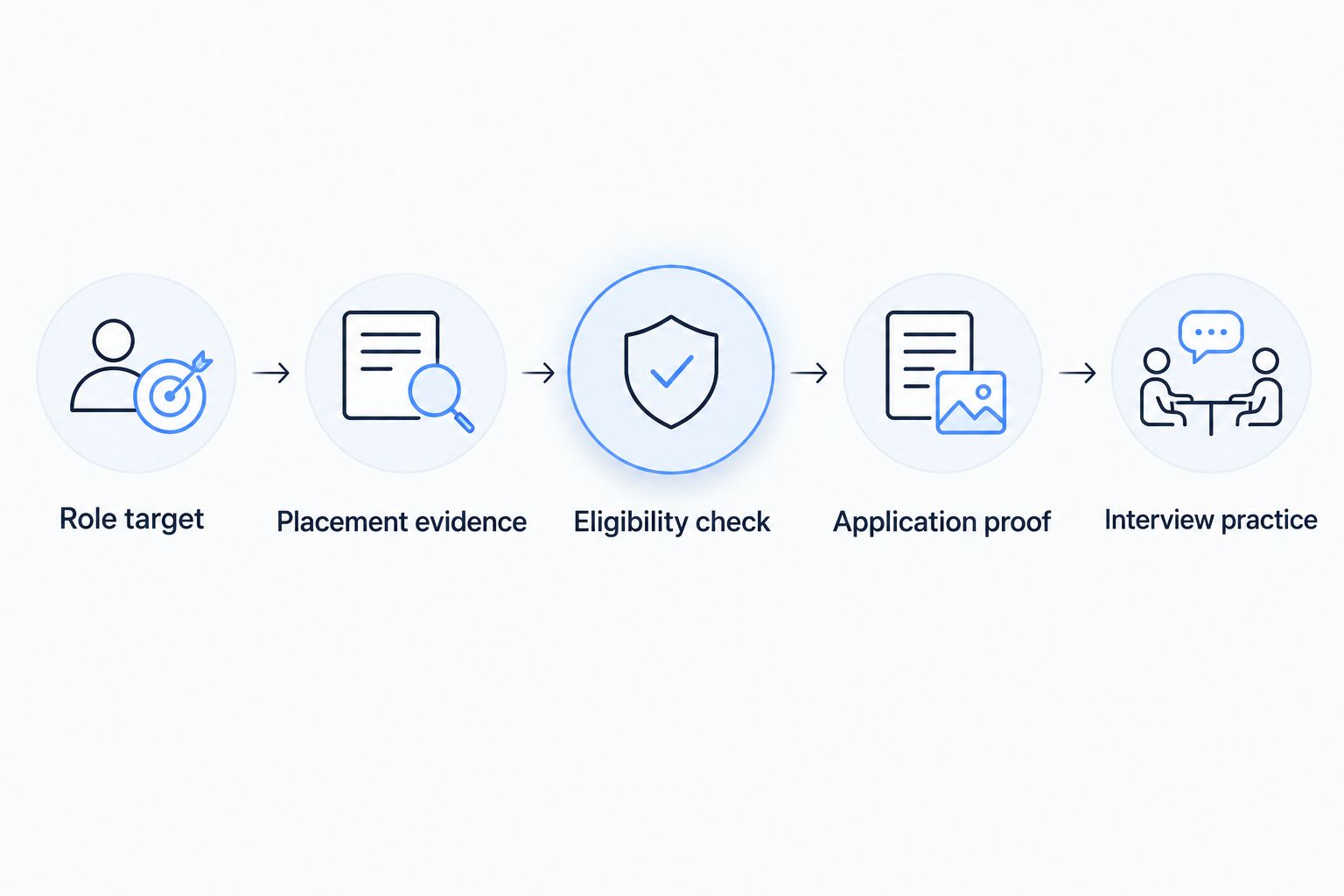
Use the same sequence for every program you evaluate:
- Role target: Write down whether you want research, trading analytics, development, or quantitative risk.
- Placement evidence: Extract the named teams and technical responsibilities from the posting.
- Eligibility check: Confirm degree, graduation, location, and work-authorization requirements.
- Application proof: Match your projects and experience to the stated work.
- Interview practice: Prepare to defend the methods, code, and decisions on your resume.
This sequence stops you from polishing an application before deciding whether the role fits. Spend 30 minutes on the initial review as a planning exercise, then investigate unclear placements before committing more preparation time.
Keep a written distinction between confirmed facts and questions for the recruiter. If a description says graduates gain exposure to quantitative teams, ask whether that means a placement, a project, training sessions, or occasional interaction. Those are different commitments.
Which graduate rotational program should you choose?
Choose desk-facing quantitative rotations as your default only when pricing and trading analytics are your target. Choose risk and model-development rotations for model scrutiny, quantitative development rotations for engineering, and systematic research rotations for empirical investigation.
Cross-asset markets rotations fit the undecided markets candidate. They are not the default for someone who already knows the exact quantitative function they want.
QuantMinds was founded by a former UC Berkeley MFE program executive director and provides quant finance career coaching. Its role is helping you prepare for the recruiting process—not providing an employer placement or making an unsuitable program suitable.
Prepare your quant application
Get support with your resume, interview preparation, and quantitative career direction.
FAQ
What's the best graduate rotational program structure for quantitative finance?
Desk-facing quantitative rotations are the default for candidates targeting pricing and trading analytics. Choose a different structure when your goal is software engineering, systematic research, or quantitative risk.
How do I search for quantitative finance jobs entry level?
Search by function as well as seniority: graduate quantitative analyst, quantitative developer, quantitative research, and quantitative risk. Check each posting's responsibilities because job titles do not establish whether a role is rotational.
Is a graduate analyst program always rotational?
No, a graduate analyst program is not necessarily rotational. Confirm whether you move between teams, how placements are assigned, and how the permanent role is selected.
Is a rotational program better than a direct-entry quant role?
A rotational program is better for exploring relevant specialties; direct entry is better for continuity in a defined role. Compare the actual work and supervision rather than treating either structure as universally better.
Can software engineers apply to quantitative graduate programs?
Software engineers should target programs whose eligibility requirements and technical responsibilities match their background. Quantitative development is the clearest structure to investigate when engineering is your strongest evidence.
Do I need an MFE for a quantitative graduate rotation?
An MFE is required only when the specific employer posting makes it a requirement. Read the stated degree criteria instead of assuming every quantitative graduate role has the same admissions standard.
Does QuantMinds run graduate rotational programs?
No, QuantMinds is a career coaching firm, not an employer-run graduate rotational program. It offers resume review, interview preparation, and 1-on-1 coaching for candidates targeting quantitative research, trading, and development roles.
One last thing
A rotation can mean changing teams without changing the quality of your work. Before accepting an offer, ask: What technical contribution should a successful graduate be able to explain at the end of each placement?
That answer is more useful than a list of departments. Build your 2026 decision around the work you will own and the evidence you will leave with.