

Best overall for research-ready MFE graduates: quantitative research. Best for strong programmers: quantitative development. Best for candidates who prefer model evaluation to trading decisions: model validation. This 2026 financial engineering career guide compares six paths by the work you do, the evidence you need, and the trade-offs you accept.
- Quantitative research is the strongest financial engineering career fit for candidates who enjoy statistical investigation and can defend their results.
- Quantitative development suits MFE graduates whose strongest evidence is software engineering, not investment research.
- Model validation suits candidates who prefer challenging assumptions and documenting weaknesses to owning trading decisions.
- QuantMinds provides resume review, interview prep, and one-on-one coaching for quantitative finance candidates.
Why this matters
An MFE is a qualification, not a job description. Quantitative researchers, developers, traders, and validation analysts solve different problems. Applying to all of them with the same resume makes your strongest evidence harder to see.
QuantMinds is best suited to financial engineering career candidates who want resume review, interview prep, and one-on-one coaching. Its founder previously served as executive director of the UC Berkeley MFE program; the practical question for your search is how to connect your background to a specific role.
For your 2026 search, start with the work rather than the employer's name. A hedge fund development position and a bank pricing position can require different preparation even when both advertisements use the word quant.
What makes the best financial engineering career path?
Use these criteria before choosing a target:
- Daily work: Do you want to investigate signals, build systems, price instruments, make trading decisions, or challenge models?
- Existing evidence: Your strongest project should resemble the work the team needs, not merely demonstrate difficult mathematics.
- Interview fit: Match your preparation to the job description's emphasis on statistics, coding, probability, derivatives, or model assessment.
- Decision ownership: Distinguish creating a model from implementing it, reviewing it, and using its output.
- Working constraints: Consider research uncertainty, production reliability, market exposure, documentation, and stakeholder communication.
The ranking below is a decision guide, not a claim about placement rates or compensation. Quantitative research leads for research-ready candidates; another path should lead when your evidence points elsewhere.
Financial engineering careers at a glance
| Career path | Best for | Standout feature | Key limitation |
|---|---|---|---|
| Quantitative research | Statistical investigators | Turns hypotheses and data into investment research | A convincing backtest still needs scrutiny |
| Quantitative development | Software-first candidates | Builds research and trading infrastructure | Engineering depth matters beyond classroom coding |
| Derivatives pricing quant | Applied mathematics specialists | Connects mathematical models to instrument valuation | Requires product knowledge alongside mathematics |
| Quantitative trading | Market decision-makers | Connects analysis to trading and risk decisions | Responsibility and automation differ across desks |
| Model validation | Critical model reviewers | Independently challenges assumptions and implementation | Reviewing models is different from owning strategies |
| Portfolio analytics | Investment-focused communicators | Explains portfolio exposures and performance | Analytical work does not necessarily include investment authority |
Read the responsibilities before relying on the title. In 2026, your application should still explain which of these functions you want to perform and why your experience supports that choice.
1. Quantitative research: best for statistical investigators
Quantitative researchers formulate hypotheses, analyze data, and evaluate models or investment signals. The work combines statistical judgment with programming. A useful result includes an explanation of where the method fails, not just where it succeeds.
Best for: MFE graduates who enjoy open-ended investigation and can defend choices about data, assumptions, and evaluation.
Quantitative research pros:
- Connects statistics and programming to investment questions.
- Gives you a clear reason to develop rigorous research projects.
- Rewards careful reasoning about uncertainty and alternative explanations.
Quantitative research cons:
- Attractive historical results can reflect leakage, overfitting, or unrealistic execution assumptions.
- A sophisticated model is not enough if you cannot explain its economic purpose.
Prepare 1 research project that you can discuss from hypothesis to failure analysis. Treat that as a preparation recommendation, not an employer requirement. Explain your baseline, data split, limitations, and what evidence would change your conclusion.
Verdict: Hold quantitative research as your primary target only if you can defend the research process, not just display the result.
2. Quantitative development: best for software-first candidates
Quantitative developers build software used in research, pricing, execution, or trading operations. The balance depends on the team: research tooling is different from performance-sensitive execution infrastructure. Read the specification before deciding which programming skills to emphasize.
Best for: Candidates whose strongest work involves implementing, testing, and maintaining software.
Quantitative development pros:
- Connects software engineering to financial applications.
- Lets you demonstrate ability through inspectable code and tests.
- Offers a distinct target for candidates who prefer implementation to hypothesis generation.
Quantitative development cons:
- Notebook-based coursework does not demonstrate every production engineering skill.
- Different teams require different combinations of languages, systems knowledge, and financial understanding.
For your 2026 applications, show what happens when inputs are wrong, dependencies fail, or another person needs to maintain your code. The guide to passing a quant developer coding interview addresses the next preparation step.
Verdict: Skip a research-first positioning if software engineering is your strongest evidence; target quantitative development instead.
3. Derivatives pricing quant: best for applied mathematics specialists
Derivatives pricing quants develop or implement models used to value financial instruments and calculate sensitivities. The work connects mathematical assumptions, numerical methods, market inputs, and product behavior. A derivation matters because of the valuation problem it solves.
Best for: Candidates who enjoy stochastic modeling, numerical analysis, and explaining how financial contracts behave.
Derivatives pricing quant pros:
- Applies mathematical finance directly to valuation problems.
- Connects model implementation with interpretable outputs such as sensitivities.
- Gives mathematically focused candidates a concrete domain for project work.
Derivatives pricing quant cons:
- Mathematical ability does not replace knowledge of the instrument being modeled.
- Calibration, numerical stability, and implementation choices introduce practical complications.
Prepare a pricing example that explains the contract, assumptions, method, and checks. Discuss why the output changes when inputs change. Avoid presenting an equation without explaining its use or its limitations.
Verdict: Hold this path as a priority if you enjoy both the mathematics and the instruments; skip it if only the derivations interest you.
4. Quantitative trading: best for market decision-makers
Quantitative trading connects analysis with decisions about execution, positions, and risk. Some roles emphasize systematic strategy development; others include more direct trading judgment. The job title alone does not tell you how much discretion the trader has.
Best for: Candidates who want to connect probabilistic reasoning with market decisions and can explain risk clearly.
Quantitative trading pros:
- Links analytical work to observable trading outcomes.
- Combines probability, market understanding, and risk judgment.
- Gives you a practical reason to examine execution assumptions.
Quantitative trading cons:
- A trading outcome does not by itself distinguish skill from chance.
- Responsibilities differ substantially between systematic and discretionary settings.
Prepare a decision explanation: what you believe, what evidence supports it, what would invalidate it, and how you would limit exposure. Mental arithmetic practice alone does not answer those questions.
Verdict: Wait before making quantitative trading your default target if you cannot explain the role's decision-making and risk responsibilities.
5. Model validation: best for critical model reviewers
Model validation examines whether a model is conceptually sound, implemented correctly, and appropriate for its intended use. The work includes challenging assumptions, reviewing evidence, and communicating limitations. It is not the same job as building an investment strategy.
Best for: Candidates who enjoy independent assessment, structured reasoning, and precise technical writing.
Model validation pros:
- Applies quantitative skills to model weaknesses and controls.
- Rewards clear explanations of assumptions and limitations.
- Offers a distinct role for candidates who prefer review to trading ownership.
Model validation cons:
- Documentation and review responsibilities are central, not incidental.
- Model assessment does not necessarily give you authority over model development or investment decisions.
Build a critique of a model you understand. Identify its intended use, test the assumptions, inspect implementation choices, and explain where its outputs become unreliable. A balanced assessment should recognize what the model does well, too.
Verdict: Skip model validation if your main goal is owning trading strategies; prioritize it if independent model challenge is the work you want.
6. Portfolio analytics: best for investment-focused communicators
Portfolio analytics examines exposures, risk, performance, and the relationships among holdings. The work helps investment teams understand portfolios rather than treating every security in isolation. Communication matters because analysis must support a decision or explain an outcome.
Best for: Candidates who enjoy connecting quantitative analysis with portfolio-level questions and stakeholder discussion.
Portfolio analytics pros:
- Connects statistical analysis with investment context.
- Develops your ability to explain risk and performance.
- Provides a clear target for portfolio-focused project work.
Portfolio analytics cons:
- Analytical responsibility does not automatically include authority to select investments.
- The balance between recurring reporting and exploratory analysis depends on the position.
Prepare a portfolio analysis that distinguishes returns, exposures, and risk. Explain what your measures show and what they leave out. Ask interviewers which decisions the analysis supports and how much of the role involves recurring reporting.
Verdict: Hold portfolio analytics as a target when portfolio interpretation interests you more than building execution systems or pricing individual derivatives.
How these paths are ranked
These six paths are ordered by their fit with the candidate profiles stated above, using daily work, existing evidence, interview fit, decision ownership, and working constraints. They are not ranked by prestige, compensation, or the likelihood of receiving an offer.
QuantMinds focuses on coaching candidates for quantitative research, trading, and development roles. The other paths belong in this comparison because choosing a financial engineering career requires understanding adjacent work, not because every path is the same recruiting target.
Turn a career choice into an application plan
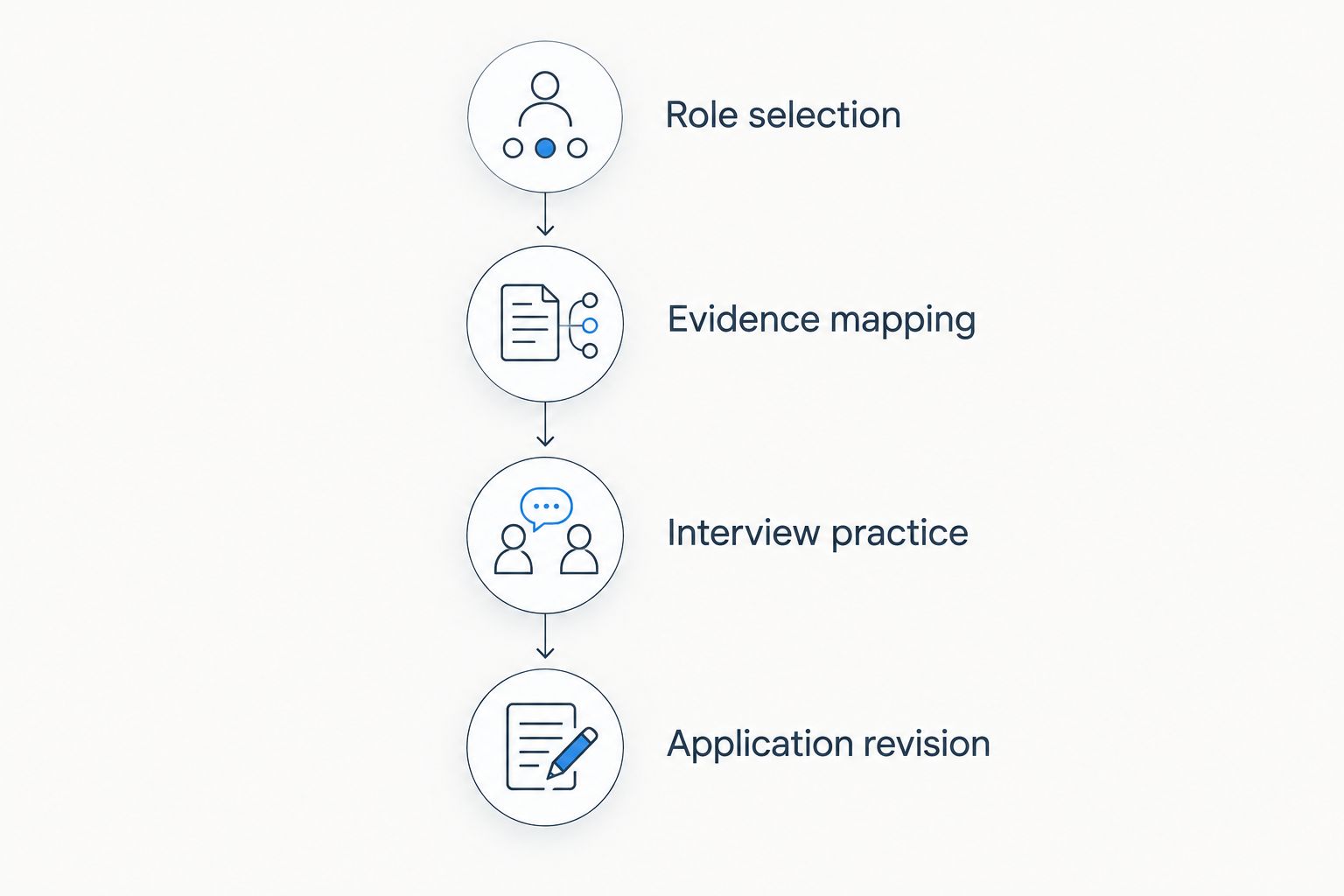
For your 2026 search, use this sequence before sending another general-purpose quant resume.
Role selection
Choose a primary role family and a nearby alternative. Write down the daily work you want, then check it against actual job descriptions. Separate duties you already demonstrate from duties you still need to learn.
Evidence mapping
Map each important responsibility to a project, internship, research contribution, or prior job. If your evidence is only a course title, develop an example you can explain. Do not relabel group work as an individual achievement.
Interview practice
Prepare a 2-minute project explanation covering the problem, your contribution, the method, and the limitation. Then schedule a 30-minute practice session for follow-up questions. These are suggested exercises, not hiring standards or promises about preparation time.
Application revision
Revise your resume and LinkedIn profile so the same role target is visible in both. Replace broad claims such as strong analytical skills with specific work you performed. Keep the technical detail accurate enough to withstand questioning.
Bring the role description and your current resume to a coaching conversation. QuantMinds offers resume review, interview prep, and one-on-one coaching; focus the discussion on the gap between your target role and the evidence you present.
Prepare for your target quant role
Focus your resume review and interview prep on the work you want to do.
Which financial engineering career should you choose?
Choose quantitative research as the default only when your strongest evidence is research. Choose quantitative development when your strongest evidence is engineering. Choose derivatives pricing when you want mathematical finance applied to valuation.
Quantitative trading fits candidates who want market decisions and risk ownership. Model validation fits candidates who want independent scrutiny. Portfolio analytics fits candidates who want to explain portfolios and support investment decisions.
Your 2026 application should make that choice visible. A focused resume gives the reader a clear answer to what you want and why your experience belongs in that role.
FAQ
What's the best financial engineering career after an MFE?
Quantitative research is the strongest fit for MFE graduates who enjoy statistical investigation and can defend research results. Quantitative development is a better fit when software engineering is your strongest evidence; the degree alone does not determine the right path.
Is quantitative research better than quantitative development?
Neither path is better for every candidate. Quantitative research centers on investigating hypotheses and evaluating models, while quantitative development centers on building the software those teams use.
Can an MFE graduate work in quantitative trading?
Yes, quantitative trading is a career path for MFE graduates. Your application still needs to demonstrate the probability, programming, market understanding, and risk reasoning relevant to the specific role.
Do all financial engineering jobs involve trading?
No, financial engineering jobs also include pricing, model validation, software development, and portfolio analytics. These roles can support trading or investment teams without giving you direct responsibility for trading decisions.
Is model validation the same as quantitative research?
No, model validation independently assesses models, while quantitative research develops and evaluates hypotheses or methods. Validation emphasizes suitability, implementation, assumptions, limitations, and clear documentation.
What should I put on my resume for a financial engineering career?
Put role-relevant evidence on your resume: the problem you worked on, your contribution, your method, and the outcome you can substantiate. Research candidates should emphasize defensible analysis; development candidates should emphasize software implementation and testing.
How does QuantMinds help MFE candidates prepare?
QuantMinds offers resume review, interview prep, and one-on-one coaching for candidates pursuing quantitative research, trading, and development roles. Its founder previously served as executive director of the UC Berkeley MFE program.
One last thing
Ask what the team expects you to produce, not just what the position is called. A signal, a pricing library, a validation report, and a portfolio risk explanation are different deliverables. That answer tells you which project to feature and which interview preparation to prioritize.