

Best overall for applied-math graduates: quantitative analyst; best for software engineers: quant developer; best for statistical researchers: quant researcher. This guide compares quantitative finance graduate jobs in 2026 by the work you will do, the evidence you need, and the trade-offs you should accept before applying.
- Quantitative finance graduate jobs reward role-specific evidence: choose quantitative analysis, quant development, quant research, trading, validation, or risk.
- Quant developer is the strongest fit for graduates whose main evidence is software engineering.
- Quant researcher suits graduates who can defend statistical methods, research assumptions, and out-of-sample evaluation.
- QuantMinds provides quant finance career coaching, resume review, and interview preparation for candidates targeting hedge funds and prop firms.
Why this matters
A quant developer and a quant researcher do not need the same resume. One must show software engineering judgment; the other must show research judgment. Sending an identical application to both makes your strongest evidence harder to find.
QuantMinds provides quant finance career coaching for professionals and students targeting quantitative research, trading, and development roles. Its founder previously served as executive director of the UC Berkeley MFE program. QuantMinds is a fit for candidates seeking quant finance career coaching through resume review, interview preparation, and individual coaching.
For your 2026 search, separate role fit from employer prestige. Start with work you can already demonstrate, then check each posting's degree requirements, graduation window, location, and work-authorization conditions. A famous firm name does not fix a mismatch between your background and the job.
What makes the best quantitative finance graduate jobs?
The best entry-level role connects your current strengths to work you want to keep doing. Use these criteria before reading the ranking:
- Work content: Distinguish building software, developing models, making trading decisions, and evaluating risk.
- Evidence fit: Match the role to projects, research, internships, or engineering work you can explain without exaggeration.
- Technical requirements: Read the actual mathematics, statistics, programming, and finance requirements rather than relying on the title.
- Graduate eligibility: Check whether the posting accepts your degree level and graduation date.
- Learning direction: Choose experience that develops the skills you want, not merely a title containing quant.
- Role boundaries: Establish whether you will own research, implementation, testing, reporting, or trading decisions.
This is a fit-based ranking, not a compensation ranking or a claim that one role is easiest to obtain. The first option is a default for applied-math graduates; the other options each serve a different candidate profile.
Quantitative finance graduate jobs at a glance
| Rank and role | Best for | Standout work | Key limitation |
|---|---|---|---|
| 1. Quantitative analyst | Applied-math graduates interested in pricing | Turning mathematical models into financial calculations | The title covers materially different responsibilities |
| 2. Quant developer | Computer science graduates with engineering evidence | Building research and trading software | Software ownership is not the same as research ownership |
| 3. Quant researcher | Statistics-focused graduates with research evidence | Testing hypotheses and evaluating predictive signals | Degree and research requirements differ by posting |
| 4. Quant trader | Graduates drawn to decisions under uncertainty | Applying probability and market reasoning to trading | Trading responsibility differs across desks and firms |
| 5. Model validation analyst | Graduates who enjoy challenging assumptions | Independently evaluating model limitations | The role evaluates models rather than owning trading strategies |
| 6. Quantitative risk analyst | Graduates interested in portfolios and exposures | Measuring financial risk across positions | Some roles emphasize reporting more than model development |
1. Quantitative analyst: best for applied-math graduates
A quantitative analyst applies mathematical and numerical methods to financial problems such as derivatives pricing. Depending on the team, the work includes implementing models, calibrating parameters, calculating sensitivities, or supporting a trading desk. Read the responsibilities closely: quantitative analyst is not a standardized job description.
Best for: Graduates in mathematics, physics, engineering, or financial engineering who want to connect mathematical models to financial instruments.
Quantitative analyst pros:
- Uses applied mathematics in a financial context.
- Connects numerical implementation with model interpretation.
- Builds knowledge of instruments, pricing assumptions, and sensitivities.
Quantitative analyst cons:
- Requires instrument knowledge beyond general mathematical ability.
- Some positions emphasize implementation or support rather than original research.
For a 2026 application, show a model you understand end to end. Explain the financial question, mathematical assumptions, numerical method, and checks you used. A pricing implementation with clearly documented limitations is more informative than a list of equations you cannot discuss.
Verdict: Buy into this path if applied mathematics is your strongest evidence and pricing work interests you. Skip it as a default if you mainly want general software engineering.
2. Quant developer: best for software engineering graduates
A quant developer builds software used in quantitative research, trading, or analytics. Work includes research infrastructure, data pipelines, pricing libraries, and trading systems. The relevant languages and performance requirements depend on the system, so follow the posting rather than assuming every quant developer job requires the same stack.
Best for: Computer science and engineering graduates who can demonstrate code quality, testing, debugging, and technical design.
Quant developer pros:
- Makes software engineering your primary contribution.
- Connects implementation decisions to research or trading needs.
- Supports a portfolio built around working, explainable systems.
Quant developer cons:
- Does not automatically include ownership of investment research.
- Specialized systems roles require more than solving coding puzzles.
Present an engineering project as a system, not a repository link. Explain its inputs, architecture, failure handling, tests, and design trade-offs. If you claim a performance improvement, retain the benchmark setup and actual measurements; do not substitute an impressive-sounding figure.
Verdict: Buy into this path if your strongest work is software engineering. Hold off on specialized systems positions until you can defend the technical requirements they list.
3. Quant researcher: best for statistical research graduates
A quant researcher investigates hypotheses, analyzes data, and evaluates models or signals. In investment research, that means examining whether an apparent relationship survives appropriate testing and practical constraints. A backtest is evidence to interrogate, not proof that a strategy will work.
Best for: Graduates with substantial statistics, machine learning, econometrics, or mathematical research experience who enjoy uncertain answers.
Quant researcher pros:
- Centers the work on hypothesis development and testing.
- Uses statistical reasoning alongside programming.
- Rewards clear explanations of assumptions and limitations.
Quant researcher cons:
- Some postings specify advanced degrees or specialist research experience.
- A visually impressive result can conceal data leakage or weak evaluation.
In 2026, your research description should distinguish model development from evaluation. Explain how you split the data, selected a baseline, handled repeated experimentation, and checked failure cases. Use the guide to preparing for a quant researcher interview to connect project evidence with interview preparation.
Verdict: Buy into this path if you can defend the research process, not just the final result. Hold if your only evidence is a tutorial copied without independent analysis.
4. Quant trader: best for decision-focused graduates
A quant trader applies quantitative reasoning to trading decisions and risk management. The balance between discretionary judgment, systematic execution, monitoring, and strategy development differs by team. Ask what the trader actually controls before treating every position as the same career.
Best for: Graduates who enjoy probability, updating decisions as information changes, and explaining choices under uncertainty.
Quant trader pros:
- Connects analytical reasoning directly to trading decisions.
- Makes risk and uncertainty part of the daily work.
- Suits candidates who prefer decisions to open-ended research projects.
Quant trader cons:
- Outcome feedback does not by itself establish whether a decision was sound.
- Research ownership and coding responsibilities differ across positions.
Prepare to explain the reasoning behind a decision before knowing its outcome. Expected value, conditional probability, and the distinction between a good decision and a lucky result are useful foundations. Avoid reducing preparation to memorizing puzzle answers; unfamiliar questions require a method you can articulate.
Verdict: Buy into this path if decision-making is the work you want. Skip it if the trading title appeals to you more than the actual responsibilities.
5. Model validation analyst: best for critical model thinkers
A model validation analyst independently evaluates models, their implementation, and their intended use. The work includes assessing assumptions, comparing methodologies, checking performance, and documenting limitations. It combines technical analysis with written explanations that other stakeholders must understand.
Best for: Graduates who enjoy finding weaknesses in an argument and explaining when a model should not be trusted.
Model validation analyst pros:
- Develops disciplined scrutiny of methods and assumptions.
- Combines quantitative testing with technical communication.
- Provides work centered on model limitations rather than promotional results.
Model validation analyst cons:
- Does not offer the same ownership as developing a trading strategy.
- Documentation and review are central responsibilities, not incidental tasks.
Show how you challenged an existing model. Compare it with an alternative, identify conditions where it fails, and explain whether those failures matter for its intended use. A polished implementation alone does not demonstrate independent evaluation.
Verdict: Buy into this path if you enjoy questioning models and writing defensible conclusions. Skip it if you want a role focused exclusively on building new trading strategies.
6. Quantitative risk analyst: best for portfolio-risk graduates
A quantitative risk analyst measures and interprets exposures, sensitivities, and potential losses. The work includes scenario analysis, stress testing, and examining relationships across positions. Some roles develop methods; others focus on applying established systems and explaining their output.
Best for: Graduates interested in how positions interact and how portfolios behave under adverse conditions.
Quantitative risk analyst pros:
- Connects quantitative methods to portfolio-level questions.
- Builds experience interpreting exposures and scenarios.
- Requires communicating results alongside their limitations.
Quantitative risk analyst cons:
- Some jobs emphasize recurring reporting rather than model development.
- Risk measurement is not the same responsibility as selecting investments.
For your 2026 search, distinguish a quantitative development role within risk from a reporting-heavy analyst role. Ask what models you will build, what analysis you will own, and who uses the results. Demonstrate a scenario analysis and explain why the selected scenarios are informative.
Verdict: Buy into this path if portfolio behavior interests you more than individual trading decisions. Hold if the posting does not explain the technical work.
How we ranked these roles
The ranking prioritizes alignment between graduate evidence and job responsibilities. Quantitative analyst comes first for applied-math graduates because the role connects modeling with financial applications; quant developer becomes the first choice when engineering is your strongest evidence.
No role wins every criterion. Research emphasizes experimental judgment, trading emphasizes decisions, validation emphasizes independent challenge, and risk emphasizes exposures. Employer-specific requirements take precedence over this role-level guide.
Turn the ranking into an application plan
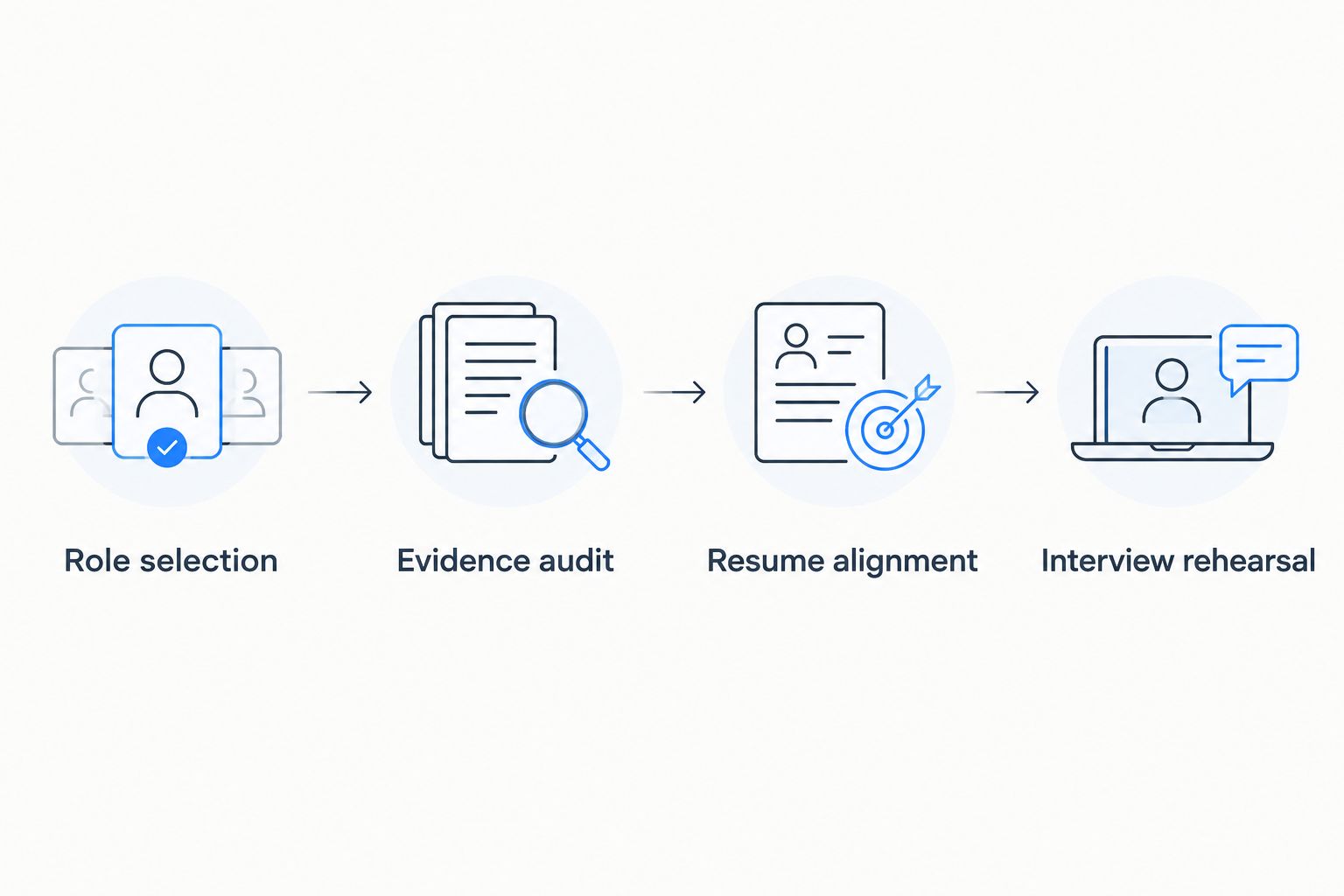
Use this sequence to keep your 2026 applications focused. The goal is not to claim competence in every quant discipline; it is to make your strongest evidence easy to evaluate.
- Role selection: Choose a primary role and an adjacent role supported by your existing work.
- Evidence audit: Match each important requirement to a project, research contribution, internship task, or demonstrated skill.
- Resume alignment: Put the most relevant evidence where a reader can find it quickly. State your contribution, method, and verified result.
- Interview rehearsal: Explain assumptions, alternatives, errors, and limitations without relying on prepared slogans.
QuantMinds offers resume review, interview preparation, and individual coaching for candidates targeting quantitative research, trading, and development. Coaching provides feedback on your preparation; it does not replace the technical evidence an employer asks you to demonstrate.
Get feedback on your quant applications
Explore resume review, interview preparation, and individual career coaching.
Which quantitative finance graduate job should you choose?
Choose quantitative analyst if your strongest evidence is applied mathematics and you want pricing-related work. Choose quant developer if it is engineering, or quant researcher if it is statistical investigation. Do not use the default recommendation to override a clear strength.
For 2026, a focused application is one where the role, resume, project discussion, and interview preparation tell the same story. If those components point in different directions, fix the mismatch before expanding your employer list.
FAQ
What's the best quantitative finance graduate job for a computer science major?
Quant developer is the strongest fit when your main evidence is software engineering. Compare each posting's language, systems, and testing requirements with work you can explain in detail.
What's the best entry-level quant role for a math graduate?
Quantitative analyst is a strong starting point for math graduates interested in financial modeling and pricing. Quant research is a better fit when your strongest evidence is statistical experimentation rather than pricing work.
Can I apply for quantitative finance graduate jobs without a finance degree?
Yes, when the posting accepts your degree and you meet its technical requirements. Demonstrate the mathematics, statistics, or engineering relevant to the role, then learn the financial context its responsibilities require.
Do I need a master's degree to become a quant researcher?
The requirement depends on the employer and position. Check the stated degree criteria rather than assuming that every quant researcher role either requires or accepts the same qualification.
Is quant development the same as quant research?
No. Quant development centers on software and systems, while quant research centers on hypotheses, methods, and evaluation; some positions combine responsibilities, so read the job description.
Are model validation jobs a direct route into trading?
Model validation and trading are different functions, so validation is not an automatic route into trading. Evaluate a validation position on the technical work it offers rather than an assumed future transfer.
What should I put on a graduate quant resume without an internship?
Use relevant research, projects, coursework applications, and engineering work that you can defend. Explain your own contribution and verified results rather than presenting a project title as proof of competence.
How can QuantMinds help with graduate quant applications?
QuantMinds provides resume review, interview preparation, and individual career coaching for candidates targeting quantitative research, trading, and development roles. Its founder previously served as executive director of the UC Berkeley MFE program.
One last thing
The word quant is less useful than the verbs in a job description. Build, research, execute, validate, and report describe different working days. Before you apply, underline those verbs and identify evidence that you can do the work they describe.
Choose the responsibilities you want, then pursue the title. That keeps your search grounded when similar titles conceal different jobs.