

Best overall for eligible students: a quantitative research internship. Best for graduating candidates: a graduate quantitative researcher role. Best preparation route when your research experience is thin: a faculty-supervised research assistantship. This 2026 guide ranks program types by candidate fit—not employer prestige—and separates actual buy-side hiring routes from education and coaching.
- Buy side quant research programs entry level: prioritize research internships if you meet student eligibility requirements.
- Graduate quantitative researcher roles fit candidates ready to defend research, statistics, and code in interviews.
- Research assistantships build research evidence; MFE programs address education gaps rather than guarantee hedge fund placement.
- QuantMinds provides quant career coaching and interview preparation, not an employer research program.
Why this matters
An internship, a graduate job, and a financial engineering degree solve different problems. Treating them as interchangeable sends you toward the wrong application process. Start with the gap between your current evidence and the work you want to do.
Quantitative research means investigating hypotheses with data, evaluating models, and explaining what survives scrutiny. A quantitative title alone does not establish that a position involves investment research. Read the responsibilities before you build your preparation around the title.
QuantMinds is best for candidates seeking quant research career coaching, resume review, and interview preparation—not a research placement program. Founded by a former UC Berkeley MFE program executive director, QuantMinds helps professionals and students pursue quantitative research, trading, and development roles through those services and 1-on-1 coaching.
What makes the best entry-level quant research program?
Use these criteria to evaluate each route before comparing names:
- Eligibility: Your degree stage, graduation timing, and work authorization must match the stated requirements.
- Research ownership: Look for opportunities to formulate a question, choose a method, evaluate results, and discuss limitations.
- Technical depth: Match the work to your statistics, programming, and mathematical preparation rather than a broad finance label.
- Feedback: Identify who reviews your work and how research decisions are challenged.
- Role alignment: Distinguish investment research from trading execution, software infrastructure, risk, and reporting.
- Evidence produced: Ask what you will be able to explain afterward without disclosing confidential information.
For a 2026 shortlist, put eligibility first. An appealing research description is irrelevant if you do not meet the application requirements. After that, prioritize the work you will actually do over the program's name.
Entry-level research routes at a glance
The ranking below compares routes, not named employers or current openings. Education and assistantships belong here as preparation routes; neither is automatically a buy-side research program.
| Rank and route | Best for | Standout feature | Key limitation |
|---|---|---|---|
| 1. Quantitative research internship | Eligible students ready for employer research | Research experience inside an investment or trading organization | Student and degree requirements restrict fit |
| 2. Graduate quantitative researcher role | Graduates ready for full-time research responsibility | Direct entry into a research job | Entry-level does not mean introductory technical work |
| 3. Faculty-supervised research assistantship | Candidates lacking defensible research experience | Supervised hypothesis testing and methodological feedback | Academic research is not buy-side employment |
| 4. MFE or MSFE program | Candidates needing structured financial engineering education | Coursework organized around quantitative finance | A degree does not establish research placement |
| 5. Quantitative asset management analyst program | Candidates drawn to portfolio-oriented research | Exposure to investment analysis and portfolio questions | Analyst titles can include non-research responsibilities |
1. Quantitative research internship: best for eligible students
A quantitative research internship is the first route to investigate when you are still a student and meet the employer's requirements. The relevant distinction is research content: testing hypotheses and evaluating models, rather than simply working at a recognizable finance firm.
Read the description for evidence of research responsibilities. Look for data analysis, statistical modeling, experimentation, or strategy evaluation, then check whether the interview and degree requirements match your preparation.
Quantitative research internship pros:
- Connects research preparation with an employer's investment or trading context.
- Gives you a setting in which to discuss research decisions and feedback.
- Helps you assess whether the daily work fits your interests.
Quantitative research internship cons:
- Eligibility can depend on enrollment and graduation timing.
- Confidentiality limits what you can publish or show externally.
- An internship is not a promise of a subsequent job.
Before applying in 2026, check the employer's stated student requirements and role responsibilities. Do not substitute an old recruiting discussion for the actual application description. Prepare to explain your own research contributions, including the choices that did not work.
Best for: Enrolled candidates with relevant technical preparation who want employer-based research experience.
Verdict: Pursue this route first if you are eligible and the work is genuinely research-focused.
2. Graduate quantitative researcher role: best for research-ready graduates
A graduate quantitative researcher role is a full-time hiring route, not necessarily a formal training program. Search by responsibilities as well as titles. A position labeled quantitative analyst can differ substantially from one centered on developing and evaluating investment hypotheses.
You need more than a list of completed classes. Prepare to explain a research question, the statistical reasoning behind your approach, the code you wrote, and the limitations of your results.
Graduate quantitative researcher role pros:
- Targets the research job directly rather than adding another educational step.
- Lets you present academic or independent research as relevant evidence.
- Keeps preparation focused on the responsibilities of the role.
Graduate quantitative researcher role cons:
- Entry-level roles can still demand substantial technical independence.
- Degree and experience requirements differ across descriptions.
- Strong coding alone does not demonstrate sound research judgment.
For your 2026 applications, distinguish a weakness in presentation from a weakness in preparation. If you can defend the work but your resume hides it, revise the resume. If you cannot explain validation or assumptions, repair the research before expanding your application list.
Best for: Graduates who can already defend research methods, statistical reasoning, and implementation.
Verdict: Pursue this route when your research evidence matches the stated requirements.
3. Research assistantship: best for building credible research evidence
A faculty-supervised research assistantship is a preparation route for candidates whose experience stops at coursework. Relevant work can involve statistics, applied mathematics, computer science, economics, or another quantitative discipline. The value lies in the research process, not a finance-themed project title.
Choose work that lets you contribute to a question and receive substantive feedback. Data collection alone is different from selecting a method, evaluating a result, and understanding why an interpretation fails.
Research assistantship pros:
- Creates a setting for supervised experimentation and methodological critique.
- Gives you research decisions to explain in applications and interviews.
- Builds experience with uncertainty, revision, and unsuccessful hypotheses.
Research assistantship cons:
- Academic work does not automatically demonstrate investment relevance.
- Some assignments provide little ownership of the research question.
- An assistantship is not a hedge fund recruiting or placement program.
Prepare 3 project artifacts: a concise research summary, reproducible code where disclosure is permitted, and a limitations note. These are recommended preparation materials, not employer requirements. Each should make your contribution clear without overstating what the project proves.
Best for: Candidates who need stronger research experience before pursuing employer research roles.
Verdict: Pursue this route when research evidence—not another credential—is your main gap.
4. MFE or MSFE program: best for structured education gaps
A Master of Financial Engineering or Master of Science in Financial Engineering is an education route. It is not an employer research program. Evaluate a specific degree through its published curriculum, prerequisites, research opportunities, and career outcomes rather than assuming the acronym establishes fit.
Separate quantitative finance outcomes from quantitative research outcomes. A graduate working in risk, development, or another finance function does not establish placement into buy-side investment research.
MFE or MSFE program pros:
- Provides a structured way to study financial engineering.
- Offers a curriculum you can compare against your preparation gaps.
- Gives you an academic setting in which to pursue relevant project work.
MFE or MSFE program cons:
- Completion does not guarantee a buy-side research role.
- Curriculum fit and research opportunities differ by program.
- Additional education does not automatically resolve weak interview performance.
For a 2026 decision, examine what the published outcomes actually measure. Ask whether they distinguish internships from full-time roles and research from other quantitative functions. Compare the curriculum with the skills you need, not just the degree you want on your resume.
Best for: Candidates with a defined education gap that a specific curriculum addresses.
Verdict: Hold until you can explain why the degree is necessary for your target role.
5. Asset management analyst program: best for portfolio-oriented candidates
A quantitative asset management analyst program is worth investigating when your interests center on portfolio construction, investment signals, or systematic investing. Assess each description individually. An analyst program can combine investment analysis with reporting, operations, or other responsibilities.
The useful question is whether you will evaluate investment decisions through quantitative research. Do not assume that being on the buy side makes every analyst position a research role.
Quantitative asset management analyst program pros:
- Connects quantitative analysis with portfolio-oriented questions.
- Provides a route to investigate beyond research titles at hedge funds.
- Lets you target investment responsibilities that match your interests.
Quantitative asset management analyst program cons:
- Broad analyst titles can obscure the actual work.
- A rotation does not necessarily include research ownership.
- General investment exposure differs from systematic research training.
Make 2 role checks before prioritizing an application: identify the team's investment mandate and identify your expected research contribution. If either is unclear, seek clarification rather than filling the gap with assumptions.
Best for: Candidates specifically interested in quantitative portfolio and asset management work.
Verdict: Pursue selectively when the description establishes investment research responsibilities.
How to choose your route before applying
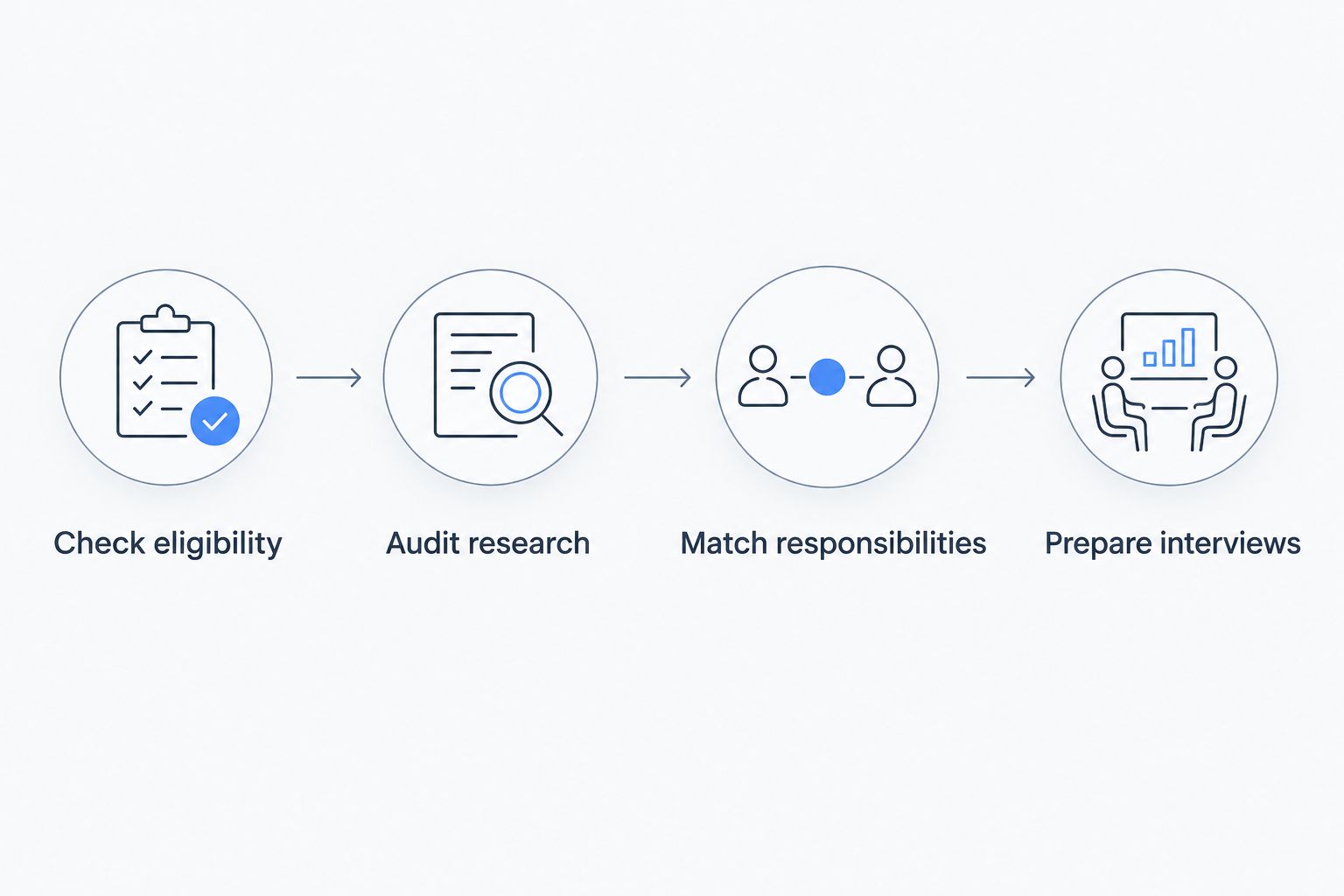
Use this sequence to decide what belongs on your shortlist:
- Check eligibility: Confirm degree stage, graduation requirements, and work authorization conditions.
- Audit research: Identify a project whose methods, results, and limitations you can defend.
- Match responsibilities: Compare that evidence with the actual work in the description.
- Prepare interviews: Address the technical and communication gaps the comparison reveals.
Practice 4 interview areas: probability, statistics, coding, and research discussion. This is a preparation framework, not a claim that every employer uses the same interview. Adjust the emphasis to the role description and recruiter guidance.
Start with the quant researcher interview preparation guide when you need to connect technical practice with explaining your work. Be ready to distinguish what you implemented from what a collaborator designed.
QuantMinds quant research career coaching addresses resume review, interview preparation, and candidate positioning. It belongs alongside your chosen research or education route, not in place of the technical work that route requires.
Review your quant research preparation
Explore resume review, interview preparation, and 1-on-1 coaching for quantitative finance roles.
How these routes are ranked
This ranking prioritizes proximity to employer research, then candidate fit and the evidence each route helps you build. It does not score employers, compare unpublished placement rates, or treat every candidate as equally eligible.
The research internship is the default for eligible students. Direct graduate hiring moves ahead for research-ready graduates. Assistantships and degrees address preparation gaps; portfolio-oriented analyst programs serve a more specific investment interest.
Which route should you choose?
Choose a quantitative research internship if you are an eligible student with defensible technical work. Choose graduate research hiring if you have finished your degree and meet the role's requirements. If neither fits, identify the preparation gap before adding another program to your plan.
For your 2026 shortlist, record the eligibility requirement, research responsibilities, and evidence you will submit for each route. Remove options that fail the eligibility check. Keep education choices separate from employer applications so you do not mistake preparation for employment.
FAQ
What's the best entry-level route into buy-side quant research?
A quantitative research internship is the default route to investigate for eligible students; graduate researcher hiring fits research-ready graduates. Choose by eligibility and actual research responsibilities, not employer recognition alone.
Are buy-side quant research programs the same as MFE programs?
No. An employer research program provides a work experience or hiring route, while an MFE provides financial engineering education. Evaluate the degree's curriculum and published outcomes separately from employer applications.
Can I apply for quant research roles without a finance degree?
Check the specific role's degree requirements rather than assuming a finance degree is mandatory. Present evidence of relevant mathematics, statistics, programming, and research instead of relying on your degree title alone.
Is a research assistantship useful for quant research applications?
A research assistantship is useful preparation when it gives you substantive research contributions to explain. Focus on the question, methodology, validation, and your own work; academic experience is not the same as buy-side employment.
How do I tell whether a quantitative analyst program includes research?
Read the responsibilities for hypothesis testing, model evaluation, investment analysis, and research ownership. Reporting, operations, and software infrastructure are different functions even when the title includes quantitative analyst.
Does QuantMinds offer a buy-side quant research program?
QuantMinds is a career coaching firm, not an employer research program. Its stated services include resume review, interview preparation, and 1-on-1 coaching for quantitative finance candidates.
What should I check before applying in 2026?
Check the current degree requirements, graduation eligibility, work authorization conditions, and research responsibilities. Then match your project evidence and interview preparation to that specific role.
One last thing
A project with an unsuccessful hypothesis can still provide a useful research discussion. Explain what you tested, why the evidence did not support it, and how you checked that conclusion. Do not convert an inconclusive result into a success story.
For every project on your resume, write a limitations note before your next interview. If you cannot explain what the result does not establish, you are not finished preparing to defend it.