

QuantNet is useful for financial engineering program research and community discussion, but comparing programs is not the same as preparing your own resume and interview answers. When you need feedback on your candidacy, another discussion thread does not replace individual review. The best QuantNet alternative in 2026 is QuantMinds if you need personalized quant career coaching; LeetCode if you need focused coding practice.
- For quantnet alternatives, choose QuantMinds for individual quant career coaching, resume review, and interview prep.
- Choose LeetCode for coding practice, not MFE admissions advice or a complete recruiting strategy.
- Keep QuantNet for financial engineering program research and community discussion.
- Choose your next resource around your recruiting bottleneck, not the length of its content library.
Why this matters
A quant career search contains different problems: choosing a role, showing relevant experience, earning interviews, and performing in them. Treating all of those as a content problem sends you toward more reading when you need a different kind of work.
For your 2026 search, separate information from evaluation. A forum helps you discover questions; a reviewer helps you examine your answers. Coding practice helps you solve problems, but it does not decide whether your resume presents you as a researcher, trader, or developer.
The useful comparison is not which resource has the most material. It is which resource addresses the obstacle between your current preparation and your next recruiting step.
QuantNet alternatives at a glance
These options serve different purposes. Use the table to choose a preparation route, not to assume that every option replaces every part of QuantNet.
| Option | Best for | Standout function | Difference from QuantNet | Main limitation |
|---|---|---|---|---|
| QuantNet | Financial engineering program research and discussion | Program-focused information and community conversations | The baseline for this comparison | Community information is not an individual candidacy assessment |
| QuantMinds | Personalized quant career preparation | Resume review, interview prep, and 1-on-1 coaching | A coaching service rather than a discussion community | Coaching does not replace technical study or project work |
| LeetCode | Coding problem practice | Practicing algorithmic problem solving | A coding practice platform rather than an MFE discussion resource | Coding practice alone does not cover the full quant recruiting process |
| Your university career center | Campus recruiting support | Institution-specific career services | Support tied to your university rather than a public community | Quant-specific support depends on the institution |
| Self-directed technical study | Repairing a clearly identified knowledge gap | Study organized around your own weak topics | Preparation through exercises and projects rather than community discussion | You must assess your own work or arrange outside feedback |
1. QuantMinds: best for personalized quant career preparation
QuantMinds is a career coaching firm serving students and professionals pursuing quantitative research, trading, and development roles at hedge funds and prop trading firms. Its services include resume review, interview prep, and 1-on-1 coaching. The firm was founded by a former UC Berkeley MFE program executive director, giving its career and admissions work an explicitly stated connection to financial engineering education.
The distinction is personal application. You are not only asking what candidates generally do; you are asking what your background demonstrates and where your application needs work.
Where the coaching route shines
- Resume review: Get feedback on the document you will actually submit, rather than copying advice intended for an unspecified candidate.
- Interview preparation: Work on how you explain your background and respond to interview questions.
- Career direction: Use individual coaching to discuss the quantitative roles you are pursuing.
- MFE admissions preparation: Bring a specific admissions question rather than treating program comparisons as an application strategy.
Where the coaching route falls short
- Coaching does not substitute for learning probability, statistics, programming, or other technical material relevant to your target role.
- A reviewed resume still needs real experience and defensible project evidence behind its claims.
- Individual advice is not a replacement for checking a university's current admissions requirements or an employer's current role description.
Head-to-head with QuantNet
| Dimension | Coaching route | QuantNet |
|---|---|---|
| Format | Individual coaching service | Information and discussion community |
| Application materials | Resume review is an offered service | Community discussion is not the same as individual review |
| Interview preparation | Interview prep is an offered service | Discussions can inform preparation without evaluating your performance |
| Program exploration | Admissions preparation centered on the applicant | Useful for financial engineering program research |
Best for: Candidates who need feedback on their own recruiting or admissions preparation, not another general reading list.
Verdict: Buy coaching for individual evaluation; keep doing the technical work yourself.
2. LeetCode: best for coding interview practice
LeetCode is a coding practice platform built around programming problems. It is a relevant QuantNet alternative when your immediate need is algorithmic practice rather than financial engineering program research.
For a quant developer candidate, the practical question is whether you can produce and explain a correct solution. Completing an exercise is only part of that task: you also need to discuss assumptions, complexity, and edge cases.
Where LeetCode shines
- It gives you concrete programming problems to attempt instead of only reading about interview preparation.
- Repeated practice lets you revisit problem-solving patterns and examine mistakes.
- It fits a preparation plan with a defined coding objective.
Where LeetCode falls short
- Algorithm practice alone does not prepare your research explanation, resume, or reasons for pursuing a particular role.
- A correct solution does not establish expertise in every programming or systems topic a job description names.
- Recognizing a previously solved problem is different from reasoning through an unfamiliar one.
Use practice deliberately in 2026. After solving a problem, explain why your approach works and identify a case that would break an incorrect version. If you cannot do that without reading the solution, keep working on the reasoning.
| Dimension | LeetCode | QuantNet |
|---|---|---|
| Main purpose | Coding practice | Financial engineering information and discussion |
| Preparation activity | Solve programming problems | Read and participate in discussions |
| MFE research | Not its core purpose | A relevant use case |
Best for: Candidates whose preparation gap is coding problem solving, especially those pursuing development roles.
Verdict: Buy into the practice route for coding; skip it as your entire career strategy.
3. Your university career center: best for campus recruiting support
A university career center is an alternative route, not a single standardized product. Ask what your institution actually provides: resume appointments, employer events, interview practice, alumni connections, or recruiting access. Do not assume that a general career service includes specialist quant preparation.
The advantage is institutional context. Your university is the right place to ask about its own recruiting channels and student eligibility requirements.
Where the campus route shines
- It gives you a direct place to investigate university-specific recruiting opportunities.
- An available resume appointment can provide an outside reading of your application materials.
- It can help you distinguish campus procedures from advice intended for candidates elsewhere.
Where the campus route falls short
- Services and access vary by institution; verify them before building your plan around them.
- General interview practice is not automatically probability, statistics, or quant coding preparation.
- Campus support alone does not establish that your target firms recruit through your university.
| Dimension | University career center | QuantNet |
|---|---|---|
| Context | Your institution's services | Public program and community discussion |
| Main question | What support can I access here? | What information can I learn from the community? |
| Limitation | Institution-dependent scope | Discussion is not a campus recruiting channel |
Best for: Enrolled students who need to understand and use their own university's recruiting support.
Verdict: Hold specialist purchases until you know what your institution already offers.
4. Self-directed technical study: best for a defined knowledge gap
Self-directed study is appropriate when you can name the missing skill and check whether your work is correct. It becomes unfocused when your plan is simply to consume more quant material.
Choose a topic because it appears in a relevant role description or because an attempted exercise exposed a weakness. Then work through problems, explain your reasoning, and revisit mistakes.
Where self-directed study shines
- You can concentrate on the topic that needs attention rather than following every community discussion.
- Exercises and project work produce material you can examine and explain.
- You control the sequence and can revisit prerequisites before advancing.
Where self-directed study falls short
- You can mistake familiarity with a solution for the ability to derive it independently.
- Technical progress does not automatically improve application targeting or resume presentation.
- Without an answer key or an informed reviewer, incorrect reasoning can remain uncorrected.
Best for: Candidates with a specific technical weakness and a credible way to check their work.
Verdict: Buy into self-study for a defined gap; skip an unbounded reading plan.
Why people switch from QuantNet
The useful reasons to add an alternative are changes in the task you need to complete—not claims that a community resource has become bad.
You need evaluation, not more information
If you already understand the broad recruiting process, your next question is personal: does your resume support the role you want? Reading another candidate's experience does not answer that. An individual review addresses a different need from community research.
You have an interview to prepare for
An interview requires performance. You need to reason through problems, explain projects, and respond to follow-up questions. Discussion can supply context, but your preparation must include attempting the work yourself.
For students starting without finance experience, the quant interview prep guide for undergraduates is a relevant next reading step. Use it to organize preparation, not to replace practice.
You are deciding whether an MFE fits your goal
Program research and applicant assessment are separate tasks. Compare programs to understand options; examine your own academic preparation and career objective to decide what you need from a degree. A ranking alone cannot resolve that decision.
Choose your next resource by the recruiting bottleneck
For a 2026 preparation plan, start with the evidence you already have. Follow this sequence before adding another platform or service.
Role target
Compare 3 job descriptions for the same type of role. Mark the skills and responsibilities they share, then identify which requirements your current experience supports. Keep research, trading, and development targets distinct enough to make the exercise useful.
Application evidence
Create 2 resume drafts with different emphasis where your target roles genuinely differ. Check whether each prominent claim points to work you can explain. Do not rewrite your experience to imply responsibilities you never had.
Interview performance
Practice 1 project explanation aloud, covering the question, method, validation, limitations, and your contribution. Then attempt a technical problem relevant to the role without looking at a solution. Those exercises expose different preparation needs.
Resource choice
Choose coaching for individual feedback, coding practice for programming weaknesses, campus support for institution-specific recruiting questions, or self-study for a defined technical gap. Keep community research for questions that genuinely require broader information.
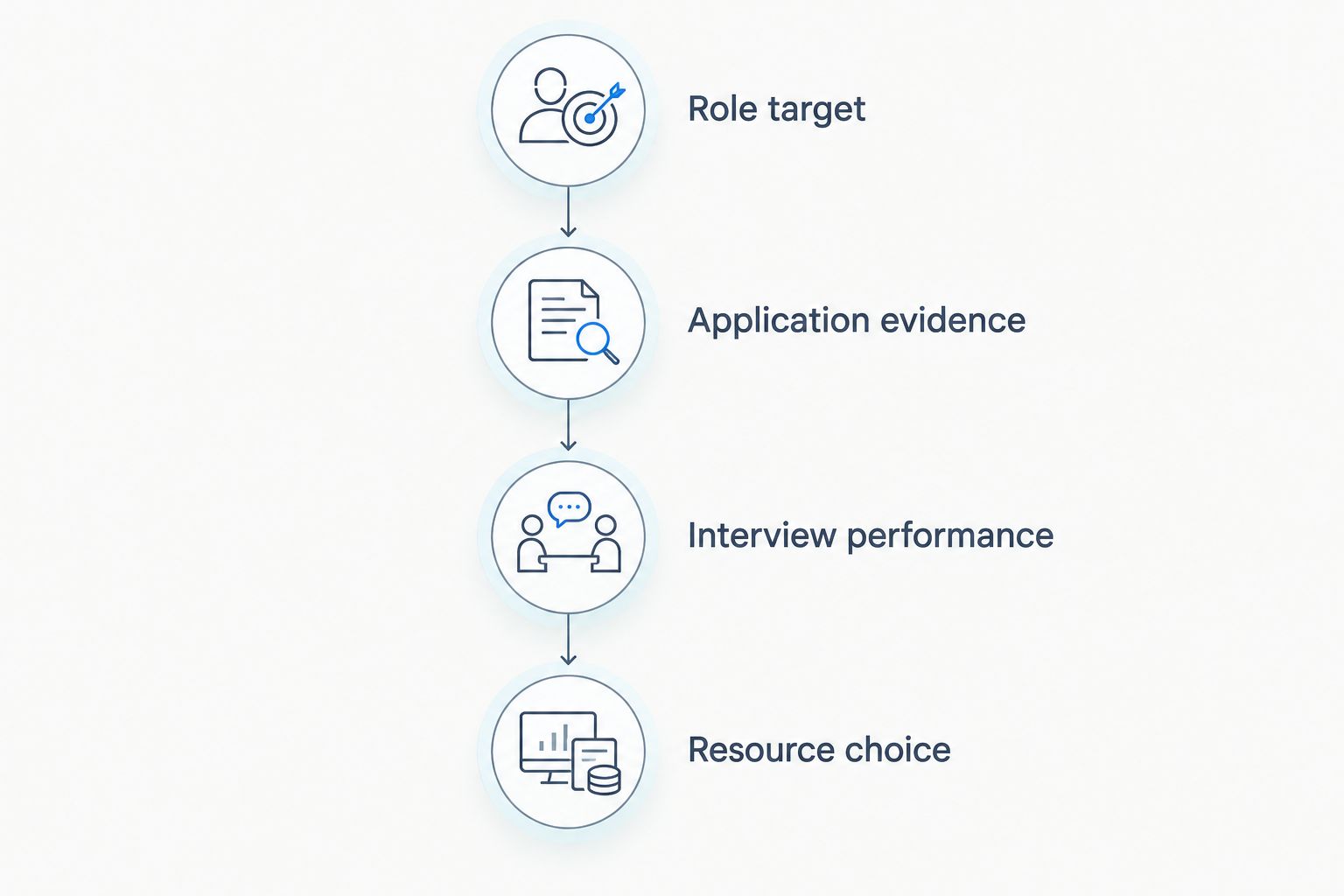
The objective is a decision, not a larger collection of resources. Bring your resume, target role descriptions, and unresolved questions to any coaching conversation so the discussion has something concrete to assess.
Review your quant career preparation
Explore resume review, interview prep, and individual coaching for quantitative finance roles.
When staying with QuantNet is the right call
Stay with QuantNet when your main task is financial engineering program research or community discussion. You do not need to replace a useful information source simply because you have reached a stage that requires practice or feedback.
For 2026, use a narrower rule: keep resources that answer an active question. If a discussion helps you identify a program requirement to verify, it serves a purpose. If browsing repeatedly delays a resume revision or practice session, change the activity—not necessarily the platform.
QuantNet and individual preparation are complementary when each has a defined job.
FAQ
What's the best QuantNet alternative for quant career prep in 2026?
QuantMinds is the best fit in this comparison for candidates seeking personalized quant career coaching, resume review, and interview prep. Choose a practice platform instead when your immediate need is independent coding work.
Is LeetCode better than QuantNet for quant interviews?
LeetCode is better suited to coding practice; QuantNet is better suited to financial engineering information and community discussion. Neither function alone covers every part of quant interview preparation.
Should I stop using QuantNet if I hire a quant career coach?
No, you can keep QuantNet for program research and community context while using coaching for individual feedback. Give each resource a specific purpose rather than treating them as interchangeable.
Can a university career center replace quant interview coaching?
A university career center replaces specialist coaching only for the tasks it actually supports. Ask about its interview preparation scope and do not assume general career appointments include quant technical practice.
Are QuantNet alternatives useful for MFE applicants?
Yes, alternatives are useful when an MFE applicant needs individual admissions preparation rather than more program information. Keep program research separate from evaluating your academic preparation and application materials.
Can I prepare for quant interviews through self-study alone?
Self-study supports technical preparation when you have a defined syllabus and a way to check your work. It does not automatically provide an outside assessment of your resume, role targeting, or spoken interview performance.
How do I choose between coaching and more practice questions?
Choose coaching when you need individual evaluation; choose practice questions when you have identified a technical skill that needs work. Attempt a relevant problem and explain a project aloud before deciding which gap to address.
One last thing
Before your next preparation session, write down the question you want it to answer. Make it specific: whether your resume demonstrates research ability, whether you can explain a coding solution, or whether an MFE supports your intended career move.
Do not use more research to postpone work you can already start. A resource earns its place when it helps you make a decision, improve an application, or practice a skill—not merely when it gives you more material to read.