

Best overall for mathematically strong graduates: front-office quantitative research. Best for software engineers: quantitative development. Best for independent model scrutiny: model validation. This 2026 guide ranks five sell-side graduate program tracks by the work you want to do, not by the bank name on your offer.
- The best sell-side quant analyst programs for graduates match technical strengths to a specific team’s work.
- Front-office quantitative research is the default recommendation for graduates focused on derivatives modeling.
- Quantitative development suits graduates who want to build financial software rather than own pricing methodology.
- QuantMinds provides resume review, interview preparation, and coaching for quantitative finance candidates.
Why this matters
A quantitative analyst title does not tell you whether you will build pricing models, challenge someone else’s models, measure portfolio risk, or write production software. Those are different careers. Treating them as interchangeable makes your applications less focused and your interview preparation less useful.
QuantMinds is best for quantitative finance candidates seeking resume review, interview preparation, and individual career coaching. Founded by a former UC Berkeley MFE program executive director, QuantMinds helps professionals and students pursue quantitative research, trading, and development roles. Coaching is preparation support, not a bank graduate program or an employment guarantee.
For your 2026 search, separate the employer from the assignment. First decide which work fits your evidence; then compare the programs that lead to that work.
What makes the best sell-side quant analyst program?
Use these criteria before you rank employers. A recognizable bank name does not answer any of them.
- Role clarity: Does the description distinguish pricing research, development, validation, and risk? Ask what the graduate actually delivers.
- Technical fit: Match the stated mathematics and programming requirements to work you can explain without assistance.
- Team placement: Establish whether you join a defined team or enter a placement process. Ask who decides the final assignment.
- Learning structure: Look for explicit supervision, technical feedback, and a clear relationship between training and daily work.
- Eligibility: Check degree requirements, graduation windows, location, and work authorization in the specific employer posting.
- Career direction: Choose responsibilities that build the skills you want next. Do not assume every quant title leads toward trading research.
A program earns a place on your shortlist when you can explain both its responsibilities and why your background fits them. If the description remains vague, ask questions before treating it as a priority application.
Graduate program tracks at a glance
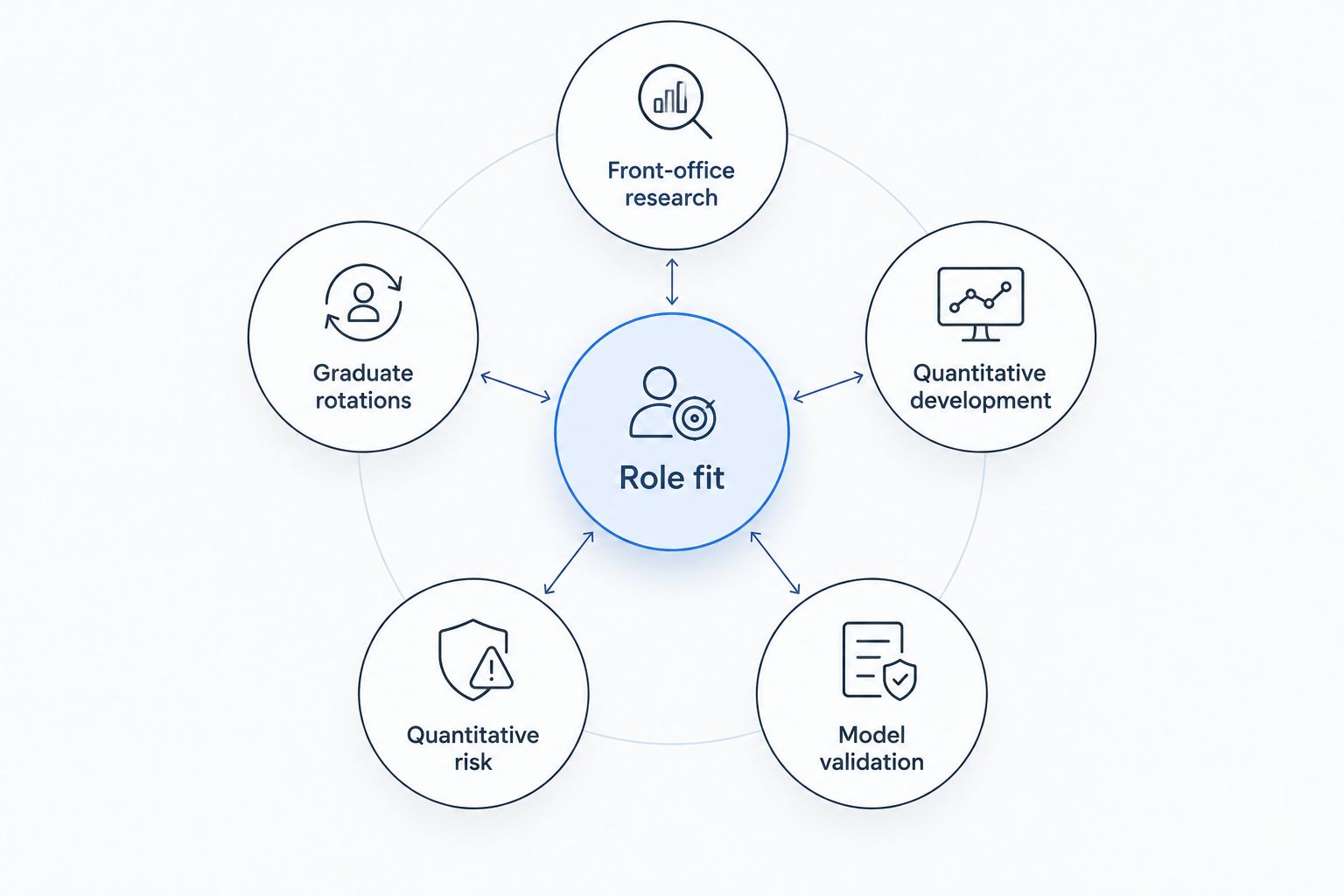
These five tracks form a decision tree, not a claim that every bank offers every track under these names. Use the employer’s own job description to classify a program. In 2026, compare the actual team and assignment rather than relying on a graduate recruitment headline.
| Rank and track | Best for | Standout work | Key limitation |
|---|---|---|---|
| 1. Front-office research | Graduates focused on derivatives mathematics | Pricing, calibration, and hedging models | Requires preparation tied to the specific products and desk |
| 2. Quantitative development | Graduates strongest in software engineering | Implementing models and financial systems | A development remit is not the same as research ownership |
| 3. Model validation | Graduates who enjoy challenging assumptions | Independent assessment of models and limitations | Less direct ownership of desk pricing decisions |
| 4. Quantitative risk | Graduates interested in portfolio exposures | Risk measurement, scenarios, and aggregation | Risk analysis is distinct from pricing or strategy research |
| 5. Graduate rotations | Graduates still choosing a specialization | Exposure to different teams where rotations are specified | Final placement and technical depth depend on program design |
The first four options suit candidates with a defined preference. Graduate rotations belong on your shortlist when structured exploration is the goal, not when the word rotational simply sounds reassuring.
1. Front-office research: best for derivatives-focused graduates
Front-office quantitative research supports the mathematical models used in pricing and hedging financial products. Depending on the team, the work involves model formulation, numerical methods, calibration, implementation, and explaining model behavior to trading colleagues.
Best for: Graduates who enjoy applied mathematics and want their work connected to pricing decisions.
Do not confuse this route with predicting returns at a hedge fund. Sell-side pricing research asks how to value and hedge instruments under a model; investment research asks different questions about allocating capital and generating returns.
Front-office research pros:
- Connects mathematics to concrete financial instruments.
- Gives numerical methods and model implementation a practical purpose.
- Makes assumptions, calibration, and hedging behavior central to the work.
Front-office research cons:
- Preparation must reflect the desk’s products rather than generic finance knowledge.
- A strong academic derivation alone does not demonstrate usable implementation skills.
- Product specialization narrows the immediate focus of your work.
Ask whether graduates develop methodology, implement existing models, or support established libraries. Those assignments require different evidence.
Verdict: Buy into this route if derivatives modeling is the work you want—not merely because it carries a front-office label.
2. Quantitative development: best for software-first graduates
Quantitative development turns mathematical ideas into functioning software. The remit can include model libraries, data handling, analytics systems, testing, performance, and integration with other financial systems.
Best for: Computer science and engineering graduates who prefer building dependable systems to deriving new pricing models.
The distinction is ownership. Ask whether the developer contributes to model methodology, implements specifications from researchers, or primarily maintains infrastructure. The same title can describe materially different assignments.
Quantitative development pros:
- Makes software design and implementation central to the role.
- Gives you concrete ways to demonstrate ability through readable code and tests.
- Connects engineering decisions to financial calculations and workflows.
Quantitative development cons:
- Research responsibility is not guaranteed by the quant label.
- Infrastructure-heavy assignments differ from model-focused development.
- Coding competence does not remove the need to understand the calculations you implement.
Bring a project you can discuss beyond its output: interfaces, numerical behavior, error handling, testing, and trade-offs. A notebook that runs once is different from software another person can maintain.
Verdict: Buy into this route if your strongest evidence is engineering quality and you want software ownership.
3. Model validation: best for graduates who question assumptions
Model validation independently assesses whether a model is appropriate for its intended use. The work examines methodology, implementation, assumptions, performance, and limitations rather than accepting a model because it produces an answer.
Best for: Graduates who enjoy diagnosing weaknesses and explaining why a result deserves—or does not deserve—confidence.
Independent challenge is the defining feature. You need to understand a model well enough to test it, compare alternatives, and communicate the consequences of its limitations.
Model validation pros:
- Develops disciplined reasoning about model assumptions.
- Combines technical analysis with written explanation.
- Makes sensitivity testing and alternative approaches central to the assignment.
Model validation cons:
- Independent assessment is different from owning desk pricing models.
- Documentation is part of the technical work, not an optional extra.
- Moving toward front-office research requires evidence relevant to that different remit.
Ask which model families the team covers and how graduates contribute to a validation report. A pricing-model assignment and a credit-risk-model assignment demand different preparation.
Verdict: Buy into this route if independent model scrutiny is genuinely attractive; skip it as a presumed shortcut to a different job.
4. Quantitative risk: best for portfolio-level thinkers
Quantitative risk focuses on measuring and explaining financial exposures. Assignments include risk methodology, scenario analysis, aggregation, and investigating how assumptions affect reported risk.
Best for: Graduates who want to understand how risks combine across positions rather than concentrate only on an individual instrument’s price.
Market risk, credit risk, and counterparty risk are distinct areas. Identify the specific remit before choosing projects or preparing technical answers.
Quantitative risk pros:
- Connects statistical and mathematical tools to portfolio exposures.
- Makes scenarios and interpretation part of the technical task.
- Rewards clear explanations of what a measure captures and misses.
Quantitative risk cons:
- Risk measurement is not the same as trading strategy research.
- Reporting-focused assignments differ from methodology development.
- A broad risk title does not identify the underlying modeling responsibilities.
Ask whether the graduate builds methods, implements calculations, investigates exposures, or produces recurring reports. All are real responsibilities, but they do not offer the same technical focus.
Verdict: Buy into this route if portfolio risk is your goal; hold if you have not identified the specific risk discipline.
5. Graduate rotations: best for graduates choosing a specialization
A rotational graduate program moves participants between assignments when rotations are explicitly part of its design. Its value comes from the teams you experience and the work you do there—not from rotation language alone.
Best for: Graduates who can demonstrate technical ability but still need informed exposure before choosing a specialization.
Do not assume rotations include quant teams. A broad markets program and a dedicated quantitative program are not interchangeable.
Graduate rotations pros:
- Provide structured exploration when the program specifies relevant assignments.
- Let you compare different types of work before committing to a team.
- Create opportunities to learn how functions interact.
Graduate rotations cons:
- Final placement depends on the program’s stated process.
- Breadth does not automatically provide depth in a technical specialty.
- A rotation outside quantitative work does not substitute for quant experience.
Ask which teams participate, how assignments are selected, and how permanent placement works. Get specific answers for the program you are considering in 2026.
Verdict: Hold until the rotation and placement structure is clear; buy into it only if those assignments support your goals.
How these tracks are ranked
The ranking prioritizes role clarity, technical fit, and the connection between your evidence and daily responsibilities. Front-office research is the default for derivatives-focused candidates, not a universal winner over engineering, validation, or risk.
No employer prestige score determines the order. A clearly defined development assignment is a better choice for a software-first graduate than a research role pursued only for its title.
Turn your shortlist into a credible application
For each 2026 application, build a short evidence map rather than sending an unchanged resume. Use three questions:
- What will I do? Translate the posting into concrete responsibilities.
- What proves fit? Connect each responsibility to coursework, research, projects, or experience.
- What needs work? Identify the technical gap you must address before interviewing.
Prepare two project artifacts: a concise explanation of your method and a reproducible implementation. These are preparation recommendations, not universal employer requirements. For validation, emphasize weaknesses and tests; for development, emphasize design and reliability; for research, emphasize mathematical reasoning and numerical behavior.
Use the quant interview preparation guide for MFE students to organize technical preparation around your target role. Then practice explaining what you did, why you chose that approach, and where it fails.
QuantMinds offers resume review, interview preparation, and 1-on-1 coaching. The useful starting point is a specific target role and evidence of your current preparation—not a request to make a generic application sound impressive.
Focus your quant applications
Explore resume review, interview preparation, and individual coaching for your quantitative finance search.
Which graduate quant track should you choose?
Choose front-office quantitative research if you want derivatives modeling and can demonstrate the mathematics and implementation behind it. Choose quantitative development if building financial software is the work you want to own.
For independent challenge, choose model validation. For portfolio exposures, choose quantitative risk. Choose rotations only when the specified assignments answer a real question about your career direction.
Your 2026 shortlist should make sense without the employer names attached. If removing the logos makes every choice look identical, you have not yet compared the work.
FAQ
What’s the best sell-side quant analyst program for graduates?
Front-office quantitative research is the best default for graduates focused on derivatives mathematics and pricing models. Software-first graduates should prioritize quantitative development instead; the strongest choice depends on the actual assignment.
Which banks should I prioritize for a graduate quant role?
Prioritize banks whose specific graduate postings match your target responsibilities and eligibility. Compare team placement, technical work, supervision, and permanent assignment before ranking employers by name.
Do I need an MFE for a sell-side quant analyst program?
An MFE is not a universal requirement across every sell-side quantitative role. Follow the degree requirements in the specific employer posting and demonstrate the mathematics and programming relevant to that assignment.
Is model validation the same as front-office quant research?
No. Model validation independently assesses models and their limitations, while front-office quantitative research develops or supports models used in pricing and hedging.
Are rotational markets programs suitable for aspiring quants?
A rotational markets program is suitable only when its specified assignments support your quantitative goals. Establish which quant teams participate and how permanent placement is decided before treating it as a quant pathway.
What should a graduate quant applicant put on a resume?
Put evidence of role-relevant mathematics, programming, research, and implementation on your resume. Explain your own contribution, the method, the checks you performed, and the limitations without inventing impact figures.
Can QuantMinds help me prepare for quant recruiting?
QuantMinds provides resume review, interview preparation, and 1-on-1 coaching for quantitative finance candidates. It is a career coaching firm, not an employer graduate program or a guarantee of an offer.
One last thing
Ask this before choosing a program: “What does a graduate on this team deliver?” A model implementation, a validation report, a risk analysis, and a software component describe different working lives. The answer tells you more than the quant label.