

Answer Bayesian probability questions in a quant interview by stating the hypotheses, identifying the prior probabilities, writing the likelihood of the observed evidence, and normalizing to obtain the posterior. Explain your assumptions before calculating: an answer changes when the sampling process, independence assumptions, or prior changes.
- Bayesian probability questions quant interview prep starts with hypotheses, priors, likelihoods, and a clearly defined observation.
- Bayes’ theorem updates probabilities; it does not justify an unsupported prior or independence assumption.
- Use posterior odds for repeated evidence and a probability tree when the sampling process is unclear.
- QuantMinds provides quant interview preparation and one-on-one career coaching for candidates targeting quantitative roles.
Why this matters
A correct fraction is not a complete explanation. You need to show why the evidence favors one hypothesis and what information you conditioned on.
For your 2026 preparation, separate calculation errors from modeling errors. Arithmetic practice addresses the former; explicitly defining events addresses the latter. The broader guide to probability brain teasers in quant interviews covers the surrounding problem-solving skills.
State the experiment before you state the answer. A randomly observed outcome and a selectively reported outcome are not interchangeable evidence.
How do you answer Bayesian probability questions in a quant interview?
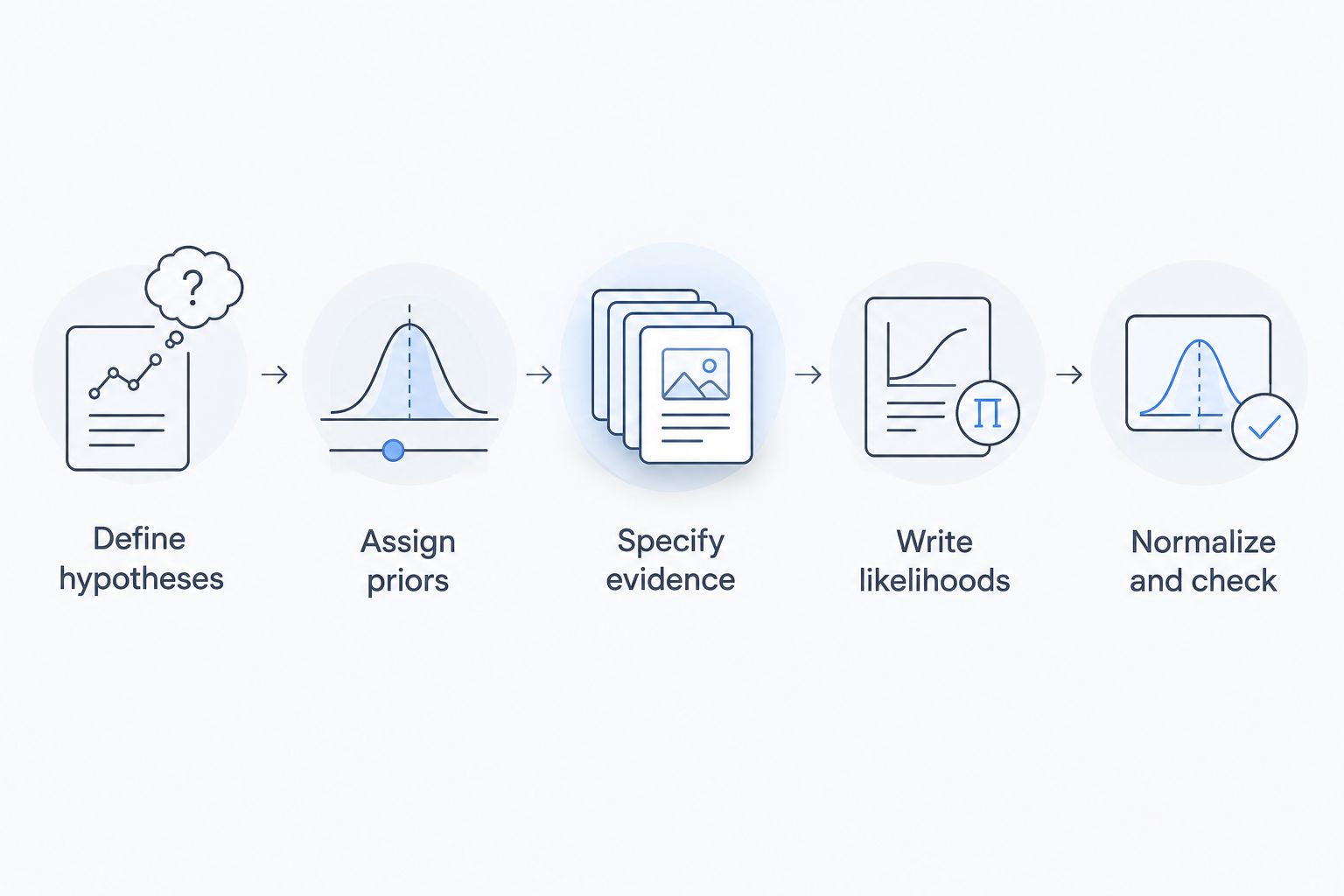
Use the following sequence. Keep the notation simple enough to explain aloud, and connect every symbol to something in the question.
- Define hypotheses. List the possible explanations for the observation. Check that they are mutually exclusive and collectively exhaustive before treating them as a complete partition.
- Assign priors. Write P(H) for each hypothesis before incorporating the new evidence. Use the selection mechanism in the question, not an automatic equal-probability assumption.
- Specify evidence. Write exactly what you observed. Distinguish an ordered sequence from a count, and an observation from a report selected by another person.
- Write likelihoods. Calculate P(E|H): the probability of that evidence if each hypothesis were true. State any conditional independence assumption.
- Normalize and check. Multiply each prior by its likelihood, then divide by the sum of those products. Verify that the posterior probabilities sum to one.
This sequence works without guessing which familiar puzzle the interviewer has adapted. It also gives you a clear place to restart when the question changes.
Write Bayes’ theorem in an explainable form
For a hypothesis H and evidence E with positive probability:
P(H|E) = P(E|H)P(H) / P(E).
If H and its complement cover all possibilities, expand the denominator:
P(E) = P(E|H)P(H) + P(E|not H)P(not H).
The numerator is the joint probability of your hypothesis and the observation. The denominator includes every modeled route to that observation. Forgetting the alternative route is the central mistake to avoid.
Fair versus two-headed coin: posterior probability 2/3
Consider the standard textbook experiment: select either a fair coin or a two-headed coin with equal probability, flip the selected coin once, and observe a head. What is the probability that you selected the two-headed coin?
Define T as the two-headed coin and F as the fair coin. The priors are P(T) = P(F) = 1/2; the likelihoods are P(head|T) = 1 and P(head|F) = 1/2.
| Hypothesis | Prior | Likelihood of a head | Unnormalized weight | Posterior |
|---|---|---|---|---|
| Two-headed coin | 1/2 | 1 | 1/2 | 2/3 |
| Fair coin | 1/2 | 1/2 | 1/4 | 1/3 |
The total probability of a head is 3/4. Therefore, P(T|head) = (1/2)/(3/4) = 2/3, or approximately 66.7%.
Explain the direction before the fraction: a head is more likely under the two-headed hypothesis, so observing one increases its probability. The posterior is not certainty because a fair coin also produces heads.
The equal prior belongs to this experiment. If the coin-selection probabilities change, the answer changes even though the likelihoods stay the same.
Repeated heads: posterior probability 4/5
Keep the same selected coin and observe two consecutive heads. Assume the flips are independent conditional on the coin type.
The likelihood of two heads is 1 under the two-headed hypothesis and 1/4 under the fair-coin hypothesis. Multiplying by the equal priors gives weights of 1/2 and 1/8, so the two-headed posterior is 4/5, or 80%.
For n consecutive heads under this same experiment:
P(T|n heads) = 2^n / (2^n + 1).
You can also update sequentially. Start the next update with the previous posterior, then multiply by the likelihood of the next observation. Do not reset to the original prior after each head.
The independence qualification matters. Conditional on a fixed coin type, the flips are independent; after averaging over the unknown coin type, observing a head changes your prediction for the next flip.
Conditional independence does not imply unconditional independence. Explain that distinction if the interviewer asks why successive observations provide information about the same hidden cause.
Positive signals: keep the base rate in the calculation
A signal-detection question uses the same structure as the coin problem. Define H as the event you want to detect and E as a positive signal.
Let p be the base rate, s the sensitivity, and f the false-positive probability. Then:
P(H|E) = sp / [sp + f(1 − p)].
The denominator contains true positives and false positives. Reporting sensitivity alone answers the wrong conditional probability: P(E|H), not P(H|E).
For a trading-flavored question, define the event carefully. A signal predicting a positive return, a profitable trade after costs, and an unusually large price move are different targets. Do not switch between them midway through the calculation.
For your 2026 practice, translate the story into events before adding finance terminology. Bayes’ theorem stays the same; the event definitions and evidence model do the work.
Which Bayesian calculation method should you use?
Use direct normalization as your default. Switch methods when another representation makes the evidence or arithmetic easier to explain.
| Method | Best for | Advantage | Limitation |
|---|---|---|---|
| Direct normalization | A small set of explicit hypotheses | Shows every contribution to the denominator | Becomes cumbersome with many branches |
| Posterior odds | Repeated evidence between two hypotheses | Turns updates into likelihood-ratio multiplication | Requires careful handling of evidence dependence |
| Probability tree | Sequential sampling and reporting rules | Makes the observation process visible | Expands quickly as branches multiply |
For two hypotheses, posterior odds equal prior odds multiplied by the likelihood ratio. In the coin example, each additional head multiplies the odds in favor of the two-headed coin by two.
A tree is better when someone selects what to reveal. Label the branch probabilities and identify which paths remain compatible with the reported evidence before summing anything.
Do not use a shortcut solely because it is shorter. Choose the representation that makes your assumptions easiest to inspect.
Why Bayesian probability answers vary
Bayesian answers change when the model changes. Check these factors before defending a result:
- Prior probabilities. Equal labels do not establish equal selection probabilities. A random selection from an uneven collection produces uneven priors.
- Sampling mechanism. Sampling with replacement and without replacement create different likelihoods for later observations.
- Reporting rule. Hearing that an outcome occurred is different from observing a randomly selected outcome when a reporter chooses what to disclose.
- Evidence dependence. Multiplying marginal likelihoods is invalid when observations are dependent within a hypothesis.
- Hypothesis coverage. Omitting a possible explanation distorts the normalization and therefore the posterior.
- Event definition. An exact sequence and a count of outcomes are different events, even when some factors cancel in a particular posterior calculation.
When a detail is ambiguous, ask a focused question. For example, clarify whether the same coin is retained between flips rather than silently choosing whichever interpretation makes the calculation familiar.
How do you explain a Bayesian answer without sounding rehearsed?
Explain the model, calculate, then interpret. Start with the target probability and the observation; next identify the likelihoods; finish by saying why the posterior moved in the direction it did.
Avoid narrating every arithmetic operation. Spend your explanation on the denominator, independence, and selection mechanism, because those establish whether the arithmetic answers the question asked.
If you make a mistake, identify its type. Reversing a conditional probability requires rebuilding the model; reducing a fraction incorrectly requires correcting the calculation. Treating both as vague carelessness makes practice less useful.
What should you practice for a 2026 quant interview?
Build your 2026 practice around variations rather than memorized final answers. For each solved problem, change a prior, alter the reporting rule, or add another observation, then explain which part of the solution changes.
Keep a short error log with separate entries for event definitions, priors, likelihoods, dependence, normalization, and arithmetic. Rework the original question without looking at the answer before attempting a variation.
When coaching fits
QuantMinds is best for candidates seeking quant interview preparation alongside one-on-one career coaching. The firm was founded by a former UC Berkeley MFE program executive director and supports candidates targeting quantitative research, trading, and development roles.
Use QuantMinds when you want coaching within that broader recruiting context. Coaching does not replace learning probability fundamentals or completing independent practice; bring attempted solutions and specific points of confusion rather than only a list of topics.
Discuss your QuantMinds interview preparation
Explore quant interview preparation and one-on-one career coaching.
FAQ
How do I start answering a Bayesian probability interview question?
Start by defining the hypothesis you want to evaluate and the evidence you observed. State the priors and likelihoods before substituting into Bayes’ theorem.
What is the difference between a prior and a posterior probability?
A prior describes uncertainty before incorporating the specified evidence; a posterior describes uncertainty after that update. A posterior becomes the prior for a subsequent update when new evidence arrives.
Why is the two-headed coin probability 2/3 after one head?
The posterior is 2/3 because equally likely fair and two-headed coins produce a head with likelihoods of 1/2 and 1, respectively. Normalize the resulting weights of 1/4 and 1/2 to obtain the posterior probabilities.
What happens after two consecutive heads with the same coin?
The two-headed coin posterior is 4/5 when the original selection was equally likely and flips are independent conditional on coin type. The fair coin produces two heads with probability 1/4, while the two-headed coin does so with probability 1.
Can I assume the hypotheses are equally likely?
Assume equal priors only when the problem’s selection mechanism justifies them. If the mechanism is unclear, ask for clarification or state explicitly that your result depends on that assumption.
Is posterior odds better than using Bayes’ theorem directly?
Posterior odds is a convenient form of Bayes’ theorem for comparing two hypotheses, especially with repeated evidence. Direct normalization is clearer when you need to display several competing explanations.
How should I prepare for Bayesian interview questions in 2026?
Prepare for Bayesian interview questions in 2026 by solving problems aloud and then changing their assumptions. Check whether you can explain the sampling mechanism, denominator, and dependence structure without relying on a memorized answer.
One last thing
Your answer should survive a change in the story. Replace coins with hidden market regimes and heads with observed signals: the same calculation applies only if the new story preserves the priors and likelihoods.
For your final 2026 rehearsal, remove the familiar labels from a solved problem. If you can reconstruct the model without recognizing the puzzle, you understand the update.