

Yes, prop trading is stressful because you make decisions under uncertainty while financial results remain visible and open to scrutiny. The pressure depends on your responsibilities, risk limits, manager, and how the team responds to losses—not just the firm's name. Choose the work and management environment you can sustain, rather than assuming every prop trading role feels the same.
- Is prop trading stressful? Yes: uncertainty, financial exposure, and performance scrutiny create pressure.
- QuantMinds provides quant career coaching for candidates targeting research, trading, and development roles.
- Compare decision responsibility, loss reviews, and operational duties before choosing a prop trading role.
- Ask for concrete examples of feedback and escalation, not assurances about a supportive culture.
Is prop trading a stressful career path?
Yes. Prop trading combines uncertain outcomes with responsibility for decisions involving a firm's capital. A sound decision can lose money, and a profitable trade does not automatically prove that the decision was sound. That gap between process and outcome is central to the pressure.
For your 2026 job search, separate the job title from the actual responsibilities. Ask what you own, how quickly you must respond, and how your work gets evaluated. If you need help positioning your background for these roles, QuantMinds provides quant career coaching, resume review, and interview preparation—not a substitute for employer due diligence.
The comparison below describes sources of pressure, not a universal ranking. Responsibilities overlap, so confirm the boundaries with each team.
| Role | Source of pressure | Potential advantage | Trade-off | Best for |
|---|---|---|---|---|
| Quant trader | Decisions involving live positions, execution, and risk | Direct connection between decisions and market outcomes | Uncertainty continues after you act | Candidates who enjoy decisions with incomplete information |
| Quant researcher | Testing ideas, challenging assumptions, and evaluating evidence | Deep analytical work with explicit hypotheses | Promising ideas can fail validation or live implementation | Candidates who enjoy investigation and revising conclusions |
| Quant developer | Correctness, reliability, and trading-system behavior | Concrete engineering problems and observable system behavior | Production responsibility can include urgent incidents | Candidates who enjoy building dependable systems |
Why this matters
Being good at probability, coding, or mental math does not answer whether you will enjoy the daily work. Interview performance and career fit are separate questions. You need evidence for both.
Use your 2026 recruiting conversations to investigate the working environment as seriously as the technical requirements. A prestigious name does not tell you whether you will have clear supervision, useful feedback, or a workable escalation process.
The right question is not whether you can tolerate any stress. It is whether you can work effectively with this particular kind of uncertainty, accountability, and feedback.
Why prop trading stress varies
There is no useful single stress rating for an entire career path. Examine these factors at the role and team level:
- Decision responsibility. Establish whether you recommend actions, execute within defined limits, or own decisions about trading risk. Responsibility without clear authority deserves scrutiny.
- Feedback speed. Live trading produces immediate outcomes; research involves evaluating evidence over a different cycle. Ask how the team avoids confusing short-term results with decision quality.
- Risk boundaries. Understand who sets limits, who monitors them, and what happens when a limit is approached or breached. Clear boundaries tell you when to stop and escalate.
- Management response. Ask how the manager distinguishes an expected loss, a flawed assumption, and a preventable mistake. Those situations require different responses.
- Operational coverage. Clarify market coverage, production support, handovers, and contact outside scheduled work. Do not infer these expectations from the title alone.
- Evaluation criteria. Find out which outcomes and behaviors enter performance reviews. Ask how those criteria change as a new hire gains responsibility.
A useful employer answer includes an example. A statement such as being performance-driven tells you little until the interviewer explains what happened after a difficult trading day or failed research project.
Quant trading: pressure from decisions and outcomes
Quant trading puts the relationship between decisions, execution, and risk close to your daily work. The appeal is direct involvement in a live decision process. The difficulty is accepting that preparation does not remove uncertainty.
Best for: candidates who enjoy making bounded decisions without complete information. That means following a process, monitoring what changes, and admitting when the original reasoning no longer holds.
Ask how a junior trader's responsibility develops. You want to understand supervision, limits, and escalation before imagining yourself independently managing risk. Do not assume that autonomy begins immediately or that every team trains new hires identically.
A warning sign in your own behavior is the urge to change rules solely to erase a loss. Treat that as a reason to examine your decision process, not as proof that you lack ability.
Quant research: pressure from uncertain evidence
Quant research replaces neither uncertainty nor accountability with a quiet technical exercise. Research involves forming hypotheses, testing them, and finding reasons an apparent result might not hold. The rewarding part is the investigation; the frustrating part is discarding work you wanted to succeed.
Best for: candidates who enjoy challenging their own conclusions. Ask whether researchers receive credit for identifying why an idea fails, not only for proposing ideas that reach production.
Clarify how research priorities are set and who decides when to stop an investigation. Ambiguous ownership makes it harder to distinguish productive persistence from work that no longer serves the team's objective.
If that pressure sounds more familiar than live trading decisions, compare it with the discussion of whether a quant researcher job is stressful. Changing roles changes the work; it does not guarantee freedom from stress.
Quant development: pressure from system responsibility
Quant development centers on software and infrastructure supporting quantitative work. Its appeal is building systems whose behavior you can inspect and improve. Its difficulty includes the consequences of incorrect behavior, especially when software supports live trading.
Best for: candidates who enjoy engineering responsibility and systematic debugging. Ask whether the role involves research tools, execution systems, data infrastructure, or a mixture. Those responsibilities are not interchangeable.
For a 2026 offer, get explicit answers about production access, code review, testing, deployment approval, and incident coverage. Do not assume that a development title means no exposure to urgent trading-related problems.
You also need to know who makes the decision to pause a system. Technical ownership without a clear decision-maker leaves an important part of the role undefined.
How to assess your fit before accepting an offer
Use a structured exercise rather than deciding whether you have a vaguely defined trading personality. This is a reflection process, not a diagnostic test or a prediction of job performance.
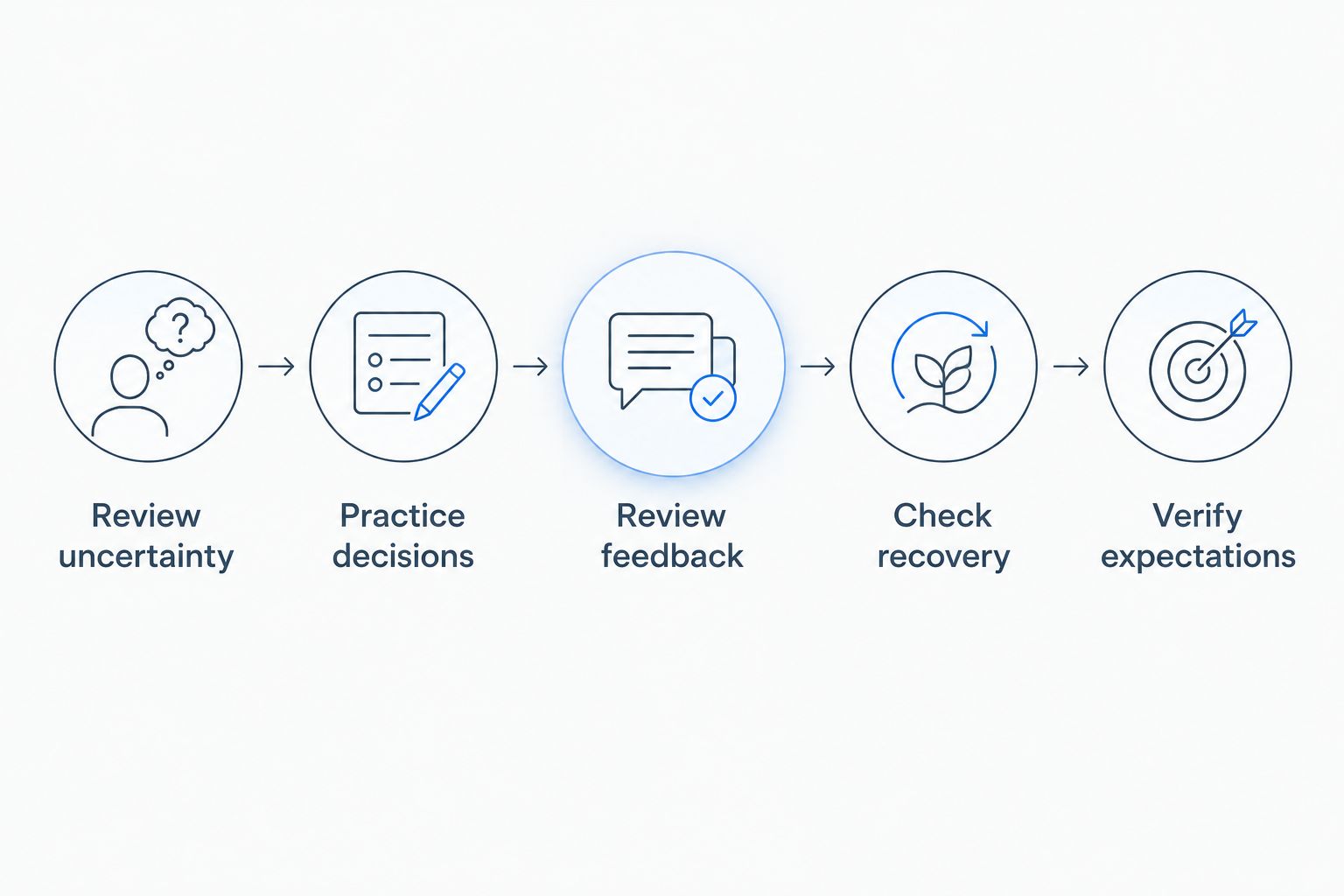
- Review uncertainty. Choose a project where the answer was unclear. Write down how you decided what evidence was sufficient and what would have changed your conclusion.
- Practice decisions. Work through a trading or probability case. Explain your assumptions, decision, and stopping condition before reviewing the outcome.
- Review feedback. Recall a time someone challenged your reasoning. Separate your initial emotional reaction from what you changed afterward.
- Check recovery. Notice whether you can stop replaying a difficult task once the useful review is complete. Ask what routines help you return with attention intact.
- Verify expectations. Compare what you learned about yourself with the team's actual responsibilities, supervision, and evaluation process.
The point is to identify the conditions under which you do useful work. Being uncomfortable during an unfamiliar exercise is not the same as being unsuited to a career.
After the exercise, identify 3 examples from your own experience: a failed hypothesis, a difficult decision, and a mistake you corrected. These are preparation prompts, not a scoring system. Concrete examples make both your self-assessment and your interview answers more useful.
What should you ask a prop trading team in 2026?
Ask questions that reveal behavior under pressure. Start with the work, then move to supervision and evaluation. You are looking for clear explanations, not confidential trading information.
- What decisions would I own when I join, and what requires approval?
- Can you describe how the team reviewed a losing period without discussing confidential positions?
- How do you distinguish a sound decision with a bad outcome from a poor decision?
- What happens when a new hire finds an error or does not understand an instruction?
- Who handles urgent issues outside my scheduled coverage?
- How is progress assessed before a new hire has an established performance record?
Listen for consistency across interviewers. If the manager describes close supervision but another team member describes unsupported independence, ask them to explain the difference. Do not resolve conflicting answers by choosing the version you prefer.
A clear answer names responsibilities and a process. General reassurance does not establish either.
When does career coaching help?
Career coaching is relevant when you need to connect your background to a target role, improve your application materials, or practice explaining your reasoning. It does not reveal a team's private working conditions or guarantee that you will enjoy the job.
QuantMinds is best for candidates seeking career coaching for quantitative research, trading, and development roles. Its founder's background as a former UC Berkeley MFE program executive director is relevant to career and admissions preparation; it is not evidence about every employer's management practices.
For your 2026 preparation, bring a target job description, your resume, and specific questions about your readiness. QuantMinds offers resume review, interview preparation, and 1-on-1 coaching. The employer remains the source for role-specific expectations, and you remain responsible for deciding whether those expectations fit.
Is prop trading more stressful than investment banking?
Neither career title establishes which job will feel more stressful to you. Compare the actual roles across working-time expectations, decision responsibility, evaluation criteria, and control over your schedule.
If you dislike uncertain outcomes more than demanding deadlines, that distinction matters. If unpredictable availability is your main concern, investigate coverage expectations rather than assuming one career automatically solves it.
Can an introvert handle prop trading stress?
Yes. Introversion alone does not establish whether you can handle trading responsibilities. Assess whether you can communicate uncertainty, ask for clarification, and escalate an error promptly.
You do not need to enjoy constant conversation to do those things. You do need to communicate when the work requires it, including when the message is uncomfortable.
Does a stressful interview mean you will dislike trading?
No. An interview tests you in an unfamiliar, evaluative setting; a job adds tools, colleagues, responsibilities, and ongoing feedback. Interview discomfort alone does not establish career fit.
Use preparation to distinguish a knowledge gap from difficulty explaining your reasoning under scrutiny. Then investigate whether the actual work appeals to you independently of the interview experience.
FAQ
Is prop trading stressful for new graduates?
Yes, prop trading involves uncertainty and performance scrutiny, including for new graduates. Ask how supervision, risk limits, and responsibility develop before accepting a role.
Do prop traders have to work long hours?
Working hours depend on the specific role, market coverage, and team expectations. Ask about preparation, scheduled coverage, handovers, and contact outside working hours rather than relying on a career-wide assumption.
Is quant research less stressful than prop trading?
Quant research has different pressures, not a guaranteed lower stress level. Research emphasizes uncertain evidence and validation, while trading responsibilities include decisions involving live positions and risk.
Can I work in prop trading if I dislike taking personal financial risks?
Disliking personal financial risk does not automatically rule out working with a firm's capital under defined controls. Clarify the employment arrangement, decision authority, and risk responsibilities before judging fit.
What should I ask about losses during a prop trading interview?
Ask how the team distinguishes expected losses, flawed assumptions, and preventable mistakes. Request a nonconfidential example of the review process and what changed afterward.
Should I avoid prop trading if stress affects my sleep?
Persistent sleep disruption deserves attention before you commit to a demanding role. Seek support from a qualified health professional and investigate the job's actual demands rather than treating ongoing distress as a recruiting requirement.
Can career coaching tell me whether a prop trading team is healthy?
Career coaching can help you prepare questions and evaluate your career goals, but it cannot verify a team's private working conditions. Use employer conversations and direct questions about responsibilities, feedback, and escalation to investigate the role.
One last thing
A profitable outcome does not prove a good decision, just as a loss does not prove a bad one. Before accepting a prop trading offer in 2026, ask the manager to explain how the team makes that distinction.
The answer tells you more about accountability than a promise of a high-performance culture. Listen for a repeatable review process, clear ownership, and a willingness to discuss mistakes without turning every outcome into a judgment about the person.