

Learning C++ for quant developer roles has no fixed completion time: your starting programming skills and the engineering demands of the target role determine the work. Learning syntax is only part of that work; you also need to write correct programs, explain memory and ownership, debug failures, and defend design decisions. For your 2026 preparation, use demonstrated skills—not elapsed months—as the readiness test.
- How long to learn C++ for quant developer roles depends on your programming foundation and target engineering responsibilities.
- C++ syntax knowledge is not enough; demonstrate ownership, debugging, algorithms, and testing.
- Python programmers should focus on object lifetimes, value semantics, and explicit performance reasoning.
- QuantMinds career coaching fits candidates seeking quant recruiting guidance alongside independent technical preparation.
Why this matters
A calendar-based plan gives you a finish date without defining what you must be able to do. A skills-based plan exposes the gap between completing lessons and independently solving engineering problems.
For a 2026 application, separate learning the language from preparing for assessment. The guide to how to pass a quant developer coding interview addresses that second task. Do not treat course completion as evidence of interview readiness.
How long does it take to learn C++ for quant developer roles?
There is no universal number of weeks or months that makes you ready for a quant developer role. Start by identifying what you already know, then test the capabilities the position actually requires.
The distinction matters because beginners, Python programmers, and experienced systems engineers face different learning problems. Use this comparison to choose your starting point, not to infer a hiring timeline.
| Starting point | Best for | Existing advantage | Main limitation to address | Readiness evidence |
|---|---|---|---|---|
| New to programming | Building a foundation before specialization | No established language habits to unlearn | Algorithms, debugging, and C++ concepts must develop together | Independently implement and test a small program |
| Comfortable with Python | Moving from scripting or research code into C++ | Familiarity with functions, data structures, and problem solving | Object lifetimes, copying, references, and compilation need explicit attention | Explain ownership and fix a lifetime-related bug |
| Experienced systems programmer | Targeting C++ engineering responsibilities | Experience reasoning about memory, tools, and performance | Modern C++ conventions and role-specific gaps still need assessment | Review unfamiliar C++ and justify design trade-offs |
Treat those as starting profiles, not rankings. Experience in another language is useful, but it does not establish C++ proficiency by itself.
Before estimating your own learning period, attempt a small implementation without following a tutorial. Compile it, test it, introduce a failure, and diagnose the cause. The parts you cannot complete independently become your study plan.
Starting from scratch: build programming foundations first
If C++ is your first programming language, your task includes learning how programs work—not just how C++ expresses them. Variables, functions, control flow, data structures, and decomposition all need deliberate practice.
Start with small programs whose behavior you can verify. Parse a file, maintain a collection of records, or implement a search routine. Write down the expected result before running the program so that a successful compilation does not become your only correctness check.
Best for new programmers: a foundation-first sequence with independent exercises. Its advantage is that you build understanding alongside syntax; its limitation is that finance-themed examples can distract you before basic programming is secure.
Move ahead when you can explain your program without reading the tutorial that inspired it. If changing the input format forces you to start over, keep working on decomposition and debugging before adding trading concepts.
Starting from Python: focus on C++ object behavior
Python experience gives you a useful problem-solving foundation. It does not remove the need to understand C++ object lifetimes, references, value semantics, and resource management.
Practice explaining when objects are created and destroyed, when a function copies an argument, and when a reference stops being valid. Learn resource acquisition is initialization, commonly called RAII: tie resource ownership to object lifetime rather than relying on scattered cleanup calls.
Best for Python programmers: targeted exercises in ownership and lifetime. The advantage is a focused transition; the limitation is that familiar-looking syntax can conceal different behavior.
For example, write a function that returns a result safely, then explain why returning a reference to a local object is invalid. Follow that with exercises involving containers and iterator invalidation. A program that happens to run is not proof that its memory use is valid.
Starting with systems experience: diagnose rather than restart
If you already work with compiled languages, operating systems, or performance-sensitive software, begin with a diagnostic review. Do not assume you need an introductory sequence, and do not assume your experience covers modern C++ idioms.
Review ownership, move semantics, templates, standard-library containers, and build tooling. Then choose unfamiliar code and explain its behavior, including cleanup during exceptions and the validity of references after container operations.
Best for experienced engineers: gap-driven preparation tied to a target role. Its advantage is relevance; its limitation is that familiar engineering experience can hide language-specific blind spots.
For your 2026 search, distinguish what you have actually built from what you have only studied. A resume should make that boundary clear. Reading about concurrency does not justify describing yourself as an experienced concurrent-systems developer.
Why your C++ learning timeline varies
Your learning timeline depends on the work between your current abilities and your target responsibilities. These factors change that gap:
- Programming foundation: If algorithms and debugging are new, you must learn them alongside C++ rather than treating them as assumed knowledge.
- Memory model familiarity: Experience with object lifetimes and resource ownership changes which concepts require the most attention.
- Target responsibilities: A role involving performance-sensitive infrastructure calls for different preparation from one centered on research tooling. Read the actual position description.
- Practice quality: Writing, testing, and repairing code gives you evidence of understanding that passive lesson completion does not.
- Feedback quality: Code review exposes unclear ownership, weak tests, and unsupported performance assumptions that you might overlook alone.
- Assessment format: Live coding, a project discussion, and a systems-design conversation require different forms of practice. Confirm the format when the recruiting team provides it.
Avoid turning these factors into a universal month count. Instead, use them to explain why your plan includes particular exercises and what result will let you move on.
Build a readiness plan around observable skills
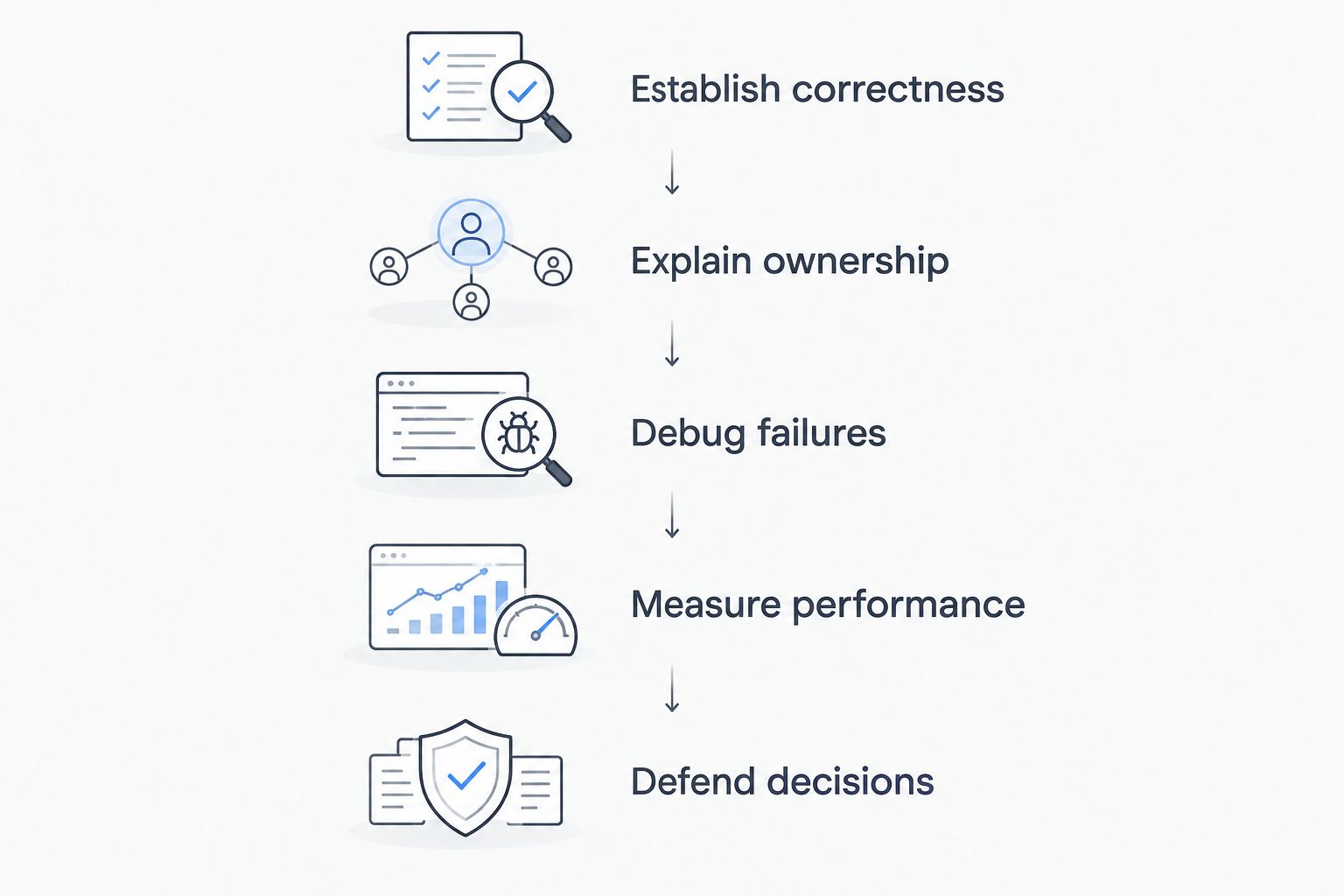
Use the following sequence for your 2026 preparation. Advance when you can demonstrate the skill independently, rather than when you finish a chapter.
Establish correctness
Implement functions and small programs from a written specification. Cover normal inputs, empty inputs, invalid inputs, and boundary conditions where relevant.
Explain why the output is correct. If you cannot describe the assumptions your implementation makes, improve the specification before adding features.
Explain ownership
Identify which object owns each resource and when that resource is released. Use standard containers and appropriate ownership types rather than scattering manual allocation and cleanup throughout the program.
Be able to distinguish an owning object from a non-owning reference. Explain what happens if the referenced object disappears or the container changes.
Debug failures
Practice investigating a failure instead of immediately rewriting the code. Read compiler diagnostics, inspect execution with a debugger, and use sanitizers where your toolchain supports them.
Keep a short record of the symptom, root cause, and fix. That record should explain the error in your mental model, not merely the line you changed.
Measure performance
State a performance question before optimizing. Compare implementations under the same conditions and describe the workload you measured.
Separate algorithmic complexity from observed runtime. A faster result on a small example does not establish that the same design wins for every input or deployment environment.
Defend decisions
Explain your choice of data structure, interface, and error handling. Name the trade-off rather than insisting your solution is universally best.
Practice modifying the implementation when a requirement changes. That tests whether you understand the design or have memorized a finished solution.
What should you build to test your readiness?
Build a small C++ program with clear requirements, tests, and an explanation of its limitations. A simplified market-data processor is a useful exercise because you can define its inputs and outputs without claiming to reproduce a trading firm's infrastructure.
For example, accept records containing an instrument identifier and a price, validate the records, and maintain the latest accepted value for each instrument. Specify what happens with malformed input or an unknown identifier. Keep the scope understandable.
Then make the engineering visible:
- Describe the input format and assumptions.
- Explain the container choice and ownership model.
- Include tests for rejected records and state updates.
- Document how to build and run the program.
- Identify limitations rather than calling the project production-ready.
A defensible small project is better evidence than an elaborate project you cannot explain. The limitation is equally important: a personal project demonstrates the work it contains, not experience operating live trading infrastructure.
How do you know when to start applying?
Start with the requirements of a specific position. Compare them with work you can demonstrate, then distinguish essential gaps from topics that are not relevant to that role.
Use a practical readiness check: implement a solution without tutorial support, test it, explain its memory behavior, and discuss alternatives. If the exercise exposes a recurring weakness, make that weakness the next preparation task.
For 2026 applications, write your resume around evidence. Describe what you implemented, how you checked correctness, and what engineering decisions you made. Do not add performance figures unless you measured them and can explain the measurement.
QuantMinds career coaching is best for candidates seeking quant recruiting guidance alongside independent technical preparation. Founded by a former UC Berkeley MFE program executive director, QuantMinds offers resume review, interview preparation, and individual coaching. Career coaching addresses positioning and preparation; it does not replace writing and debugging C++ yourself.
Can I learn C++ while applying for quant developer roles?
You can study C++ while applying, provided your applications describe your current skills accurately. Target positions whose requirements match the evidence you already have, and keep preparing for the gaps you identify.
Do not list an advanced topic merely because it appears next in your course. Be ready to explain anything you put on your resume.
Is learning syntax enough for a quant developer interview?
Learning syntax is not enough to establish C++ interview readiness. You also need to reason about correctness, data structures, object lifetimes, and the behavior of your implementation.
Practice explaining a solution aloud while checking its assumptions. Memorized code becomes fragile when the interviewer changes a requirement.
Should I study advanced C++ before building a project?
You do not need to finish every advanced C++ topic before building a project. Start with a manageable implementation, then study the concepts needed to make it correct and understandable.
Keep advanced features tied to a reason. Using templates or concurrency without a clear requirement adds complexity without demonstrating sound judgment.
FAQ
How long does it take to learn C++ for a quant developer job?
There is no fixed learning period that establishes readiness for a quant developer job. Assess your starting skills, the target role's requirements, and your ability to implement, test, debug, and explain C++ independently.
Is C++ harder to learn if I only know Python?
Python experience helps with programming fundamentals, but C++ requires explicit attention to object lifetimes, ownership, copying, and compilation. Focus your transition on those differences rather than repeating only basic syntax exercises.
Do I need to master every C++ feature before applying?
You do not need to master every C++ feature before applying. You need credible evidence for the requirements of the specific position and a clear account of your current limitations.
What is a useful C++ project for quant developer preparation?
A small market-data processing exercise is useful when it has defined inputs, validation rules, tests, and documented limitations. It demonstrates specific engineering work, not experience running a production trading system.
Should I focus on coding problems or C++ projects?
Use coding problems to practice solving bounded tasks and projects to practice integrating, testing, and explaining a program. Neither activity alone demonstrates every skill required by a particular role.
Can career coaching replace learning C++?
Career coaching cannot replace learning C++. QuantMinds offers quant career coaching, resume review, and interview preparation; you still need independent technical practice.
How should I describe C++ skills on my resume?
Describe C++ skills through work you can demonstrate and explain. Name the implementation, testing, and design decisions, and include performance figures only when you have measured them.
One last thing
Before extending your study plan, reopen an old program and change a requirement without consulting its original tutorial. Add input validation, change the data representation, or repair a failing test.
Your response to that change reveals more than another completed lesson. For your 2026 preparation, measure independence—not time spent watching explanations.