

Building a quant trading portfolio project takes as long as you need to produce a reproducible result, test its weaknesses, and explain your decisions—not merely get a backtest running. For your 2026 recruiting plan, estimate the work from a small working prototype rather than borrowing someone else’s deadline. Include data checks, validation, documentation, and interview preparation in that estimate.
- How long to build quant trading portfolio project work depends on scope, data quality, coding readiness, and validation.
- Finish a reproducible baseline before adding models, markets, or execution features.
- A working backtest is not the finish line; explain assumptions, transaction costs, and failure cases.
- QuantMinds provides quant career coaching for candidates who need resume review and interview preparation.
Why this matters
A project deadline is useful only if you know what you are promising to finish. A notebook that produces a return chart and a research project you can defend in an interview have different completion requirements.
Define the evidence you want the project to show before choosing the strategy. If the project is part of your application, use the same standard you would apply when deciding what makes a quant resume stand out: describe work you actually completed and can explain under questioning.
For a 2026 application, write down the version you intend to submit. Separate that version from improvements you would like to make later, or the project will keep expanding without becoming easier to assess.
How long does it take to build a quant trading portfolio project?
The completion time depends on your starting skills and the project’s acceptance criteria. Estimate your own timeline by completing a small end-to-end version, measuring the remaining work, and separating essential checks from optional extensions.
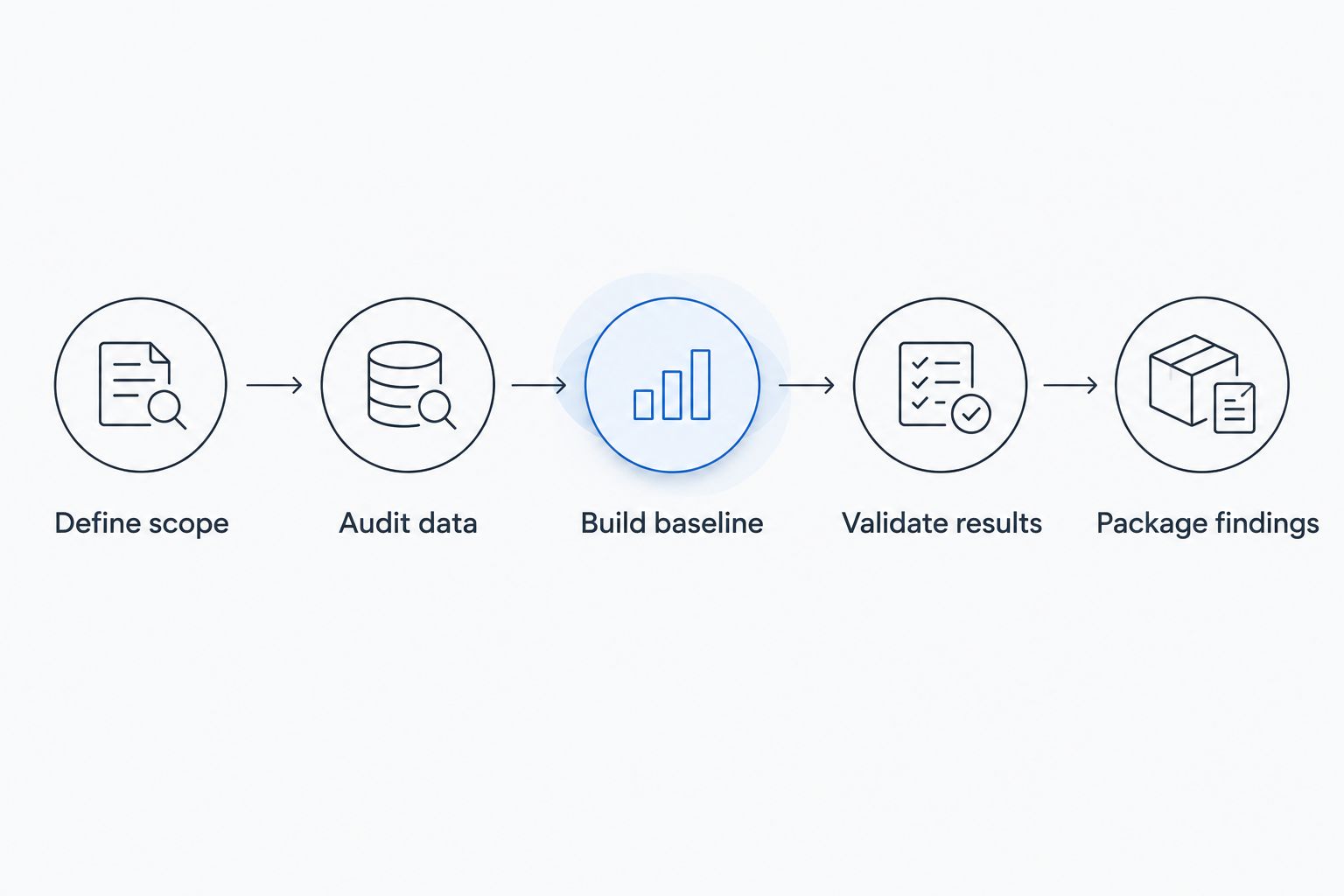
Use this sequence before committing to a submission date:
- Define scope. State the research question, intended role, dataset, and final deliverables. Specify what you are deliberately leaving out.
- Audit data. Inspect timestamps, missing observations, identifiers, and usage permissions before building the strategy around the dataset.
- Build baseline. Run the simplest complete version from data input through signal generation, positions, and reported results.
- Validate results. Check information timing, trading assumptions, transaction costs, and performance outside the development sample.
- Package findings. Make the work reproducible, explain limitations, and prepare to discuss the decisions behind the code.
The baseline gives you something concrete to estimate from. Record which tasks required unfamiliar concepts, which failures came from the data, and which parts you can already reproduce without manual intervention.
Once the baseline works, list the unfinished tasks individually. Estimate data repairs separately from model development; otherwise, an apparently simple research change can hide an unresolved data problem.
Keep learning time separate from implementation time, too. If you cannot yet explain the statistical method you intend to use, understanding it belongs on the schedule—not outside it.
Choose the project scope before choosing the deadline
Different project formats demonstrate different skills. Choose the format that matches the evidence you want to present, rather than the format with the most features.
| Project format | Best for | What it demonstrates | Main limitation | Completion condition |
|---|---|---|---|---|
| Reproducible baseline | Candidates establishing an end-to-end research workflow | Data handling, explicit rules, and repeatable analysis | Limited evidence of deeper investigation | Another person can reproduce the stated result |
| Research study | Candidates emphasizing quantitative research judgment | Hypothesis testing, comparisons, and analysis of failure cases | Repeated experimentation creates scope creep | The conclusion follows from documented tests |
| Trading-system prototype | Candidates emphasizing implementation and system behavior | Order handling, state management, tests, and operational assumptions | Infrastructure can crowd out the research question | Specified system behavior is implemented and tested |
Reproducible baseline: finish the complete workflow
Best for: candidates who need to establish that they can carry a research idea through to a reproducible result. Start with a narrow question and an understandable rule. Make the data transformations and position calculations visible.
The advantage is a clear boundary. You can check whether the workflow runs and whether its outputs match the explanation.
The limitation is depth: a working pipeline does not establish that a trading idea survives meaningful scrutiny. Present it as a baseline, not as proof of a deployable strategy.
Research study: budget for investigating the result
Best for: candidates who want to demonstrate how they evaluate a hypothesis. Write down the proposed mechanism, the comparison that would challenge it, and the evidence that would weaken your conclusion.
The advantage is room to show judgment rather than just implementation. You can explain why an apparent result disappears under a different assumption.
The limitation is an open-ended search. Define the main question before experimenting, and keep exploratory findings distinct from tests you planned in advance.
Trading-system prototype: define behavior before building infrastructure
Best for: candidates who want to demonstrate development skills through explicit trading-system requirements. Specify how the prototype handles inputs, positions, orders, errors, and restarts.
The advantage is testable engineering work. You can demonstrate whether the implementation follows its stated rules.
The limitation is distraction: interfaces and infrastructure do not establish that the underlying trading logic is sound. For your 2026 portfolio, label simulated behavior clearly and avoid presenting a prototype as production trading experience.
Why a quant trading project’s timeline varies
These factors change the work you must complete. Treat them as planning questions, not reasons to keep the deadline undefined.
- Coding readiness. If you are learning data manipulation, testing, or version control while building, include that learning in the plan. A familiar programming language does not remove unfamiliar research tasks.
- Data condition. Missing values, inconsistent timestamps, corporate actions, and changing identifiers require explicit handling. Inspect a representative sample before committing to the dataset.
- Research breadth. Adding instruments, signals, or alternative methods creates more comparisons and more decisions to document. Keep extensions outside the submission scope until the baseline is defensible.
- Trading assumptions. Transaction costs, execution timing, and position constraints affect the meaning of a backtest. Choose assumptions you can explain rather than treating implementation defaults as facts.
- Validation depth. Testing information timing and separating development from evaluation requires more work than plotting historical returns. Plan those checks before interpreting the result.
- Presentation requirements. A reproducible repository, written findings, and an interview explanation are deliverables. They are not finishing touches to squeeze in after the research deadline.
Build an estimate from work you have actually completed
Use a task ledger rather than an unsupported total. For every unfinished task, record the deliverable, dependency, uncertainty, and evidence that will show it is done.
For example, “clean the data” is too vague to schedule. “Identify missing observations and document the treatment used in the backtest” has a visible endpoint.
Keep separate entries for implementation and verification. Writing a position-sizing function is different from checking that its behavior matches the specification, especially around missing inputs or changes in available capital.
For a 2026 schedule, use the focused working time you can actually protect. Do not equate a clear calendar with uninterrupted research time, and do not count on unresolved dependencies disappearing by themselves.
After completing a task, compare the effort with your estimate. Update the remaining plan using what you learned, without quietly expanding the deliverables to fill the available time.
When a deadline becomes tight, reduce breadth before removing validity checks. Drop an optional model, dashboard, or additional market before dropping checks for information leakage or incorrect position accounting.
What does “finished” mean for a quant trading portfolio project?
A finished project has an explicit question, a reproducible method, and a conclusion bounded by the evidence. It also makes the important assumptions easy to find.
Use the following acceptance criteria for the version you intend to submit:
- Research question: The reader can identify what you tested and why the question is relevant.
- Data provenance: You explain where the data came from, its coverage, and material restrictions or limitations.
- Information timing: The analysis distinguishes information available at a decision point from information observed later.
- Evaluation design: Development choices and evaluation results are distinguished clearly.
- Trading assumptions: The write-up explains execution timing, transaction-cost treatment, and position rules.
- Reproducibility: The repository states the environment, dependencies, configuration, and steps required to run the work.
- Limitations: You identify what the analysis does not establish and what would require further investigation.
A profitable-looking chart is not a substitute for these criteria. Neither is a complicated model.
For your 2026 application version, freeze the submitted code and findings together. If you continue the research afterward, keep the later changes distinguishable so that your resume and interview explanation refer to the same work.
How do I know when to stop adding features?
Stop adding features when the agreed deliverables answer the original question and the remaining additions do not resolve a material weakness. Put those additions in a separate research backlog.
A feature earns its place if it repairs an error, tests a necessary assumption, or supplies evidence required by the project’s stated purpose. A dashboard that repeats existing findings does not take priority over an unexplained evaluation result.
Before adding anything, ask what conclusion becomes more defensible because of it. If you cannot answer clearly, finish the current version first.
Should I delay applications until the project is finished?
Do not make every application depend on an expanding project. Use completed, defensible work in your materials and describe unfinished work accurately.
If the project is central to a specific application, define the minimum submission version against that opportunity’s actual requirements. Do not represent an exploratory notebook as a validated strategy simply to meet a deadline.
Keep interview preparation separate from the build. Being able to run the repository does not mean you are ready to explain the assumptions without looking at the code.
Where career coaching fits—and where it does not
QuantMinds is best for quantitative finance candidates seeking resume review, interview preparation, and individual career coaching. Its founder is a former UC Berkeley MFE program executive director.
QuantMinds quant career coaching fits the application side of this work: how you present your experience and prepare to discuss it. Technical verification remains a separate responsibility; career positioning does not establish that a backtest or research conclusion is correct.
Prepare to explain your project
Connect your project experience with resume review and quant interview preparation.
FAQ
How long should I give myself to build a quant trading portfolio project?
Set the deadline after you complete a small end-to-end baseline and identify the remaining tasks. Include data checks, validation, documentation, and interview preparation rather than estimating coding alone.
Can I finish a quant trading project over a weekend?
Treat a weekend as a bounded work session, not evidence that the project will be finished. Define a specific deliverable and assess the remaining validation work before calling the project complete.
Is a simple trading strategy enough for a portfolio project?
A simple strategy can support a useful project when the question, method, and limitations are explicit. Complexity does not replace correct information timing or a defensible evaluation design.
Does my quant trading project need to make money?
A historical profit is not the only useful research outcome. A project can explain why a hypothesis failed, provided the analysis supports that conclusion and the limitations are clear.
Should I include live trading in my portfolio project?
Include live trading only if it is necessary to the question you intend to investigate. A reproducible research project does not need to become a live trading system to demonstrate completed analytical work.
What should I put in the project README?
State the research question, data source, setup instructions, execution steps, main findings, and limitations. Explain any manual steps or data restrictions that prevent another person from reproducing the work directly.
Can QuantMinds help me prepare to discuss my project?
QuantMinds offers interview preparation, resume review, and individual coaching for quantitative finance candidates. Use career preparation alongside, not instead of, technical verification of the project.
One last thing
Write the limitation you would least like an interviewer to ask about. Then investigate it before polishing the presentation.
If you cannot resolve it, explain exactly how it limits the conclusion. An honest boundary is more defensible than a stronger claim your analysis cannot support.