

Yes. Military veterans can break into quant finance in 2026 by showing the math, coding, research, or decision-making skills required for a specific role. Military experience gives you material for a strong application, but it does not replace technical evidence or interview preparation. Start by choosing between quant research, trading, and development rather than sending the same resume to all three.
- Yes, military veterans can break into quant finance in 2026; technical evidence matters more than military terminology.
- Quant research fits candidates who can demonstrate statistical research; quant development fits candidates who can show working code.
- Trading candidates need to explain decisions under uncertainty and prepare for the role's quantitative interviews.
- QuantMinds career coaching is best for veterans who want direct feedback on their resume, role choice, and interview preparation.
Why this matters
A military resume can describe substantial responsibility without telling a quant recruiter whether you can build a model, write production-minded code, or reason through a probability problem. The translation is your job. In 2026, make each application answer a specific question: What evidence shows you can do this quant role?
That question applies whether you served in an operational, intelligence, engineering, or technical position. Your title alone does not establish a match. If you are starting interview preparation, the quant interview prep guide for military veterans covers the next stage; first, decide which work you can credibly demonstrate.
Can military veterans break into quant finance careers?
Yes, but the route depends on the skills you can prove, not your veteran status alone. Quant research, trading, and development ask you to show different kinds of work. Pick the role that matches your strongest evidence, then build the application and interview plan around that role.
| Role | Best for | Evidence to show | Main gap to address |
|---|---|---|---|
| Quant research | Veterans who can demonstrate statistical analysis, mathematical modeling, or research | A reproducible project with a question, method, validation, and limitations | Explaining your methods and results under technical questioning |
| Quant trading | Veterans who can explain decisions under uncertainty and demonstrate quantitative reasoning | Clear reasoning on probability, estimation, and risk decisions | Showing the math behind a decision, not just confidence under pressure |
| Quant development | Veterans with substantial programming or systems experience | Code you can discuss, including tests, performance choices, and trade-offs | Passing coding interviews and explaining implementation decisions |
The strongest route is the one supported by work you can show and defend. A veteran with a strong software background should not default to a trading application because trading sounds closer to operational decision-making. A veteran with research experience should not hide it behind a generic leadership summary. Each path has an advantage and a constraint: research rewards a clear method but exposes weak statistics; trading values precise reasoning but tests it directly; development lets code speak but requires you to explain how it works.
In 2026, write down the evidence you already have for each column before choosing a target. Include academic work, professional projects, and unclassified personal work that you can discuss. Do not put sensitive operational details into a portfolio or interview story.
How should a veteran choose a quant role?
- List your technical evidence. Separate claims you can demonstrate from responsibilities you held. A programming project, statistical analysis, or documented research question gives an interviewer something concrete to examine.
- Match the evidence to a role. Put each example under research, trading, or development. If an example fits more than one, explain the distinct skill it proves for each application.
- Identify the missing test. For research, expect to explain assumptions and validation. For trading, practice quantitative reasoning aloud. For development, be ready to write and discuss code.
- Build a role-specific resume. Lead with relevant technical work and translate military experience into plain descriptions of the problem, your contribution, and the result you can substantiate.
- Practice the explanation. Have someone challenge your method, not just your delivery. If you cannot explain why an approach worked or where it failed, the resume bullet is not ready.
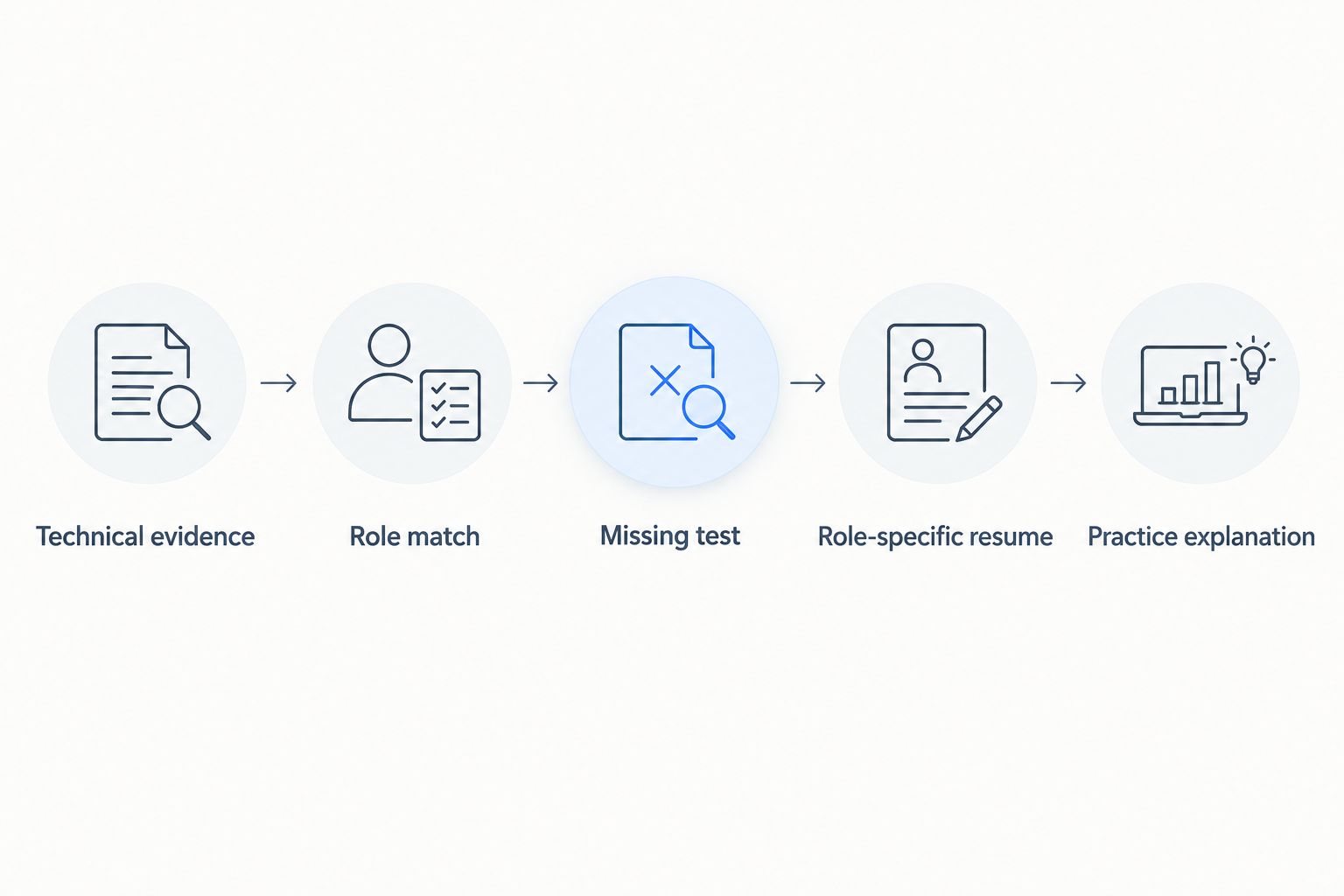
This sequence prevents a common application mistake: preparing broadly for quant finance without deciding what job you want. In 2026, a focused application gives the reader a way to connect your experience to the work. A broad one makes that connection their problem.
What belongs on a veteran's quant resume?
Put technical evidence where a recruiter can find it quickly. For a research application, that means the question you investigated, the method you used, and how you checked your findings. For a development application, name the problem the code solved and the choices you made. For trading, show relevant quantitative reasoning rather than relying on a claim that you make decisions under pressure.
Military experience still belongs on the resume. Translate it without flattening it. An unfamiliar unit name or acronym tells an outside reader little; a plain description of the system, analysis, or decision makes your contribution understandable. Keep any detail you cannot disclose out of the document. You can describe transferable work without revealing restricted information.
Avoid turning every bullet into a leadership statement. Leadership is relevant when it explains your contribution, but it does not substitute for the technical skill the role tests. The resume must make a technical case before the interview has to.
What if your military work was not technical?
You need a separate way to show technical readiness. Choose a role first, then build work that lets you demonstrate its core skills. A research candidate can present a documented analysis with assumptions and limitations. A development candidate can present code and explain testing and design decisions. A trading candidate can practice explaining quantitative problems and decisions clearly, without claiming that operational experience is identical to trading.
This is a more honest approach than renaming nontechnical duties to sound quantitative. If you cannot yet defend the math or code in an interview, the next move is skill development and practice, not a more elaborate resume. Your military experience remains part of your story; the technical work supplies the missing proof.
An MFE is one possible educational route, not a substitute for choosing a role. Judge any program against the gaps you need to close and the applications you intend to submit. Likewise, do not add a credential solely because its name appears on other candidates' resumes. First establish what you need to be able to do.
Why does the path vary between veterans?
- Technical background: Relevant coding, math, or research work changes which role you can support with evidence now.
- Target role: Research, trading, and development call for different application examples and interview practice.
- Explainable work: A project helps only if you can describe your contribution, assumptions, and limitations.
- Disclosure limits: Work you cannot discuss needs a different, shareable example of the same underlying skill.
- Resume translation: Recruiters need plain descriptions of your work rather than military shorthand.
- Interview readiness: Strong experience on paper does not answer a coding or quantitative question for you.
These factors make a blanket answer unhelpful. Two veterans can have equally demanding service records and need different recruiting plans. In 2026, compare the work each target role asks you to demonstrate with the evidence you can actually present.
Should a veteran apply for research, trading, and development at once?
Apply across roles only when you have distinct evidence for each one. A research project, a coding portfolio, and a strong trading interview are different cases; one generic resume does not make all three. If you have a clear strength, start there and expand only when you can support another application just as specifically.
Do military leadership skills help in quant interviews?
Yes, when they answer a question about your decisions, collaboration, or response to mistakes. They do not answer a technical question about probability, statistics, or code. Prepare both: a plain account of what you did and a technical explanation suited to the role.
Do veterans need an MFE to enter quant finance?
No single degree choice follows from military service alone. Compare your current math and programming skills with the demands of your target role before deciding whether additional study is the right next step. An MFE application and a quant job application also require different preparation; do not treat one as proof that the other is ready.
When does career coaching help?
Coaching is useful when you have a specific decision or weak point to examine: which role fits, what your resume fails to show, or why your interview explanations are not landing. It is less useful as a substitute for doing the underlying math or programming work. Bring a target role, a draft resume, and work you can discuss; then ask for direct criticism.
QuantMinds career coaching is best for veterans who want candid, role-specific feedback on their resume and interviews; it cannot replace technical preparation. QuantMinds offers resume review, interview prep, and 1-on-1 coaching for candidates pursuing quantitative research, trading, and development roles. That makes feedback a practical next step once you have identified the evidence you need to present.
Get feedback on your quant plan
Bring your target role, resume, and interview questions.
FAQ
Can military veterans break into quant finance without a finance background?
Yes, military veterans can pursue quant finance without a finance background if they can demonstrate the technical skills of their target role. Show relevant math, research, or coding work and prepare to explain it in an interview.
What's the best quant role for a veteran with programming experience?
Quant development is a strong first role to evaluate when programming is your clearest demonstrable skill. Compare your code and interview readiness with the work the position calls for rather than assuming every programming background fits.
Can a veteran pursue quant research without military research experience?
Yes, but the application still needs evidence of research ability. A project with a defined question, sound method, validation, and clear limitations gives you work to discuss.
Does military decision-making experience transfer to quant trading?
It gives you examples of how you approached decisions, but it does not establish quantitative trading skill on its own. Prepare to explain probability, risk, and your reasoning directly.
Should I put classified military projects on a quant resume?
No. Use work you are permitted to discuss, and describe transferable skills without disclosing restricted information. A separate, shareable technical project can provide evidence an interviewer can examine.
Do I need an MFE before applying for quant roles?
An MFE is not an automatic requirement for every quant role. Decide whether additional study addresses a specific gap in the role you want before making it your default plan.
What can QuantMinds help a veteran prepare for?
QuantMinds offers resume review, interview prep, and 1-on-1 coaching for candidates targeting quantitative research, trading, and development roles. Arrive with a target role and concrete work to discuss so the feedback can address your application.
One last thing
Do not make your military service the conclusion of your quant application. Make it the context for evidence an interviewer can test. In 2026, the useful question is not whether veterans belong in quant finance; it is whether your resume and interview answers prove you can do the particular job in front of you.