

Yes, you can get a quant job without knowing C++, especially if you target research or trading roles where the stated requirements match your strengths. You cannot treat every quant opening the same way: if a quant developer posting requires C++, you need to demonstrate C++ competence before applying. In 2026, the decision starts with the job description, not a universal list of languages every quant must know.
- A quant job without knowing C++ is possible when the role does not require it.
- Target quant research or trading roles whose stated skills match your evidence; do not assume every team uses the same languages.
- If a quant developer posting requires C++, learn it and build proof before applying.
- QuantMinds quant career coaching is best for candidates who need to align their applications with specific roles.
Why this matters
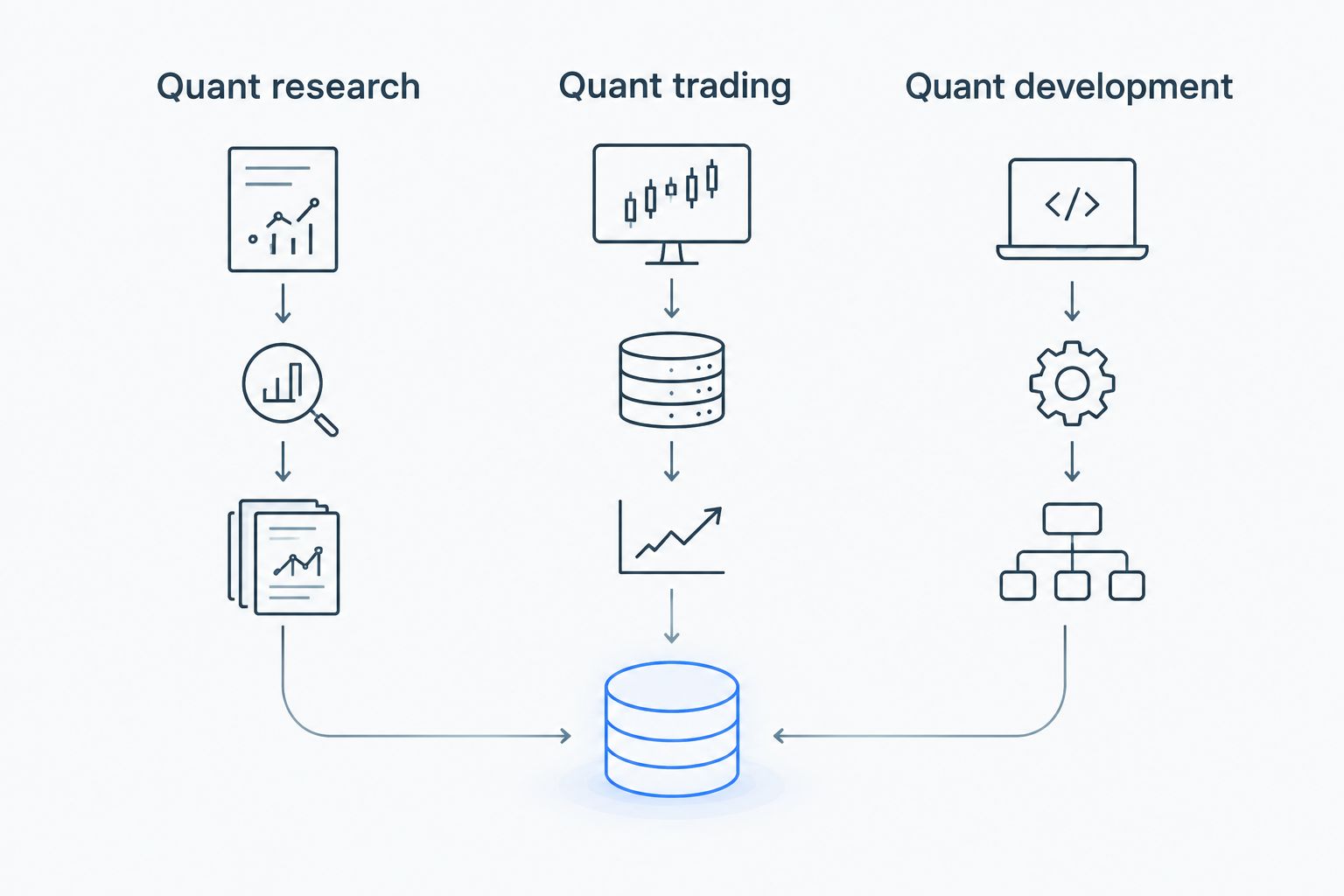
A broad search for quant jobs mixes research, trading, and development openings. Those titles point to different work, yet candidates often prepare as though every interview has the same coding requirement. That can leave you studying C++ for a role that screens on research judgment, or applying to a C++ development role with no relevant code to show.
Your next move is to sort openings by their stated requirements before changing your study plan. If you are still choosing between role types, the quant interview preparation guide for undergraduates offers a useful starting point for organizing your preparation. Your application still needs to answer the requirements of each opening you select.
Can you get a quant job without knowing C++?
Yes. The workable route is to apply where C++ is not listed as a requirement and where you can show the mathematical, statistical, programming, or decision-making skills the posting does request. A job title alone cannot tell you whether C++ is optional; read the responsibilities, required skills, and interview instructions together.
| Role you are considering | How to assess C++ | What to show instead if C++ is not required | Main drawback of applying without C++ |
|---|---|---|---|
| Quant research | Check whether the work and skills listed emphasize research methods or C++ implementation. | A defensible research project, sound statistical reasoning, and code in a requested language. | You cannot use research strength to satisfy an explicit C++ requirement. |
| Quant trading | Check the stated coding expectations alongside the decision-making and quantitative requirements. | Clear reasoning under uncertainty and any programming skills the posting requests. | A strong trading profile does not replace a required coding skill. |
| Quant development | Read the required languages and engineering responsibilities closely. | Relevant software work when the posting accepts your existing language skills. | C++ is a direct gap when the position explicitly requires it. |
These are application filters, not promises about every employer. A research opening can require C++; a development opening can name other languages. In 2026, the text of the individual posting takes precedence over advice about what a typical quant role looks like.
The distinction also changes how you describe yourself. If your strongest evidence is a statistical research project, apply to roles where you can explain its question, methods, limitations, and code. If your strongest evidence is building software, read the developer requirements before assuming that general engineering experience covers them.
Use the posting as a test, not a wish list
Start with the required qualifications. If C++ appears there, mark it as a gap you need to close. If it appears only as a preferred skill, compare the rest of your evidence with the core responsibilities before deciding whether to apply; preferred does not mean irrelevant, but it is not the same wording as required.
Next, check what the job asks you to produce. Research code, production software, and trading decisions are different outputs. Your resume should make the relevant output easy to find, rather than asking a recruiter to infer it from a course list or a generic statement that you like quantitative finance.
Finally, prepare for the assessment described in the process. If a recruiter tells you the coding interview uses a specific language, that instruction matters more than what you have heard about the broader role. Ask what language is accepted when the invitation does not say. Do not claim C++ ability on your resume simply because you plan to learn it before the interview.
Quant research without C++
Quant research is the clearest role to investigate if your strengths are statistics, mathematical modeling, and explaining research decisions rather than C++ development. That is a targeting rule, not an exemption: remove any research opening that explicitly requires C++ from your no-C++ shortlist.
Your best evidence is work you can defend in detail. Be ready to explain the question you tested, why you chose the method, what the data supports, and what it does not. Show the code you actually wrote in a language you can use confidently. A project becomes weaker, not stronger, when its resume description claims more than you can explain in an interview.
Best for: Candidates with demonstrable research and statistical work who meet the language requirements of a specific opening. Limitation: Strong research cannot erase a required engineering skill. In 2026, prioritize postings that ask for the work you can already show, then build missing skills for roles you still want.
Quant trading without C++
A quant trading application without C++ makes sense when the opening emphasizes quantitative reasoning and does not require the language. Read the assessment instructions carefully: a role can test programming even when its title says trading, and the accepted language belongs to that process rather than to a broad rule about traders.
Prepare to make your thinking visible. State assumptions, work through uncertainty, check whether an answer is plausible, and correct an error plainly when you find one. If the role asks for code, practice writing and explaining it in an accepted language; being good at mental math is not a substitute for a coding test you have been told to take.
Best for: Candidates who can demonstrate the specific reasoning and programming skills a trading opening requests. Limitation: Some trading openings ask for C++, and you should not apply as though that line is optional. Keep the shortlist tied to actual requirements rather than treating a trading title as permission to skip technical preparation.
Quant development without C++
Quant development is where a no-C++ application needs the closest scrutiny. The job centers on software work, so its listed languages and engineering responsibilities deserve more weight than the broad quant label. If C++ is required, do not present general programming experience as equivalent C++ experience.
You can still consider development openings that specify a language you know and do not require C++. Make your software contribution concrete: what you built, which part you owned, how you checked its behavior, and what trade-offs you made. Describe only work you can discuss and, where permitted, show code that represents your own contribution.
Best for: Software candidates whose existing language skills match a particular development opening. Limitation: A required C++ skill remains a required C++ skill, even if your other engineering experience is strong. If development roles that interest you consistently require it, learning C++ is a more direct move than repeatedly applying with the same gap.
Why the C++ requirement varies
The language question changes with the work and the opening. Use these factors to separate a real requirement from an assumption:
- Responsibilities: A posting centered on implementing software calls for different evidence from one centered on investigating a research question.
- Required versus preferred wording: Treat a required skill as a gap to close; treat a preferred skill as one factor in the full application.
- Interview instructions: An explicitly named coding language sets the preparation target for that assessment.
- Your existing evidence: A finished project you can explain supports your application more clearly than an unsupported claim of familiarity.
- Role fit: Research, trading, and development titles help you sort openings, but the stated duties decide what belongs on your shortlist.
None of these factors turns a missing requirement into a strength. They tell you where to spend effort: target roles that fit now, or deliberately train for a role you cannot yet support. In 2026, make that choice before you rewrite your resume for every quant opening you see.
What should you do if a quant posting requires C++?
If C++ is required, treat it as a skill to demonstrate, not a keyword to add. Study the parts relevant to the stated work, write code you can explain, and practice discussing your implementation choices. Then assess whether you are ready for that opening; an application is not a substitute for preparation.
Do not abandon the rest of your profile while learning. A developer still needs to explain software work, and a researcher still needs to defend research decisions. C++ closes the stated language gap; it does not automatically prove you can perform every responsibility on the posting.
Should you learn Python or C++ first for a quant job?
Learn the language your target postings require first. If the research or trading openings on your shortlist accept Python and do not require C++, build credible work in Python rather than postponing applications to study C++ without a role-based reason. If your target development openings require C++, move C++ into your preparation plan.
Do not turn this into a claim that one language is always better. Write down the roles you intend to pursue and the languages each one names. That small exercise gives you a defensible order for learning and stops a broad career question from consuming preparation time you need for interviews.
Can a strong project compensate for not knowing C++?
A strong project supports an application only when you still meet the role's stated requirements. It can show how you frame a problem, write code, evaluate results, and explain limitations. It cannot prove C++ competence if you did not use C++ and the posting requires it.
Choose a project that fits the role, then prepare to discuss what you personally did. For research, explain the method and its limits. For development, explain your implementation and checks. For trading, explain the decisions and assumptions your work supports. The point is to give the interviewer evidence, not another unverified skill claim.
Turn the answer into an application plan
A no-C++ job search needs a tighter shortlist, not a broader resume. Work through these steps before you submit your next application:
- Pick a role type. Choose research, trading, or development based on the work you want to do and can discuss credibly.
- Read the actual requirements. Separate required languages from preferred ones, and note any assessment language the employer names.
- Match evidence to duties. Put your most relevant project or experience where a reader will see it. Remove claims you cannot defend.
- Prepare for the stated assessment. Practice the reasoning, coding, or project explanation the process asks for, rather than preparing for every possible quant interview at once.
- Recheck the gap. If your preferred openings repeatedly require C++, make learning and demonstrating it a deliberate goal. If they do not, focus first on the skills they actually request.
This process also gives you a clearer answer when someone asks why you applied. You can connect your experience to the work in the posting and discuss the skills you are building without pretending the gap is already closed. That is stronger than presenting yourself as qualified for every quant title.
If you need an outside assessment of that match, QuantMinds offers quant career coaching, resume review, interview preparation, and one-on-one coaching for students and professionals pursuing research, trading, and development roles. QuantMinds quant career coaching is best for candidates who need an honest read on which roles their current evidence supports. Coaching can clarify your positioning; it does not replace a technical skill the employer requires.
FAQ
Can I get a quant job without knowing C++ in 2026?
Yes, you can pursue a quant job without knowing C++ when the opening does not require it and you meet its other requirements. Read each posting and its assessment instructions before applying.
Do quant researchers need to know C++?
A quant researcher needs C++ when the specific role requires it. Research titles alone do not settle the language question; check the stated work and qualifications.
Do quant traders need C++?
Quant traders need C++ for openings that explicitly require it. For other trading openings, prepare for the reasoning and programming assessments the employer actually specifies.
Can I apply for a quant developer job without C++?
Yes, if the quant developer opening does not require C++ and your skills match its stated languages and duties. Do not treat experience in another language as proof of C++ ability.
Is Python enough to get a quant job?
Python is enough for the language requirement only when a particular opening accepts it and does not require another language you lack. You also need evidence that fits the role's other responsibilities.
Should I list C++ on my quant resume if I am still learning it?
Do not list C++ as a skill you can use confidently if you cannot yet explain your own C++ work. Describe work you have completed rather than a capability you expect to develop.
What should I prepare for a quant interview without C++?
Prepare for the assessments named in your target role's process, including any accepted coding language. Be ready to explain the projects, methods, and decisions on your resume.
One last thing
Do not ask whether quant jobs require C++; ask whether your chosen openings require it. In 2026, a short list of roles whose requirements you can meet is more useful than a long list built around the word quant. If the jobs you most want all name C++, take the signal seriously and build that skill before presenting yourself as ready.