

Yes, you can become a quant after investment banking in 2026, but banking experience alone will not qualify you for quantitative research, trading, or development. You need evidence that you can do the technical work required by the specific role. The strongest transition starts with choosing a target role, testing your math and coding skills against it, and replacing deal-focused resume claims with relevant technical evidence.
- You can become a quant after investment banking in 2026, but deal experience does not replace technical evidence.
- Quant research requires defensible analysis; trading requires quantitative decision-making; development requires working code.
- QuantMinds is best for former investment bankers who need candid resume and interview feedback for a quant transition.
Why this matters. A banking title tells a recruiter that you can work in finance under pressure. It does not tell them whether you can write code, reason through probability, or test a trading hypothesis. That distinction determines what belongs on your resume and what you must learn before applying. QuantMinds offers career coaching, resume review, and interview preparation for candidates pursuing quant roles; the starting point is an honest assessment of the gap between your current work and the job you want.
Can you become a quant after working in investment banking?
Yes. The practical question is which quant role your existing skills support and what evidence is missing. Investment banking gives you experience with financial statements, models, deadlines, and stakeholders. Quant hiring evaluates different work: research methods, statistical reasoning, programming, or the ability to make and explain decisions under uncertainty.
| Target role | Banking experience that can help | Evidence you still need | Main drawback of this route |
|---|---|---|---|
| Quantitative researcher | Market context and experience explaining financial assumptions | A research project with code, a clear method, and a defensible evaluation | Familiarity with markets does not demonstrate statistical research ability |
| Quantitative trader | Market vocabulary and experience making decisions with incomplete information | Probability, mental math, and a clear account of how you assess risk | Deal execution is not the same task as trading |
| Quantitative developer | Experience working with financial users and business requirements | Working code, software fundamentals, and technical interview readiness | A financial model is not a software engineering portfolio |
Best for a banker with strong statistics and programming: quantitative research. The advantage is that market knowledge can help you frame a question. The drawback is that an interviewer can examine your method, code, and conclusions independently of your banking credentials.
Best for a banker who enjoys rapid quantitative decisions: quantitative trading. Your experience discussing markets gives you context. It does not substitute for probability work or for explaining a decision when the answer is uncertain.
Best for a banker already building software: quantitative development. Understanding what financial users need is useful. You still have to demonstrate that you can design, write, and explain code rather than relying on spreadsheet work as proof.
A role title is not a shortcut. Read the responsibilities in each posting and compare them with work you can actually show. If the evidence is thin, build it before presenting your banking background as a completed transition.
What should you do first?
Choose one target role before rewriting your resume. A research application and a developer application should not tell the same story. You need to know what the interviewer is trying to verify before deciding which banking experience deserves space.
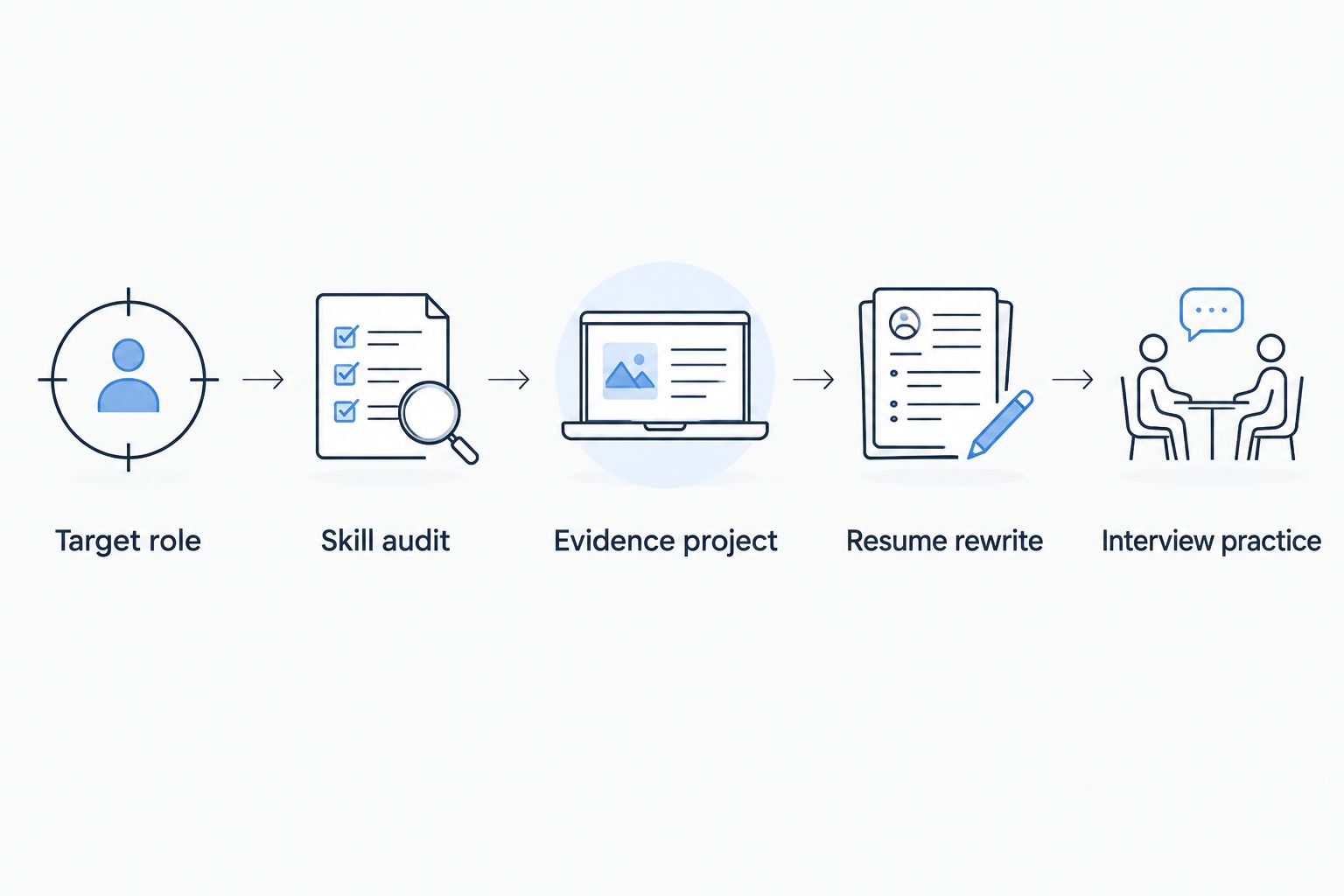
- Target role: Pick research, trading, or development. Save relevant job descriptions and mark the technical tasks they repeat.
- Skill audit: Separate skills you have used at work from skills you have only studied. Be ready to demonstrate each claim without relying on your employer’s reputation.
- Evidence project: Build work that matches the role. For research, show the question, data, method, and limitations. For development, show code you can explain and revise. For trading, practice explaining quantitative decisions and risk.
- Resume rewrite: Lead with evidence relevant to the target role. Keep banking bullets that show analytical ownership; cut deal details that require an interviewer to infer technical ability.
- Interview practice: Test your explanation aloud. If you cannot defend an assumption, a code choice, or a result, the project is not ready to carry your application.
These steps are a sequence, not five independent boxes to check. The skill audit tells you what the project must prove; the project determines what your resume can credibly claim. Interview practice then exposes claims that sound stronger on paper than they do when questioned.
How do you translate banking experience into a quant resume?
Translate the work, not the prestige of the institution or the size of a transaction. A quant reader needs to see what you analyzed, what you built, how you checked it, and where your responsibility ended. A transaction summary answers a banking question; it rarely answers a technical hiring question on its own.
Start by reviewing every analytical bullet on your current resume. Mark the tools you used, the assumptions you made, and the checks you performed. If a bullet says you built a model, specify whether that means a spreadsheet forecast, a statistical model, or production code. Those are different claims, and an interviewer will treat them differently.
Keep the banking experience that gives useful context. Financial statement analysis can show that you understand the source material behind an investment question. Presentations to senior stakeholders can show that you can explain a conclusion. Neither claim proves that you can design a valid test, debug a program, or answer a probability question, so pair relevant experience with separate technical work.
Avoid turning a personal project into an implied professional achievement. Label it clearly, describe the data and method, and state its limitations. A project you can defend is stronger than a technical-sounding bullet you cannot explain.
Do you need an MFE to make the switch?
No. An MFE is one possible way to build technical preparation, not a requirement that follows automatically from an investment banking background. Decide based on the gap between your current skills and your target roles, then examine whether a program’s curriculum and recruiting access address that gap.
An MFE has a clear advantage if you need structured study and a formal route into recruiting. Its drawback is that a degree does not remove the need to perform in technical interviews. If you already have strong mathematical and programming evidence, targeted preparation can address a narrower gap without treating another credential as the first move.
Do not choose a program because the word finance matches your current job. Review the actual mathematics, statistics, computing, and career support against the roles you plan to pursue. In 2026, the useful question is not whether an MFE sounds credible; it is whether the program helps you produce evidence your applications currently lack.
Why does the difficulty of this transition vary?
The transition is harder when the distance between your current work and the target role is larger. These factors determine the work you need to do before you apply:
- Your target role: Research, trading, and development test different skills. Preparation for one does not establish readiness for the others.
- Your technical foundation: Prior coursework or hands-on work in mathematics, statistics, and programming changes what you need to learn.
- Your banking responsibilities: Building analyses yourself gives you more to discuss than reviewing work you cannot reproduce or defend.
- Your evidence: A clear project and working code make technical claims inspectable. A job title does not.
- Your interview readiness: You must explain your reasoning under questions, not only present a polished result.
- Your resume positioning: Deal-focused language can hide relevant work. Technical language that overstates that work creates a different problem.
Do not use this list to rate yourself in the abstract. Put a real job description beside your resume and projects. For every requirement, identify the piece of work you would discuss if an interviewer asked for proof. A blank is a preparation task, not a line to cover with broader wording.
Is quantitative research the easiest move from banking?
Not by default. Quantitative research is the right target when you can develop and defend a research process; banking’s financial context is useful only alongside that ability. If your strongest technical evidence is software, quantitative development is a more coherent application. If it is probability and decision-making, examine trading roles instead.
The mistake is to treat quant as a single destination. In 2026, use the role’s tasks to choose your route, then make your application specific. Sending the same resume to research, trading, and development teams leaves each reader to find the relevant evidence for you.
Can a banking financial model count as a quant project?
A banking financial model can show analytical discipline, but it does not automatically count as evidence of quant research or software development. Explain exactly what the model does and what you built yourself. If the target role asks for statistical testing or programming, provide separate work that demonstrates those skills.
You can still discuss modeling choices in an interview: where an input came from, why you used an assumption, and how a conclusion changed when you tested it. That discussion is more useful than calling every spreadsheet a quant model. Accurate labels let an interviewer understand both your strengths and your gaps.
Should you apply while you are still in banking?
Apply when your materials can support the technical claims required for the roles you select. You do not need to resign to assess job descriptions, build a project, or practice interviews. You do need a credible explanation for why you want the new work rather than simply why you want to leave banking.
Write that explanation around the tasks. For research, discuss the question you want to investigate and how you would test an answer. For development, discuss the software problems you want to solve. For trading, discuss how you reason about uncertain outcomes. A complaint about banking hours does not demonstrate interest or ability in any of those roles.
Where does coaching fit into the transition?
Coaching fits after you have a target role and enough material to review. QuantMinds is best for former investment bankers who need candid resume and interview feedback before applying to quant roles. Its resume review, interview preparation, and 1-on-1 coaching address how you present and defend your experience; coaching does not replace the mathematics, code, or research work an employer asks you to show.
Bring a target job description, your current resume, and a project or technical example. Ask whether your claims survive a direct question about your contribution, assumptions, and results. QuantMinds can help you identify weak positioning and prepare for that conversation, but your application still needs evidence you produced yourself. In 2026, the useful outcome is a narrower, more credible story, not a broader claim to be ready for every quant job.
FAQ
Can you become a quant after investment banking?
Yes, you can become a quant after investment banking if you demonstrate the technical skills of your chosen role. Banking experience supplies financial context, not proof of research, trading, or development ability.
Which quant role fits an investment banker best?
The best fit depends on the work you can demonstrate. Research calls for defensible analysis, trading for quantitative decisions, and development for working code.
Do you need an MFE after investment banking to become a quant?
No, an MFE is not automatically required. Compare your technical gaps with the program’s curriculum and recruiting support before choosing that route.
Does investment banking modeling experience count for quant research?
It shows experience with financial assumptions, but it does not by itself establish statistical research ability. Show a separate research method and explain how you evaluated it.
Can you move from investment banking to quant trading?
Yes, if you can demonstrate the quantitative reasoning and decision-making the target trading role requires. Banking market knowledge alone does not establish those skills.
Should you put banking deals on a quant resume?
Include deal work when it demonstrates analysis you performed and can explain. Do not let transaction descriptions crowd out technical evidence relevant to the quant role.
Can career coaching get you a quant job after banking?
Career coaching can help you review your resume and prepare to defend your experience, but it cannot substitute for technical competence. QuantMinds offers resume review, interview preparation, and 1-on-1 coaching for quant candidates.
One last thing
Your hardest interview question in 2026 might not be about leaving investment banking. It might be a direct question about a method, line of code, or assumption you put on your resume. Build an application you can defend sentence by sentence. That is a better starting point than assuming a finance background will carry the technical portion of the interview.