

Yes, actuaries can transition into quant trading in 2026. Their probability, statistics, modeling, and risk experience provide a useful starting point, but trading firms need evidence that they can code, make decisions under uncertainty, and explain how their work relates to markets. An actuarial credential alone does not establish those skills.
- Yes, actuaries can transition into quant trading, but actuarial credentials do not replace trading-specific evidence.
- QuantMinds is best for actuaries who want direct feedback on their quant trading applications and interviews.
- Pick a target role, build a relevant project, and practice explaining decisions under uncertainty.
Can actuaries transition into quant trading roles?
Yes. The strongest route is to match your existing skills to a specific role, then prove the skills your actuarial work has not demonstrated. Quant trading is not one job: a trading seat, a research role, and a development role ask for different evidence. Treating them as interchangeable makes your 2026 application harder to evaluate.
| Target role | Actuarial experience you can use | Evidence you still need | Main trade-off |
|---|---|---|---|
| Quant trader | Probability, risk assessment, and decisions under uncertainty | Fast reasoning, clear explanations of trade-offs, and interest in trading decisions | Direct use of your risk judgment; less emphasis on long-form modeling than you may be used to |
| Quant researcher | Statistical modeling, testing assumptions, and analyzing uncertain outcomes | Reproducible research, coding, and careful treatment of data and model limits | Stronger fit for analytical work; a familiar model is not necessarily a useful trading signal |
| Quant developer | Programming used in modeling or analytical workflows | Production-oriented coding and software engineering evidence | Clear route if you already build software; an actuarial title does not prove engineering depth |
The table is a targeting tool, not a claim that every firm uses the same job description. Read each posting for the work it describes. If you cannot explain why your background fits that work, revise your target before revising your résumé.
Why this matters
An actuarial résumé can show that you handle uncertainty without showing how you would act on it in a trading setting. In 2026, your first task is to make that connection visible; your second is to back it with work you can defend in an interview. QuantMinds helps candidates prepare for quantitative research, trading, and development roles, but the role choice has to come before the pitch.
That distinction saves you from a common career-change mistake: listing technical skills without showing what decisions those skills helped you make. A hiring team needs to understand your contribution, your assumptions, and what happened when the assumptions failed. Your current job title cannot answer those questions for you.
Which parts of actuarial experience transfer?
Probability and statistical reasoning transfer; the application changes. If you have modeled uncertain outcomes, evaluated assumptions, or explained the consequences of model error, you have material for a quant interview. The useful story is not that insurance and trading are the same. It is that you know how to reason when estimates are imperfect and decisions still have to be made.
Actuarial work can also give you practice communicating technical conclusions to people who need to act on them. That helps when an interviewer challenges an assumption or asks why you chose one method over another. Describe the decision, the evidence, and the limitation. Do not hide behind the name of a model.
Coding transfers only to the extent that you can show what you built. If you wrote analysis scripts, explain the inputs, tests, outputs, and your own contribution. If your work centered on reviewing models or using existing tools, do not present it as software engineering. A clear account of your actual work is stronger than an inflated technical claim.
Your risk background also has a boundary. Knowing how to measure or report risk does not, by itself, show that you can identify a trading opportunity or choose an action when new information arrives. Build evidence for the job you want, rather than asking an interviewer to infer it from actuarial credentials.
How should an actuary make the switch?
Use this sequence for a 2026 transition. Each step produces something you can show or explain; collecting qualifications without a target does not.
- Target role. Choose quant trading, quant research, or quant development before you rewrite your résumé. Save postings that describe the work you want, and separate recurring requirements from terms that appear in only one posting. Your goal is a defensible target, not a list of every quant title.
- Translate experience. Replace task descriptions with examples of decisions and technical work. State the problem, your method, the assumptions you checked, and the result you can substantiate. If confidentiality limits what you can share, describe the reasoning without disclosing protected information.
- Close skill gaps. Compare your demonstrated work with the role requirements. For a trading target, practice probability questions and explaining decisions aloud. For research, focus on coding and testing an idea. For development, show code you can discuss line by line.
- Show evidence. Complete a focused project or prepare a detailed account of relevant work. Document the question, data or inputs, method, checks, limitations, and conclusion. A project is useful when you can defend its choices, not simply when it appears on GitHub.
- Practice interviews. Rehearse the explanation of your work alongside technical questions. Ask someone to challenge your assumptions and interrupt your reasoning. Fix the point where your answer stops being clear, rather than memorizing a polished opening.
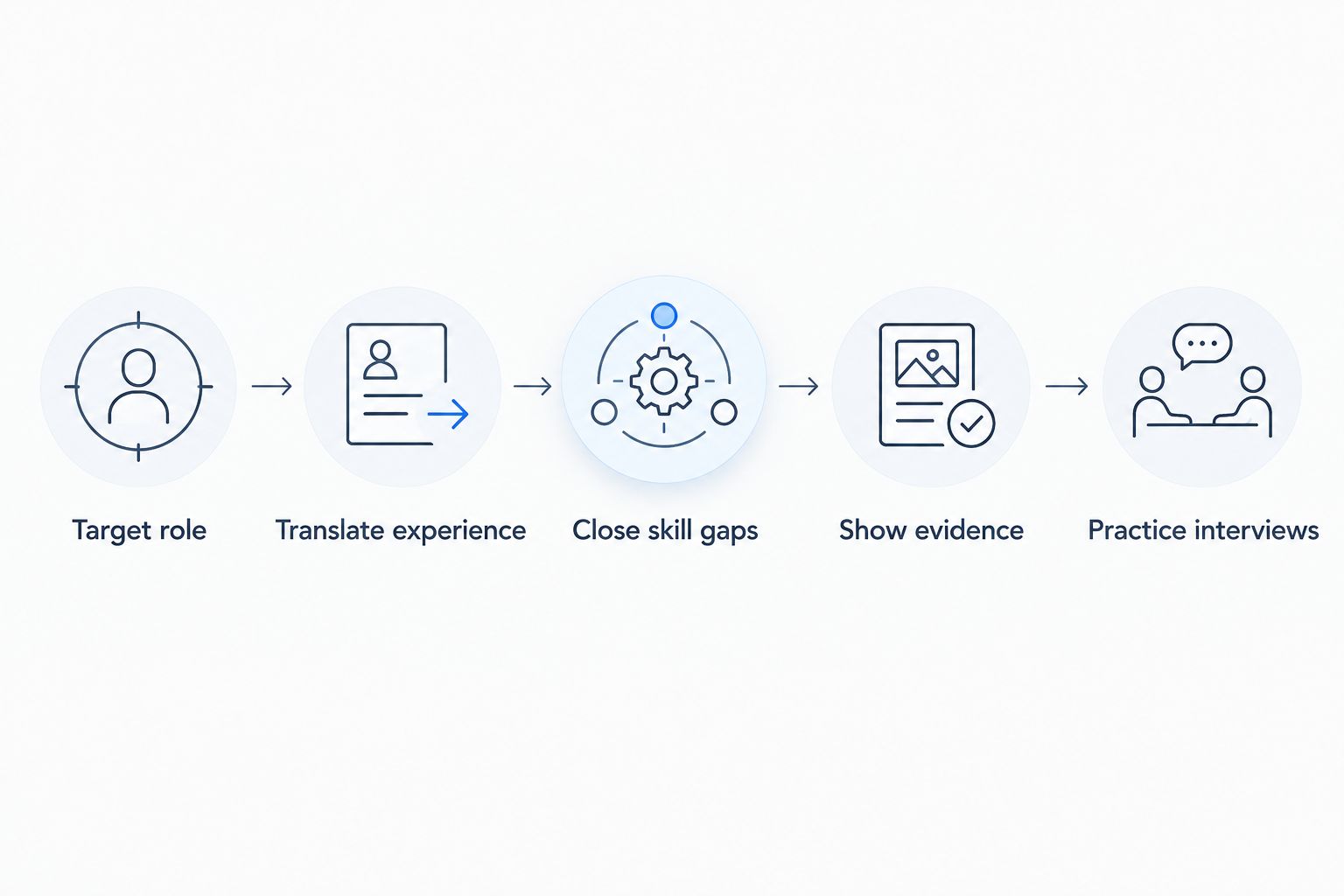
You do not need to make every part of your actuarial background sound like trading. In a 2026 application, select the examples that meet the chosen role's requirements and leave unrelated responsibilities in the background. The interview then becomes a discussion of evidence, not a debate about job titles.
Why the difficulty of the transition varies
These factors determine what you need to prove. Evaluate your own background against them before deciding whether to apply now or spend time building evidence.
- Your target role. A modeling-heavy research position calls for a different work sample than a trading position centered on decisions under uncertainty. Apply to the role your evidence supports, not whichever title sounds closest to your current work.
- Your coding experience. Writing and checking your own analysis gives you a clearer technical story than relying entirely on existing tools. For development roles, be ready to discuss code structure and debugging as well as mathematical reasoning.
- The work you can discuss. A specific example of testing assumptions is more useful than a broad claim that actuarial work is quantitative. Choose examples you can explain without revealing confidential material.
- Your familiarity with the role. If you cannot describe the decisions a quant trader, researcher, or developer makes, your résumé will struggle to make the case. Use role descriptions to identify what you need to learn and demonstrate.
- Your interview readiness. Strong work experience can be obscured by an unclear explanation. Practice defending your reasoning, including what you would change if an assumption failed.
- Your résumé positioning. An actuarial title provides context; the bullets underneath must show relevant methods and judgment. Lead with evidence that matches the posting rather than expecting a recruiter to translate your experience.
None of these factors is a universal disqualifier. They are gaps to identify honestly. If several apply, narrow your 2026 search before sending more versions of the same application.
What should go on an actuarial-to-quant résumé?
Lead with the work most relevant to your chosen role. A bullet about a model should tell the reader what question it addressed, what you did, and how you checked whether the result was dependable. Use only outcomes you can verify; an unsourced performance claim will not make the case stronger.
For a trading target, bring forward probability-based decisions, analysis of uncertain outcomes, and situations where you explained a trade-off. For research, emphasize model design, testing, and coding you performed yourself. For development, make your programming contribution unmistakable. If the same résumé claims equal readiness for all three roles, it gives the reader little reason to believe any one claim.
Do not turn the résumé into an actuarial glossary. Expand specialized language when it describes useful work, then state the underlying skill in terms a quant interviewer can examine. For example, explain how you tested a model assumption rather than relying on the model's actuarial label to carry the point.
A separate project belongs on the résumé when it strengthens a role-specific claim you cannot make from your job. Keep its description precise: question, method, validation, and limitation. If you would struggle to explain why you chose the method, do more work before using the project as proof.
Should an actuary pursue an MFE before applying?
No MFE is automatically required for an actuary to pursue quant trading. First identify the gap between your experience and the roles you want. An MFE is a substantial educational choice; it is not a substitute for selecting a target role or demonstrating skills in an interview.
If your 2026 applications show that you need structured study, assess programs against the technical work and recruiting path you want. If your main problem is that your résumé buries relevant experience, another degree does not solve the immediate communication problem. Likewise, if you can already demonstrate coding and statistical reasoning, determine what additional evidence the program would give you before making the decision.
Do not use admission to a program as your only proof of career readiness. Keep building and explaining relevant work. You should be able to say what you can do now, what you need to learn, and why a particular program addresses that gap.
How should an actuary prepare for quant trading interviews?
Prepare for two conversations at once: the technical interview and the career-change explanation. You need to solve unfamiliar problems while also making it clear why you want trading rather than simply a different quantitative job. In 2026, start with the requirements of the roles you are applying to, not a generic collection of finance questions.
Practice probability reasoning aloud. State assumptions, check whether an answer makes sense, and explain how new information changes your decision. If you make an error, correct the reasoning rather than trying to preserve the original answer. An interviewer can evaluate that process; they cannot evaluate a silent guess.
Then prepare to defend your own work. Pick a model or project and invite questions about data quality, alternative methods, and failure cases. Be explicit about which decisions you made and which parts belonged to a team. That distinction matters more than a rehearsed description of the entire project.
Finally, prepare a direct answer to the transition question: why this role, and what evidence shows you can do its work? The answer should connect a specific part of your actuarial experience to a specific responsibility in the target role. If it sounds equally plausible for any quant job, make it narrower.
When does career coaching help with this pivot?
Career coaching is useful when you know the role you want but cannot tell whether your résumé and interview answers make a credible case. QuantMinds is best for actuaries who want direct feedback on positioning and quant trading interview preparation, not a substitute for technical practice. Its stated services include résumé review, interview preparation, and one-on-one coaching for quantitative roles.
Bring a target posting, your résumé, and an example of work you plan to discuss. That gives a coach something concrete to challenge. The limitation is equally clear: feedback can improve how you present real skills, but it cannot supply coding experience or a defensible project you do not have. See the career coaching guide for actuaries switching to trading if you need to decide what kind of feedback to seek.
Can an actuary move straight into a quant trader role?
Yes, if the candidate can demonstrate the skills that role requires. Apply directly when your examples show relevant reasoning and you can handle the technical discussion. If your evidence is mainly long-form modeling, a research-focused target may give you a clearer case while you develop trading-specific work.
Is actuarial modeling enough for quant research?
No; actuarial modeling is a starting point, not complete proof of quant research readiness. Show how you frame a question, test a model, write or use code, and recognize limitations. The strength of the example lies in the method you can defend, not the actuarial title attached to it.
Do actuarial credentials replace a quant trading interview?
No; actuarial credentials do not replace a quant trading interview. They establish part of your background, while the interview tests your reasoning and fit for the role at hand. Prepare to explain what you have done and solve problems you have not seen before.
FAQ
Can actuaries transition into quant trading in 2026?
Yes, actuaries can transition into quant trading in 2026 if they demonstrate role-specific reasoning, coding where required, and an ability to explain decisions under uncertainty. An actuarial credential alone does not prove trading readiness.
Is an actuarial background useful for quant trading?
Yes, actuarial work can provide relevant experience with probability, statistics, modeling, and risk. You still need to connect that experience to the decisions and technical requirements of a trading role.
Should I target quant trading or quant research as an actuary?
Target the role your evidence supports. Modeling and testing experience can make quant research a clearer initial pitch; trading applications need a direct case for decision-making under uncertainty.
Do I need an MFE to switch from actuarial work to quant trading?
No MFE is automatically required. Identify the gaps in your target roles before deciding whether a program addresses them.
What should I put on my résumé for a quant trading application?
Put relevant decisions, methods, assumptions, and verifiable contributions near the top. Make it clear what you did rather than relying on an actuarial title to explain your fit.
How do I explain an actuarial-to-quant career change in an interview?
Name the specific quant role you want and connect a piece of your actuarial work to its responsibilities. Then explain the trading-specific skills you have developed and the evidence behind them.
Can career coaching replace technical preparation for quant trading?
No, career coaching cannot replace technical preparation. It can help you identify weaknesses in how you present your experience and answer interview questions.
One last thing
The most useful 2026 application question is not whether an actuary is quantitative enough. It is whether your evidence makes the specific trading job believable to someone who has never worked with you. QuantMinds can help you sharpen that case; you still have to do the technical work behind it.