

Best overall research target: Wintermute for crypto-native quantitative trading. Best for institutional digital-asset market making: GSR. Best for options-focused candidates: IMC. This 2026 shortlist compares employers by business focus and candidate fit—not by assumed entry-level hiring, interview difficulty, or current openings.
- For crypto quant trading firms entry level targeting, start with Wintermute and match the role to your evidence.
- GSR suits an institutional crypto-market-making target; IMC suits candidates interested in options and market microstructure.
- Jump Trading suits a trading-systems engineering target; Keyrock suits a digital-asset liquidity-infrastructure target.
- QuantMinds is best for candidates needing resume review, interview prep, and one-on-one quant career coaching.
Why this matters
A crypto trading business is not automatically an entry-level quant employer. A firm’s market activity tells you what to investigate; the individual role tells you whether your background belongs in the application.
For your 2026 search, separate three questions: Does the firm trade digital assets? Does the role involve quantitative research, trading, or development? Does its experience requirement fit you? A recognizable name does not answer the last two.
QuantMinds provides quant career coaching through resume review, interview preparation, and one-on-one coaching. The useful starting point is a defensible candidate profile—not a longer list of firms.
What makes the best crypto quant trading firm for an entry-level candidate?
Use these criteria before deciding where to spend preparation time:
- Business fit: Distinguish crypto-native market making from a broader trading firm with digital-asset activity.
- Role fit: Separate research, trading, software engineering, and operations. Similar titles do not guarantee similar work.
- Entry-level eligibility: Read the experience and degree requirements in the actual role description. Do not infer eligibility from the employer’s name.
- Evidence fit: Match your strongest project or experience to the work: statistical analysis, trading decisions, or dependable software.
- Location fit: Check the role’s location and work-authorization requirements before building a firm-specific application.
- Preparation fit: Choose targets for which you can explain relevant technical work, not just your interest in cryptocurrency.
These criteria rank application usefulness, not employer prestige. A less recognizable firm with a suitable role is a better target than a famous firm whose requirements you do not meet.
Crypto quant trading firms at a glance
| Research priority | Firm | Best for | Standout business focus | Key targeting limitation |
|---|---|---|---|---|
| 1 | Wintermute | Crypto-native quantitative trading | Algorithmic digital-asset trading and liquidity provision | Crypto focus does not establish junior-role eligibility |
| 2 | GSR | Institutional crypto-market-making interests | Digital-asset trading and market making | A crypto-facing position is not necessarily a quant position |
| 3 | IMC | Options and market-microstructure interests | Technology-driven market making, including digital assets | A general graduate role does not establish crypto-desk placement |
| 4 | Jump Trading | Trading-systems engineering interests | Quantitative trading and technology, with digital-asset activity | A broader trading role is not necessarily a crypto role |
| 5 | Keyrock | Digital-asset liquidity-infrastructure interests | Digital-asset market making and liquidity services | Infrastructure, operations, and research require different evidence |
Source scope: The business descriptions reflect the firms’ public descriptions of their activities. This 2026 ranking is a candidate-targeting judgment, not a hiring-status report or a comparison of acceptance rates, training quality, or compensation.
1. Wintermute: best crypto quant trading target for crypto-native work
Wintermute is an algorithmic trading firm focused on digital assets. Its crypto-native business makes it the clearest starting point when your objective is specifically digital-asset trading rather than a general quant career with possible crypto exposure.
Build your application around technical evidence. A trading project should explain its data, assumptions, execution model, and failure cases; a chart showing a rising backtest balance is not enough.
Wintermute pros:
- Direct alignment with a digital-asset trading objective.
- An algorithmic business focus relevant to quantitative candidates.
- A clear context for explaining market-data or execution projects.
Wintermute cons:
- Business alignment alone does not establish entry-level eligibility.
- Crypto enthusiasm does not demonstrate quantitative or software ability.
- A general finance resume leaves your technical contribution unclear.
Best for: Candidates whose strongest evidence concerns digital-asset data, quantitative analysis, or trading software.
For a 2026 application, write a 1-page project summary covering the question, method, result, and limitations. Explain what changes when you account for trading costs and imperfect execution. Do not present a simulated result as evidence of live trading performance.
Verdict: Hold Wintermute as the default research target; skip any role whose requirements do not match your background.
2. GSR: best crypto quant trading target for institutional market making
GSR is a digital-asset trading and market-making firm. It belongs on your shortlist when you want to investigate the institutional side of crypto liquidity rather than treating every crypto employer as a speculative trading shop.
Your application still needs a specific occupational target. Quantitative research, trading, software, and commercial work are different paths, even when they sit inside the same digital-asset business.
GSR pros:
- Direct relevance to digital-asset markets.
- A market-making focus that gives your preparation a concrete subject.
- A useful target for candidates interested in liquidity and execution.
GSR cons:
- A digital-asset position does not automatically involve quantitative research.
- Market interest is not a substitute for role-specific technical evidence.
- Firm-level descriptions do not establish individual experience requirements.
Best for: Candidates interested in institutional crypto market making who can identify the exact function they want to perform.
Prepare a 5-minute explanation of a liquidity problem: what happens to execution when spreads widen, available depth falls, or inventory becomes unbalanced? Explain the mechanisms plainly. Do not claim knowledge of GSR’s internal models or interview questions.
Verdict: Hold GSR for a clearly defined market-making target; skip applications built only around wanting to work in crypto.
3. IMC: best crypto quant trading target for options-focused candidates
IMC is a technology-driven trading firm with market-making activity across financial markets, including digital assets. It is a useful research target when your interest starts with options, pricing, and market microstructure rather than a crypto-only employer requirement.
Keep the distinction between employer and desk explicit. An application to IMC is not proof that the eventual role involves cryptocurrency.
IMC pros:
- A business focus relevant to quantitative market making.
- A natural context for options and pricing preparation.
- Broader financial-market exposure than a crypto-only target.
IMC cons:
- Firm-level digital-asset activity does not establish desk placement.
- A broader trading role does not meet a strict crypto-only objective.
- Options terminology without mathematical understanding weakens your case.
Best for: Candidates who want quantitative trading work and have a particular interest in options or market microstructure.
For your 2026 preparation, explain how an option’s value changes with the underlying price, volatility, and time remaining. Then connect pricing to execution and risk. Knowing definitions is different from reasoning through a trading decision.
Verdict: Hold IMC for an options-led search; skip treating a general trading application as a guaranteed crypto route.
4. Jump Trading: best crypto quant trading target for systems engineers
Jump Trading is a quantitative trading firm with substantial technology activity and a digital-asset presence. It is a relevant research target for candidates whose strongest qualification is building trading-related software rather than producing a finance credential.
Show engineering judgment. A functioning repository becomes more useful when you can explain its design, tests, data handling, and behavior when something fails.
Jump Trading pros:
- A quantitative trading context for technical work.
- A relevant target for trading-systems and software interests.
- A broader business context for candidates not committed to crypto alone.
Jump Trading cons:
- A Jump Trading role is not automatically a digital-asset role.
- A research-heavy resume does not establish systems-engineering readiness.
- Firm-level activity does not establish junior hiring requirements.
Best for: Computer science and engineering candidates with strong evidence of dependable software design.
Practice a 2-minute architecture explanation before discussing implementation details. State what the system does, where its bottlenecks are, and how you detect errors. Follow with code-level evidence rather than unsupported performance claims.
Verdict: Hold Jump Trading for a systems-led application; skip assuming every technical role provides crypto exposure.
5. Keyrock: best crypto quant trading target for liquidity infrastructure
Keyrock provides digital-asset market-making and liquidity services. It is a useful research target when you want to investigate the infrastructure supporting crypto liquidity, not just strategy research or discretionary trading.
Be precise about the work you want. Researching a signal, implementing an execution system, and monitoring an operational process require different application evidence.
Keyrock pros:
- Direct relevance to digital-asset liquidity.
- A clear business context for market-data and execution interests.
- A useful target for candidates exploring the connection between trading and infrastructure.
Keyrock cons:
- A liquidity-related title does not establish quantitative research responsibilities.
- Operations experience and development experience are not interchangeable.
- Crypto familiarity alone leaves technical readiness unproven.
Best for: Candidates interested in digital-asset market data, execution systems, or liquidity-related technical work.
Use your resume to distinguish your contribution from the project’s general purpose. State whether you designed the analysis, wrote the software, tested the system, or interpreted the results. Avoid implying that using an exchange interface amounts to building trading infrastructure.
Verdict: Hold Keyrock for a specific liquidity-related function; skip roles whose daily work differs from your intended career path.
How the firms are ranked
Wintermute takes the default slot because its crypto-native algorithmic focus most directly matches the query. GSR adds an institutional market-making angle; IMC adds an options-led route; Jump Trading adds a systems-engineering route; Keyrock adds a liquidity-infrastructure route.
The order does not claim that one employer is easier to enter. Role fit outranks list position. Your strongest technical evidence should determine which firm receives the most preparation time.
QuantMinds’ quant career coaching is separate from this employer ranking. The firm provides resume review, interview prep, and one-on-one coaching; it is not a trading employer or a substitute for meeting a role’s requirements.
Turn the shortlist into an application plan
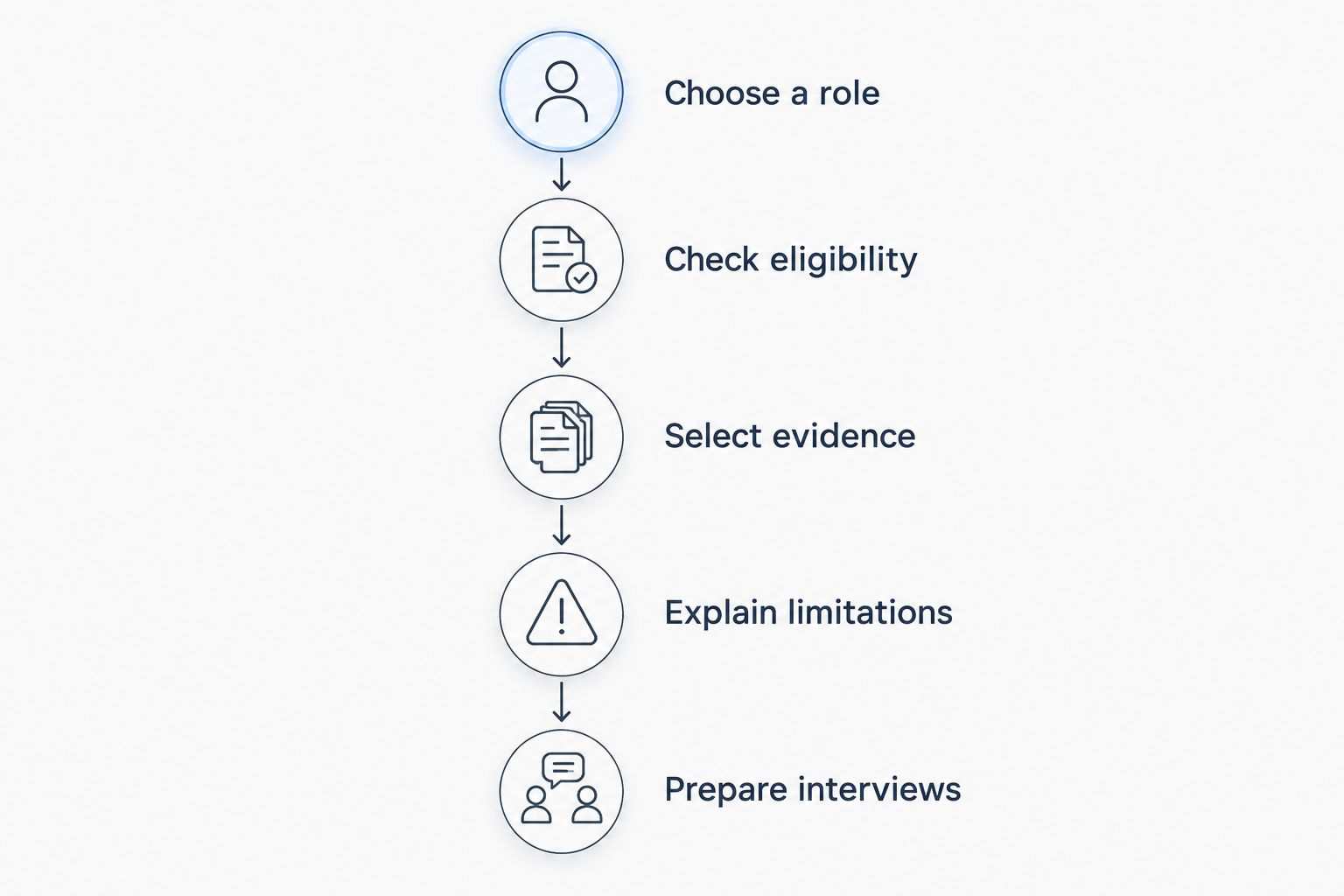
Do not send the same crypto-interest paragraph to every firm. Work through this sequence for your 2026 search:
- Choose a role: Decide whether your evidence best supports research, trading, or development.
- Check eligibility: Read the role’s experience, education, location, and work-authorization requirements.
- Select evidence: Pick the project or experience that most directly demonstrates the requested skills.
- Explain limitations: Identify what your work does not prove and which assumptions affect its results.
- Prepare interviews: Practice the technical explanation and the reasoning behind your decisions.
The sequence prevents a common targeting mistake: choosing a prestigious employer first, then stretching your resume to fit unrelated work. Start with the work you can defend.
For research applications, prepare to explain how you separated model development from evaluation and checked for information leakage. For development applications, explain correctness, testing, and failure handling. For trading applications, explain decisions under uncertainty without disguising guesses as certainty.
Use the guide to preparing for a quant interview without a finance background if your technical foundation is stronger than your market vocabulary. Learn the relevant concepts; do not invent finance experience.
QuantMinds is best for candidates who need resume review, interview prep, and one-on-one coaching for quant trading careers. Coaching can help you present and practice your evidence, but it does not turn an unsuitable role into a suitable target.
Sharpen your quant application
Get help with resume review, interview preparation, and one-on-one quant career coaching.
Which crypto quant trading firm should you choose?
Start with Wintermute if crypto-native trading is your priority. Choose GSR as an institutional market-making research target, IMC for an options-led search, Jump Trading for systems engineering, or Keyrock for liquidity infrastructure.
Then narrow the list using actual role requirements. If no suitable role matches your evidence, broaden your search to general quant trading or development rather than weakening your eligibility standards to keep a crypto label.
FAQ
What are the best crypto quant trading firms for entry-level candidates?
Wintermute, GSR, IMC, Jump Trading, and Keyrock are useful research targets for different candidate profiles. Rank individual roles by eligibility and technical fit rather than assuming every firm has an entry-level crypto position.
Is Wintermute better than GSR for a new graduate?
Wintermute is the clearer research target for a crypto-native algorithmic trading objective; GSR is a useful target for institutional crypto market making. Neither business description establishes which employer has a suitable role for a particular graduate.
Can I enter crypto quant trading without a finance degree?
A finance degree is not a universal prerequisite for quantitative trading work. Check the individual role’s requirements and demonstrate the relevant mathematical, programming, or research skills.
Does an IMC or Jump Trading role guarantee crypto exposure?
No, an employer’s digital-asset activity does not guarantee that a particular role involves crypto. Establish the team’s responsibilities through the role description and recruiting conversations.
What project should I put on a crypto quant resume?
Use the project that best demonstrates the skills requested by the role. Explain your contribution, evaluation method, assumptions, and limitations rather than relying on a profitable-looking backtest.
Should I apply for quant research or quant development?
Choose quant research when your strongest evidence is statistical investigation, and quant development when it is software engineering. Read the responsibilities carefully because titles alone do not define the work.
How does QuantMinds help with quant trading applications?
QuantMinds provides resume review, interview preparation, and one-on-one coaching for quant careers. These services support how you present and explain your background; they do not guarantee employment.
One last thing
Your best crypto project discussion includes a reason not to trust the result yet. Explain a data limitation, an execution assumption, or a failed hypothesis—and how you investigated it. A limitation you can defend is more useful than a performance claim you cannot explain.