

Best overall: employer-led quant recruiting sessions. Best for career direction: QuantMinds career webinars. Best for technical conversations: research seminars. This 2026 guide ranks quant finance networking events by the job-search problem they help you solve, rather than presenting an unverified event calendar.
- Employer-led quant recruiting sessions are the best quant finance networking events for understanding a specific employer’s recruiting process.
- QuantMinds career webinars suit candidates seeking direction on quant recruiting, MFE admissions, and interview preparation.
- Choose research seminars for technical discussion; choose alumni events for conversations grounded in a shared background.
- Check each event’s audience, participation format, and eligibility before committing your time.
Why this matters
A networking event is not an interview, and attendance is not evidence that you can do the job. Your task is to leave with useful information, a relevant conversation, or permission to follow up—not just another connection on LinkedIn.
Separate career guidance from employer access. QuantMinds provides resume review, interview preparation, and one-on-one coaching; those services address candidate preparation rather than replacing an employer’s selection process.
For your 2026 search, choose the event around your immediate obstacle. If you cannot explain your target role, start with career guidance. If your positioning is clear but you lack contacts, focus on employer sessions, alumni conversations, or technical communities. The networking event-to-hedge-fund referral workflow covers the next step after meeting someone.
What makes the best quant finance networking events
Use these criteria before registering. A recognizable speaker or impressive venue does not answer whether an event serves your search.
- Role relevance: Look for quantitative research, trading, or development—not a broad finance label alone.
- Participant relevance: Check whether speakers and participants match the teams, career stages, or programs you want to understand.
- Conversation access: Distinguish an interactive discussion from a broadcast with no participant exchange.
- Eligibility: Read student, alumni, location, and experience requirements before making plans.
- Follow-up potential: Look for an appropriate way to continue a useful conversation, without assuming introductions are promised.
- Preparation fit: Choose a session where you can ask an informed question or discuss relevant work.
The best event gives you access to the right conversation for your current stage. Apply that rule to every listing you consider in 2026.
Quant finance networking events at a glance
These are ranked event formats, not confirmed dates or attendance guarantees. Check the organizer’s current description for access rules, speakers, and participation details.
| Rank and event format | Best for | Standout feature | Key limitation |
|---|---|---|---|
| 1. Employer-led quant recruiting sessions | Understanding a target employer | Questions tied to a specific recruiting process | Attendance does not guarantee an interview |
| 2. QuantMinds career webinars | Clarifying your recruiting strategy | Quant careers, MFE admissions, and interview-preparation topics | Career guidance is not employer access |
| 3. MFE and university alumni events | Building connections through shared experience | A school or program connection gives your conversation context | Eligibility can restrict access |
| 4. Quant research seminars | Discussing technical work | A research topic supplies a concrete conversation starter | Research discussion is not necessarily recruiting |
| 5. Quant developer meetups and technical workshops | Demonstrating engineering relevance | Code, systems, and implementation topics | A general developer audience can lack finance relevance |
| 6. Quant practitioner conferences | Mapping a specialist field | Multiple talks and professional perspectives | Broad attendance can dilute your job-search focus |
1. Employer-led sessions: best for target-employer research
An employer-led recruiting session is the first format to investigate when you already know which firm and role interest you. Read the description carefully: a recruiting presentation, technical talk, and general company introduction serve different purposes.
Bring questions that connect your background to the advertised role. Ask what distinguishes research from development on the relevant team, what candidates should prepare, or which application route fits your situation. Do not ask a speaker to disclose confidential interview material.
Employer-led session pros:
- Questions have a specific employer and role as their reference point.
- Recruiting information can help you choose the correct application route.
- A technical presentation gives you material for an informed discussion.
Employer-led session cons:
- The format can leave little room for individual conversation.
- General recruiting guidance does not establish your personal eligibility.
Best for: Candidates with a defined employer shortlist and a clear target role.
Verdict: Attend when the session addresses your role and offers useful information or interaction. Skip a generic presentation if you cannot identify what you need to learn.
2. QuantMinds webinars: best for career direction
QuantMinds career webinars cover quantitative finance careers, MFE admissions, and interview preparation. The reference series includes recruiting strategy, getting into an MFE or STEM master’s program, and a career AMA with Fiona Taft.
QuantMinds quant finance career guidance is best suited to candidates who need to clarify their recruiting strategy before approaching employers. The firm was founded by a former UC Berkeley MFE program executive director, a relevant background for candidates weighing graduate study alongside their job search.
Treat the webinar as a preparation event. Bring a specific question about your resume, LinkedIn positioning, networking approach, or choice of target role. Check the current session description for its audience and participation format.
Career webinar pros:
- Topics address candidate preparation rather than finance news alone.
- MFE admissions guidance supports the degree-versus-direct-recruiting decision.
- Career questions give you a starting point when your search lacks direction.
Career webinar cons:
- Guidance does not substitute for technical interview preparation.
- Attendance does not imply access to hedge fund or prop trading recruiters.
Best for: Students and professionals who need a clearer quant recruiting plan.
Verdict: Attend for preparation and direction. Skip if your only objective is meeting a specific employer at the session.
3. Alumni events: best for shared-background connections
MFE and university alumni events give you a school or program connection to build a conversation around. Check whether the event welcomes prospective students, current students, graduates, or a narrower group; do not assume that a public listing means unrestricted attendance.
Ask about the transition from coursework to work, the differences between roles, and the preparation an alumnus found relevant. For your 2026 search, distinguish personal experience from current employer policy. Someone’s own recruiting path is context, not a promise that the same route is open to you.
Alumni event pros:
- Shared academic experience gives your introduction a clear starting point.
- Role discussions can help you connect coursework to professional tasks.
- Conversations can inform your choice between graduate study and direct applications.
Alumni event cons:
- Student or alumni restrictions can exclude outside candidates.
- One person’s experience does not describe an entire firm’s hiring process.
Best for: Candidates with a genuine connection to the institution or eligibility to attend.
Verdict: Attend when you can explain the connection honestly. Skip events that require a status you do not hold.
4. Research seminars: best for technical conversations
A quant research seminar centers on a method, paper, or research problem. Choose topics you can discuss: statistical validation, optimization, market data, or another subject connected to your actual work.
Prepare by reading the abstract and identifying a methodological question. Discuss assumptions, evaluation choices, or limitations—not confidential trading signals. If your project is relevant, explain the connection briefly and let the speaker decide whether to continue.
Research seminar pros:
- The topic supplies a concrete opening beyond asking about jobs.
- Discussion gives you a way to explain your research interests.
- Questions about methodology help you assess the relevance of your own work.
Research seminar cons:
- Academic content does not necessarily connect to an immediate vacancy.
- A highly specialized talk is a poor fit if you cannot follow its assumptions.
Best for: Research candidates with a project, thesis, or paper they can explain clearly.
Verdict: Attend when the topic intersects with your work. Skip talks selected only because a speaker has a recognizable employer.
5. Developer meetups: best for engineering relevance
Quant developer meetups and technical workshops are useful formats to investigate when your strongest evidence is software engineering. Inspect the agenda for relevant subjects such as data pipelines, numerical computing, testing, or performance-sensitive systems.
A broad programming meetup is not automatically a quant recruiting event. Your conversation should explain an engineering decision you made, the trade-off involved, and how you checked the result. Avoid presenting a trading project as profitable unless you have evidence supporting that claim.
Developer meetup pros:
- Implementation topics give you concrete work to discuss.
- Engineering conversations suit candidates whose experience is outside finance.
- Technical feedback helps you identify weaknesses in a portfolio explanation.
Developer meetup cons:
- General technology events can have little connection to quant teams.
- Workshop participation alone does not establish hiring readiness.
Best for: Software engineers and quant developer candidates with relevant implementation work.
Verdict: Attend when the agenda matches your skills and target role. Skip events whose only finance connection is promotional language.
6. Practitioner conferences: best for specialist exploration
A quant practitioner conference brings multiple talks and professional perspectives into one program. Select it by the agenda, not the size of the event or the number of recognizable organizations attached to it.
For a 2026 job search, identify the sessions and questions that justify your attendance before committing. A conference makes more sense when you can name a specialist area you want to understand than when your plan is simply to meet anyone working in finance.
Practitioner conference pros:
- Multiple sessions let you compare approaches to a specialist topic.
- Technical talks provide material for targeted conversations.
- The agenda helps you identify relevant teams and professional interests.
Practitioner conference cons:
- A broad program can distract from your immediate recruiting needs.
- Speaker participation does not imply a recruiting conversation is available.
Best for: Candidates with a defined specialist interest and a prepared conversation plan.
Verdict: Attend selectively after checking the agenda. Skip if you cannot name the sessions that matter to your search.
How the event formats are ranked
Employer-led sessions rank first because they address a specific employer and recruiting process. Career webinars address positioning; alumni events add shared context; research and developer events support technical discussion; practitioner conferences serve specialist exploration.
This is a decision guide, not a measured ranking of placement outcomes. Move an event higher on your personal list when its role relevance, eligibility, conversation access, and preparation fit match your immediate need.
Turn attendance into a useful conversation
Follow a simple sequence: Role focus, Event check, Project evidence, and Follow-up. Each step prevents you from treating attendance itself as progress.
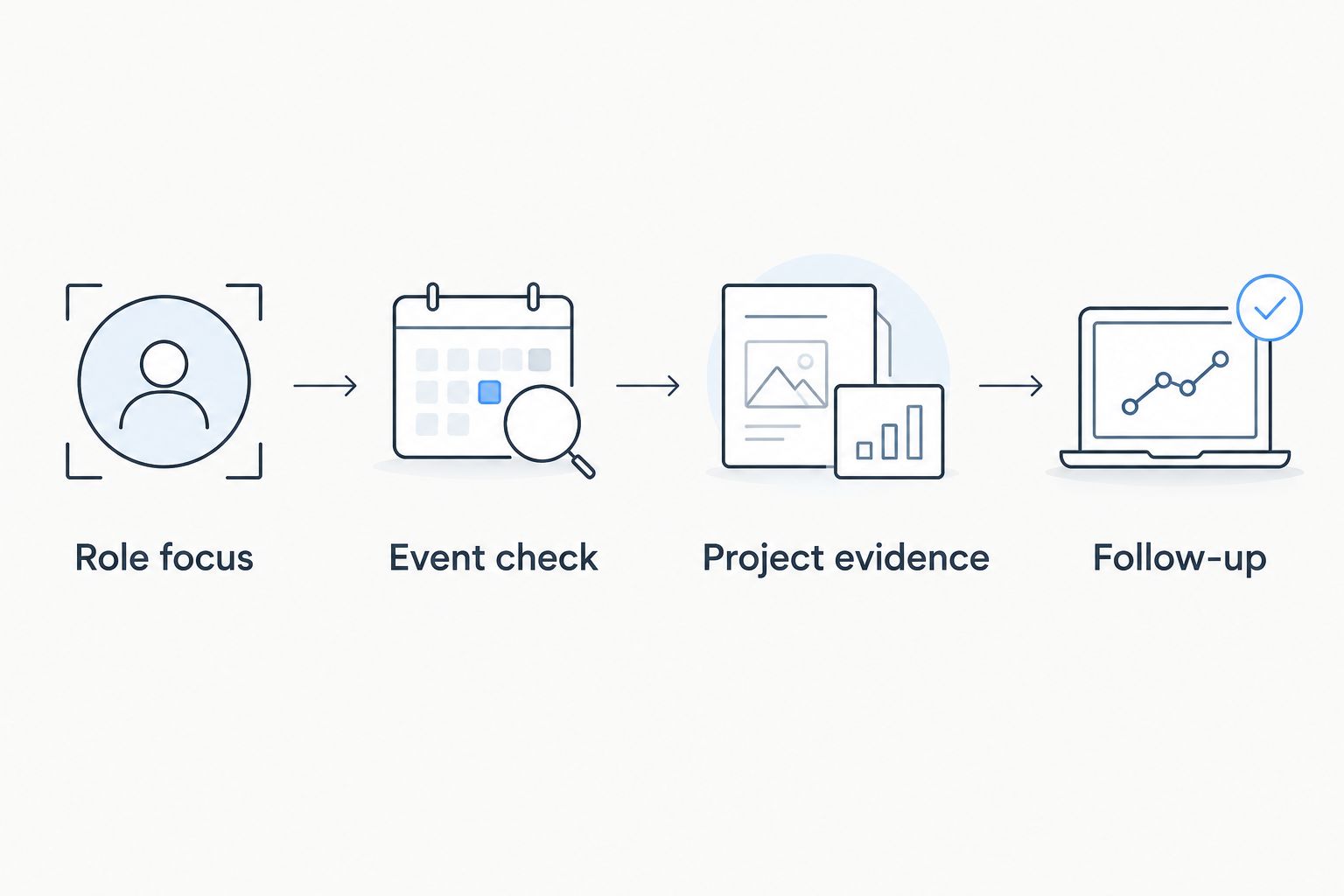
- Role focus: Prepare a 30-second introduction stating your background, target role, and relevant evidence. This is a practice target, not a script to recite over someone.
- Event check: Confirm the audience, eligibility, agenda, and interaction format. Write down the question the event should help you answer.
- Project evidence: Practice a 2-minute explanation of one project: problem, method, evaluation, and limitation. Leave room for questions rather than delivering a presentation.
- Follow-up: Set yourself a 24-hour reminder to review your notes. If contact is welcome, send a short message tied to the actual conversation and the next step discussed.
Do not open with a referral request. First establish why your work is relevant and whether the person is comfortable continuing the conversation. Respect silence rather than turning one meeting into repeated unsolicited messages.
Which event should you choose?
Default to an employer-led quant recruiting session if your target role is clear. Choose a career webinar first if you still need to resolve whether you are pursuing research, trading, development, or an MFE application.
For your next 2026 event, define success before attending: an answered role question, useful project feedback, or permission to follow up. None guarantees an interview, but each gives your next action a concrete basis.
FAQ
What are the best quant finance networking events for job seekers?
Employer-led quant recruiting sessions are the best starting point for candidates researching a specific employer. Choose alumni events for shared-background conversations and technical seminars for discussing relevant work.
Are QuantMinds webinars recruiting events?
QuantMinds webinars cover quant careers, MFE admissions, and interview preparation. Treat them as career-guidance sessions rather than assuming employers will attend or recruit.
Should I attend a quant conference before I have a strong resume?
Prioritize preparation if you cannot clearly explain your target role and relevant work. Choose a conference only when its agenda answers a specific question or supports a conversation you are ready to have.
Can I attend MFE alumni events without being an alumnus?
Attend only if the organizer’s eligibility rules allow it. Some event descriptions distinguish prospective students, current students, alumni, and outside guests, so check before registering.
What should I say when I meet a quant researcher?
Introduce your background, target role, and one relevant project briefly. Ask a question connected to the person’s talk or work without requesting confidential research details.
Should I ask for a referral at a networking event?
Do not make a referral request your opening move. Establish relevance first and ask whether the person is comfortable with a follow-up conversation.
Are online quant events useful for networking?
An online quant event is useful for networking when its format supports relevant interaction. Check for discussion or appropriate follow-up options; a broadcast without interaction serves learning rather than relationship building.
What should I check before attending a quant event in 2026?
Check the current agenda, audience, eligibility, and participation format. Confirm that the event addresses your target role and prepare a question you cannot answer from the description alone.
One last thing
Write your follow-up question before you attend. If you cannot identify what you want to learn from the people in the room, you have selected an event—not a networking opportunity. A focused question gives both your introduction and your follow-up a purpose.