

Best starting point: JPMorgan Chase for its named Quantitative Finance Analyst Program. Best for pricing and trading strategy: Goldman Sachs. Best for risk-focused quantitative work: Bank of America. This 2026 guide to the best banks for quant analyst graduate programs ranks role fit, not prestige or acceptance odds.
- JPMorgan Chase leads this best banks for quant analyst graduate programs shortlist for its identifiable quantitative graduate pathway.
- Goldman Sachs and Morgan Stanley suit candidates targeting quantitative strategist roles rather than general banking analyst positions.
- Citi deserves consideration for markets-focused quantitative analysis; Bank of America for quantitative risk and analytics.
- Choose the team's work before the bank's name; graduate eligibility and recruiting requirements belong to the specific posting.
Why this matters
A bank's graduate analyst program is not automatically a quant program. Investment banking, markets sales, software engineering, model validation, and derivatives research involve different work. An application that treats them as interchangeable gives the recruiter no clear reason to select you.
QuantMinds provides quant finance career coaching for candidates who need to turn technical experience into a focused recruiting story. QuantMinds offers resume review, interview preparation, and 1-on-1 coaching; it is not a bank, graduate employer, or substitute for technical preparation.
For your 2026 search, start with the work you want to do: build pricing models, investigate trading signals, assess model risk, or implement quantitative systems. Then identify the bank and team that match that work. The ranking below is a starting shortlist, not a claim that one bank offers better outcomes for every graduate.
What makes the best quant analyst graduate program?
Use these criteria before you compare names:
- Technical work: Look for explicit responsibilities involving modeling, statistical analysis, numerical methods, or quantitative implementation. A general reference to analytics is not enough.
- Team placement: Identify whether the role sits with trading, research, risk, model validation, or technology. These are different career paths.
- Graduate eligibility: Read the degree, graduation-date, location, and work-authorization requirements in the specific posting.
- Learning structure: Establish whether the role involves rotations, direct team placement, formal training, or another arrangement. Never infer this from the word graduate.
- Evidence fit: Match the responsibilities to projects, research, internships, or software you can explain under questioning.
- Career direction: Decide whether you want a sell-side career or experience relevant to a later move. A bank quant role is not automatically a route into hedge fund research.
Best banks at a glance
The table separates five recruiting targets by use case. These are established quantitative role families, not a statement about a particular 2026 hiring cycle, program duration, or placement guarantee.
| Rank and bank | Best for | Quantitative pathway to investigate | Key limitation |
|---|---|---|---|
| 1. JPMorgan Chase | Candidates seeking an identifiable quantitative graduate pathway | Quantitative Finance Analyst Program | The program name alone does not establish your eventual team's work |
| 2. Goldman Sachs | Candidates targeting pricing and trading strategy | Quantitative strategist roles | Strategist roles require closer reading than a general analyst-program search |
| 3. Morgan Stanley | Candidates combining quantitative modeling with implementation | Quantitative strategist roles | Quantitative work and general technology work are not interchangeable |
| 4. Citi | Candidates targeting markets-focused quantitative analysis | Markets quantitative analysis roles | Asset class and team responsibilities determine fit |
| 5. Bank of America | Candidates interested in quantitative risk and analytics | Global Quantitative Analytics roles | Risk-oriented work differs from trading-signal research |
1. JPMorgan Chase: best for a defined quant graduate pathway
JPMorgan Chase is the default starting point because its Quantitative Finance Analyst Program gives you a specific quantitative pathway to investigate. That is more useful than searching a broad graduate banking category and hoping the placement will be mathematical.
The next question is team fit. Pricing, trading support, risk analysis, and implementation demand different evidence, even when they sit under a quantitative finance label.
JPMorgan Chase pros:
- A named quantitative analyst program gives your search a clear focus.
- The quantitative finance label distinguishes the pathway from investment banking.
- The program provides a concrete basis for investigating responsibilities and eligibility.
JPMorgan Chase cons:
- A program-level description does not answer every team-placement question.
- You still need to distinguish modeling work from implementation and risk responsibilities.
Best for: You want a clearly identifiable graduate quant pathway and have not yet narrowed your search to a specific quantitative function.
For a 2026 application, extract the technical responsibilities from the relevant description and match each to evidence. If you cannot explain why the work interests you beyond the bank's name, your application needs more preparation.
Verdict: Hold until you can connect your technical evidence to the program's actual responsibilities.
2. Goldman Sachs: best for pricing and trading strategy
Goldman Sachs uses quantitative strategist roles for work connecting mathematical modeling, programming, and financial decisions. Investigate the role itself rather than assuming that every analyst position within a markets division is a quant position.
For candidates interested in pricing and trading strategy, the useful distinction is between building models and simply consuming their outputs. Your application should make that distinction clear.
Goldman Sachs pros:
- The quantitative strategist title provides a useful search term.
- Modeling and programming experience can form a coherent application story.
- Team-specific responsibilities help you connect technical preparation to financial problems.
Goldman Sachs cons:
- The strategist label does not describe one uniform job across every team.
- A general interest in trading is not evidence that you can build or analyze models.
Best for: You can explain a mathematical model, its implementation, and the financial decision it supports.
Prepare a project explanation that covers assumptions, numerical choices, and failure cases. If your project involves derivatives pricing, explain what drives the result rather than only naming a formula or library.
Verdict: Hold until your project discussion demonstrates modeling judgment, not just financial vocabulary.
3. Morgan Stanley: best for modeling plus implementation
Morgan Stanley's quantitative strategist roles are a useful target when your strengths span mathematical analysis and programming. Read the responsibilities closely to distinguish a quantitative modeling role from a broader technology position.
Your strongest evidence is work that connects an analytical idea to a functioning implementation. A clean repository helps, but you must also explain why the method is appropriate and how you checked the output.
Morgan Stanley pros:
- Quantitative strategist roles give mathematical and programming experience a shared context.
- Implementation projects let you demonstrate more than theoretical familiarity.
- Team-level descriptions help separate research, modeling, and software responsibilities.
Morgan Stanley cons:
- Strong coding alone does not establish quantitative modeling ability.
- Strong mathematics alone does not demonstrate that you can implement and test a solution.
Best for: You have both mathematical depth and software evidence, and want a role where the connection matters.
Build your application around one defensible example. Explain the problem, method, implementation, validation, and limitation without hiding behind technical terminology. Treat the code as evidence of your reasoning, not a substitute for it.
Verdict: Hold until you can defend both the mathematics and the implementation of your strongest project.
4. Citi: best for markets-focused quantitative analysis
Citi's markets quantitative analysis roles are worth investigating when you want your modeling work connected to financial instruments and markets. The asset class matters: the mathematical questions depend on the instruments and decisions involved.
Do not send a generic research pitch to every markets team. Identify the financial problem in the role description and explain how your background prepares you to work on it.
Citi pros:
- Markets quantitative analysis gives your search a specific functional direction.
- Asset-class context helps you make technical preparation more focused.
- A relevant modeling project provides a clear basis for discussing your fit.
Citi cons:
- A markets label does not establish the balance between modeling, coding, and support work.
- Preparation for one type of financial instrument does not cover every team.
Best for: You want markets-facing quantitative work and can connect technical methods to a specific financial problem.
For your 2026 shortlist, write down the asset class and responsibilities beside the employer name. If those fields remain unclear, investigate before tailoring your resume. A bank name is not a job specification.
Verdict: Hold until you understand the team's financial instruments and can explain relevant technical evidence.
5. Bank of America: best for quantitative risk and analytics
Bank of America's Global Quantitative Analytics roles provide a useful recruiting target for candidates interested in quantitative risk and analytical modeling. This is a distinct choice, not a consolation version of trading research.
Risk-focused work asks you to think about assumptions, model behavior, and the consequences of incorrect outputs. Candidates who enjoy examining limitations should give that work serious consideration.
Bank of America pros:
- The Global Quantitative Analytics label gives your search a defined quantitative focus.
- Risk-oriented modeling offers a direct use for statistical and analytical judgment.
- Projects involving validation and uncertainty can support your application story.
Bank of America cons:
- Risk and analytics work is not the same as developing trading signals.
- The role label alone does not establish whether a position builds, validates, or uses models.
Best for: You want to investigate risk, model reliability, or analytical decision-making rather than focus exclusively on trading performance.
Show how you tested assumptions and identified a model's limits. A polished result without an explanation of what would invalidate it is weak evidence for risk-focused work.
Verdict: Hold if your only goal is trading-signal research; pursue the fit assessment if risk modeling genuinely interests you.
How this shortlist is ranked
The ordering follows the criteria above: an identifiable graduate pathway first, followed by distinct quantitative use cases. It is not based on acceptance rates, compensation, recruiting volume, or measured graduate outcomes.
JPMorgan Chase is the starting recommendation because the named program makes the initial search specific. Goldman Sachs, Morgan Stanley, Citi, and Bank of America become stronger choices when their particular role families match your evidence and career direction.
Your best bank is the one where you can explain the job and prove your fit—not the one with the most recognizable name.
Turn the shortlist into an application plan
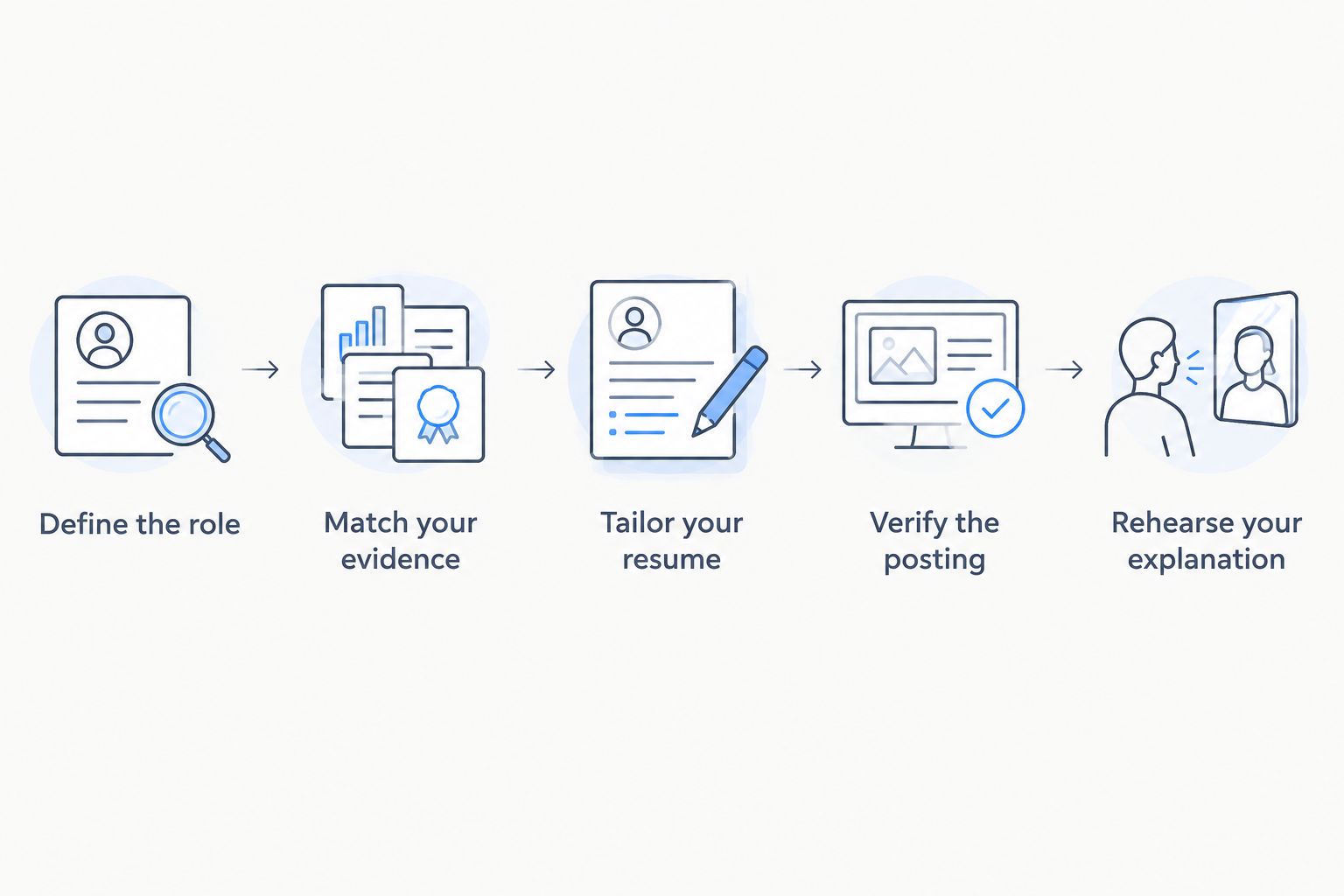
Use this sequence to make the ranking useful rather than collect more employer names.
Define the role
Choose the work before tailoring the application. Write a plain-language target such as derivatives modeling, quantitative risk, or model implementation. Avoid combining incompatible goals in the same resume summary.
Match your evidence
Start with 2 projects you can defend in detail. For each, record the question, method, implementation, validation, and limitation. This is a preparation recommendation, not a bank requirement.
Tailor your resume
Use 1 page as a starting constraint for an early-career resume, not a universal rule. Put relevant mathematical and programming evidence ahead of generic descriptions of enthusiasm. Keep claims specific enough to survive follow-up questions.
Verify the posting
For each 2026 application, check the stated degree requirements, graduation window, location, and work authorization. Ask 3 questions about any unclear role: What will I build? Who will use it? How will its quality be judged?
Rehearse your explanation
Practice explaining your strongest project aloud before expanding your application list. For structured preparation, use the quant interview preparation guide for MFE students.
Which bank should you choose?
Start with JPMorgan Chase if you need an identifiable quantitative graduate pathway. Prioritize Goldman Sachs for pricing and trading strategy, Morgan Stanley for modeling plus implementation, Citi for markets quantitative analysis, and Bank of America for risk and analytics.
QuantMinds' quant finance career coaching fits candidates who need help selecting and presenting their evidence. Its founder's background as a former UC Berkeley MFE program executive director is relevant to the firm's career and admissions focus. Coaching does not replace the mathematics, programming, or research judgment required by the role.
FAQ
What's the best bank for a quant analyst graduate program in 2026?
JPMorgan Chase is the starting recommendation in this shortlist because it has a named Quantitative Finance Analyst Program. Your final choice should depend on the specific team's responsibilities, eligibility requirements, and fit with your technical evidence.
Is a bank graduate analyst program the same as a quant program?
No, a general graduate analyst program is not automatically quantitative. Look for explicit modeling, statistical analysis, numerical methods, or quantitative implementation responsibilities rather than relying on the analyst title.
Is Goldman Sachs better than Morgan Stanley for graduate quants?
Neither is universally better for graduate quants. This guide separates Goldman Sachs for pricing and trading strategy from Morgan Stanley for modeling plus implementation, but the specific team description should decide your application priority.
Do I need an MFE to enter a bank quant graduate program?
An MFE is not a universal requirement for bank quant roles. Follow the degree and technical requirements in the individual posting rather than treating one qualification as mandatory across every employer.
How do I choose between quantitative risk and trading roles?
Choose quantitative risk if assessing uncertainty and model reliability is the work you want; choose trading-related modeling if you want to work on pricing or trading decisions. Read the responsibilities carefully because neither label describes one uniform job.
Can international students apply to bank quant graduate programs?
International students should assess each role against its stated work-authorization requirements. Do not assume that a bank-wide reputation for international hiring establishes sponsorship for a specific role or location.
How can QuantMinds help with bank quant applications?
QuantMinds offers resume review, interview preparation, and 1-on-1 coaching for quantitative finance candidates. Use that support to improve targeting and presentation while continuing the technical preparation your chosen role requires.
One last thing
A role title is a search term, not a description of your future working day. Before prioritizing a 2026 application, write this sentence: I want this team because it works on this problem, and this project shows I can contribute.
If you cannot fill in both parts specifically, investigate the role before polishing the application. More applications will not fix an unclear target.