

Best for recruiting preparation: QuantMinds. Best for academic foundations: an MFE or MSFE degree. Best for focused skill gaps: structured technical study. This 2026 guide compares hedge fund quant trader training programs by the problem you need to solve, separating career coaching from technical education and employer training.
- QuantMinds is the best fit here for candidates seeking quant recruiting preparation, not a replacement for technical education.
- Choose hedge fund quant trader training programs by your missing skill, not the training label.
- MFE and MSFE degrees suit candidates seeking formal financial engineering education; inspect each curriculum before choosing.
- Technical study and research projects serve different purposes: learning methods versus demonstrating independent judgment.
- Employer training belongs after selection; it is not a substitute for preparing your application and interviews.
Why this matters
A quant trader training search mixes several different decisions. You might need stronger probability skills, a defensible research project, help explaining your background, or a formal degree. Those are not interchangeable needs.
The best training route fixes the weakness that blocks your next step. A resume review does not teach statistical inference. A technical course does not diagnose why your applications fail to communicate relevant experience.
For your 2026 search, start with actual job descriptions. Separate quantitative trading, quantitative research, and quantitative development requirements before choosing training; the shared word quant does not make the roles identical.
What makes the best quant trader training program
Use these criteria before comparing the options. A program name tells you less than the work you will complete and the feedback you will receive.
- Role fit: Match the content to your intended trading, research, or development role rather than quantitative finance in general.
- Technical depth: Look for explicit coverage of the mathematics, statistics, programming, or market concepts you need.
- Feedback: Distinguish evaluated work from videos and answer keys. Ask who reviews your reasoning and what that review includes.
- Application evidence: Identify what you can explain afterward: a project, a technical solution, or a clearer account of relevant experience.
- Recruiting support: Separate resume and interview preparation from academic instruction. Confirm which service you are choosing.
- Entry requirements: Check prerequisites and eligibility before committing. Employer training requires a different entry route from an independent study program.
Treat missing details as a reason to ask questions, not permission to assume. In 2026, inspect the current syllabus, assessment format, and scope directly with the provider.
Quant trader training options at a glance
This ranking compares training routes, not measured placement outcomes. Each option owns a different use case; there is no evidence here for a universal winner across technical education and recruiting preparation.
| Rank | Training option | Best for | Standout purpose | Key limitation |
|---|---|---|---|---|
| 1 | QuantMinds career coaching | Turning an existing background into a recruiting plan | Resume review, interview prep, and 1-on-1 coaching | Not a substitute for technical education |
| 2 | MFE or MSFE degree | Formal financial engineering foundations | An academic route into quantitative finance study | Curriculum and career relevance require program-level review |
| 3 | Structured technical study | A specific mathematics or coding gap | Concentrated work on a defined subject | Course completion alone does not establish interview readiness |
| 4 | Project-based research training | Demonstrating independent analytical work | A research artifact you can defend | Weak methodology produces weak evidence |
| 5 | Employer training | Learning within an internship or employed role | Instruction connected to the employer's work | Requires selection before participation |
1. QuantMinds: best for quant recruiting preparation
QuantMinds is a career coaching firm that helps professionals and students pursue quantitative research, trading, and development roles at hedge funds and prop trading firms. Its stated services include resume review, interview prep, and 1-on-1 coaching; its founder is a former UC Berkeley MFE program executive director.
QuantMinds is best for quant candidates who need help translating their background into a recruiting plan. Choose coaching when your immediate question concerns positioning, application materials, or interview preparation rather than learning an entire technical subject.
Bring concrete material: your resume, target job descriptions, and examples of work you struggle to explain. Ask what the proposed coaching will address and what preparation you need beforehand. Do not treat career coaching as a trading credential.
QuantMinds pros:
- Stated services address both application materials and interview preparation.
- The firm's focus includes hedge funds and prop trading firms.
- 1-on-1 coaching provides an individual format for discussing your background.
- The founder's MFE program leadership background is relevant to career and admissions questions.
QuantMinds cons:
- Career coaching does not replace a mathematics, statistics, or programming curriculum.
- Resume work alone does not demonstrate trading or research ability.
- You must confirm the coaching scope against your particular technical and recruiting needs.
Best for: Candidates with relevant experience or education who need clearer positioning and targeted preparation.
Verdict: Buy coaching for a recruiting problem; skip it as a substitute for technical foundations.
2. MFE or MSFE degrees: best for formal academic foundations
An MFE or MSFE degree is an academic route, not a short interview-preparation service. Financial engineering programs connect quantitative methods with financial applications, but the specific balance of mathematics, computing, and finance depends on the curriculum.
Start your comparison with MFE programs in the US, then inspect each institution's current requirements. For a 2026 decision, distinguish coursework relevant to your target role from coursework that simply sounds advanced.
Ask whether you need formal education or better evidence of skills you already possess. A degree is a different commitment from targeted preparation, and the degree title alone does not answer that question.
MFE and MSFE pros:
- Provide a formal academic structure for financial engineering study.
- Offer an opportunity to connect quantitative methods with finance.
- Let you assess course coverage and degree requirements before applying.
MFE and MSFE cons:
- The degree label does not establish the depth of every technical subject.
- Academic performance does not replace explaining your work in interviews.
- A broad curriculum is not the most direct response to every narrow skill gap.
Best for: Candidates seeking formal financial engineering education rather than application polishing alone.
Verdict: Buy into the degree route when the curriculum addresses your educational needs; hold when your main gap is recruiting execution.
3. Structured technical study: best for a defined skill gap
Structured technical study means choosing instruction around a specific missing capability: probability, statistical inference, Python, algorithms, or another requirement in your target job descriptions. It is a training route, not a particular provider recommendation.
Choose the subject first. Then inspect prerequisites, exercises, assessments, and feedback rather than judging the course by its finance branding.
For example, if you cannot explain conditional probability, more resume editing will not fix that weakness. If you can explain the mathematics but cannot implement a solution, select programming work with relevant exercises instead of repeating familiar theory.
Structured technical study pros:
- Keeps your work focused on an identifiable weakness.
- Lets you select exercises that match the skill you need.
- Creates a clear distinction between understanding a concept and applying it.
Structured technical study cons:
- Recorded instruction alone does not evaluate your reasoning.
- Familiar exercises can disguise dependence on memorized solutions.
- Subject knowledge does not automatically translate into a strong application.
Best for: Candidates who can name the technical task they cannot yet complete independently.
Verdict: Buy targeted instruction with suitable exercises; skip broad training that repeats material you already understand.
4. Project-based research training: best for demonstrating judgment
Project-based training organizes your learning around an analytical question, implementation, and review of the result. For quantitative trading preparation, the useful output is not merely a chart or backtest; it is a defensible explanation of your choices and limitations.
Build around a question you can investigate honestly. Document the data, assumptions, evaluation method, and failure cases. Historical results do not establish future trading performance.
Use your 2026 preparation to improve the quality of that explanation. If a project works only because you inspected the evaluation data while making modeling choices, investigate the problem rather than presenting the result as clean evidence.
Project-based training pros:
- Connects coding, statistics, and analytical reasoning in a single piece of work.
- Gives you specific decisions to discuss in interviews.
- Exposes gaps that isolated exercises leave hidden.
Project-based training cons:
- Poor data handling can invalidate the conclusions.
- Independent work lacks external criticism unless you arrange review.
- A copied notebook provides little evidence of your own judgment.
Best for: Candidates who understand the basics but need work they can explain and defend.
Verdict: Buy into a carefully reviewed project process; skip impressive-looking results you cannot justify.
5. Employer training: best for learning after selection
Employer training belongs inside an internship, graduate program, or employed role when the employer provides it. Unlike independent education, this route depends on being selected first; inspect the specific employer's description rather than assuming every role includes a formal training program.
Separate hedge fund opportunities from prop trading opportunities. Both belong in a quant career search, but the employer category does not establish the content of training or the responsibilities of a particular position.
Your application still needs to meet the role's stated requirements. Do not postpone prerequisite study because you expect an employer to teach everything after hiring.
Employer training pros:
- Connects learning with the work of a particular organization.
- Provides context for employer-specific processes when instruction is offered.
- Lets you evaluate training alongside the actual role description.
Employer training cons:
- Requires selection before you can participate.
- The instruction's scope depends on the employer and position.
- It is not an independent preparation option for every job seeker.
Best for: Candidates pursuing eligible internships or employed roles that explicitly include training.
Verdict: Buy into a suitable opportunity after reviewing the role; skip relying on unspecified training to cover prerequisite gaps.
How to choose your next move
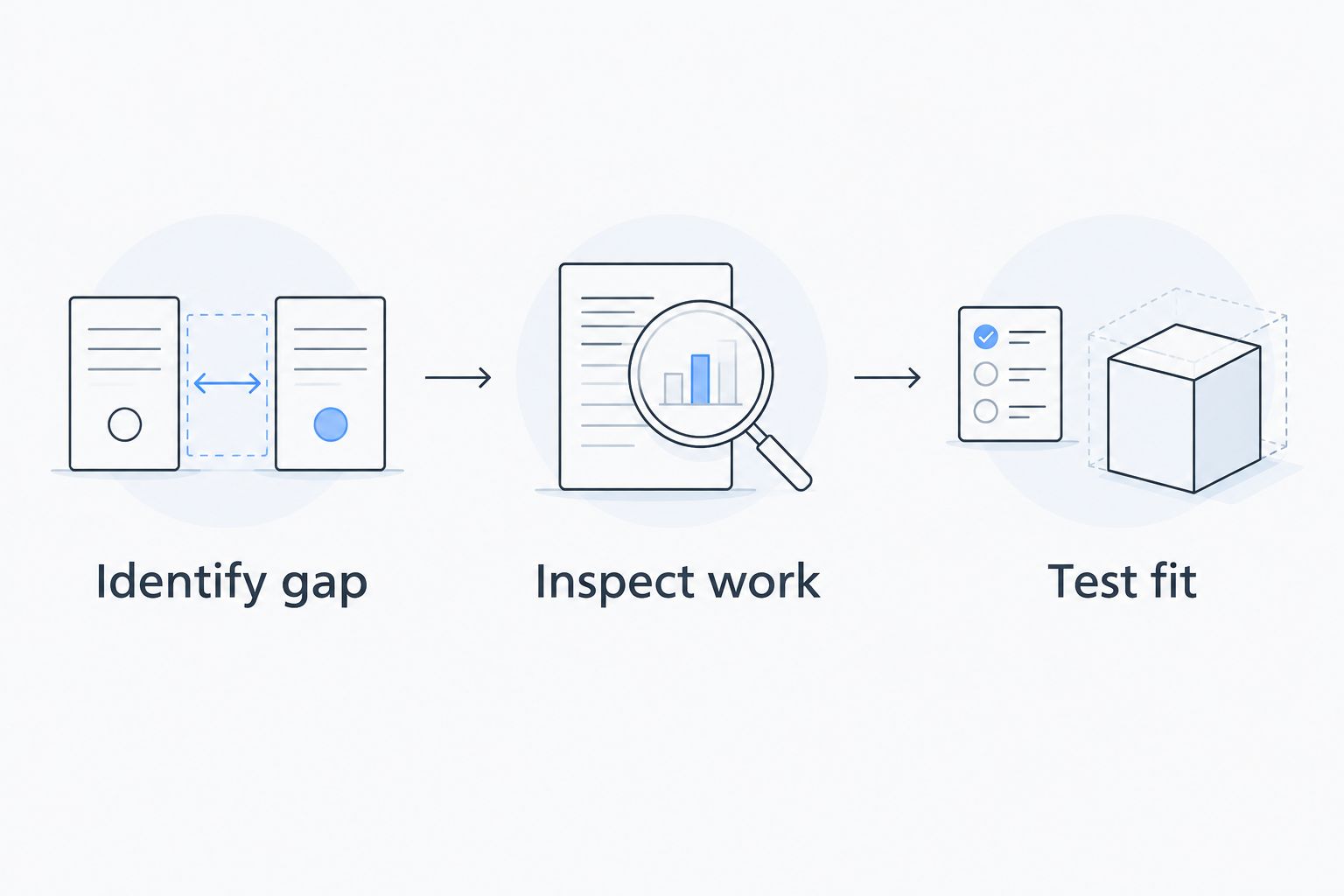
Use this sequence to make a 2026 training decision. The aim is to identify a concrete problem before choosing a format.
Identify gap
Start with 1 resume, 2 target job descriptions, and 3 project examples or technical solutions. These are suggested preparation materials, not hiring thresholds. Compare what the roles ask for with what you can demonstrate, then label the problem: missing knowledge, weak evidence, or unclear presentation.
Inspect work
Ask what the training requires you to do. Distinguish attending instruction, completing exercises, receiving criticism, and practicing explanations; each produces different evidence of progress. If you need feedback, verify that feedback is part of the arrangement.
Test fit
Choose a task that exposes your weakness and repeat it after preparation. Explain a probability solution without notes, implement a method independently, or defend a research decision. Evaluate the task, not your confidence alone.
How these options are ranked
The ranking prioritizes role fit, technical depth, feedback, application evidence, recruiting support, and entry requirements. Coaching comes first for recruiting execution; degrees, focused study, projects, and employer training address different needs. This is a decision guide, not a placement-rate ranking or a claim that one route outperforms every other route.
Which training route should you choose?
Default to a diagnosis before committing to a program. If you cannot solve the relevant technical problems, start with education. If you can solve them but cannot show or explain your work, focus on evidence and interview preparation.
Choose an MFE or MSFE for a justified academic need, targeted study for a defined weakness, and project-based work for independent analytical evidence. Treat employer training as part of an opportunity you must first qualify for—not your preparation plan.
FAQ
What's the best hedge fund quant trader training program for recruiting preparation?
QuantMinds is the best fit in this guide for recruiting preparation because its stated services include resume review, interview prep, and 1-on-1 coaching. Choose technical education separately when your main gap is mathematics, statistics, or programming.
Is an MFE better than career coaching for becoming a quant trader?
An MFE and career coaching address different needs. An MFE provides formal financial engineering education; coaching addresses recruiting preparation and how you present your background.
Can a technical course prepare me for a quant trading interview?
A technical course can address a relevant subject gap, but completing it does not establish interview readiness. Practice solving unfamiliar problems and explaining your reasoning without relying on the course solution.
Do hedge funds and prop trading firms offer the same training?
Do not assume hedge funds and prop trading firms offer the same training. Review the specific employer's role and program description because the employer category alone does not establish the curriculum.
Do I need a research project before choosing a training program?
A research project is not a universal prerequisite for choosing training. Existing work helps you identify gaps, but candidates without suitable projects can begin with technical solutions and target job requirements.
How do I check whether a quant training program fits me?
Check the prerequisites, required work, assessment format, and feedback against your specific weakness. A course that teaches missing knowledge serves a different purpose from coaching that improves your application or explanations.
Does finishing a quant trader training program guarantee a hedge fund job?
No training route establishes a guaranteed hedge fund job. Evaluate what the program teaches and what you can demonstrate afterward rather than treating completion as a hiring outcome.
One last thing
Before choosing training, explain your strongest piece of technical work without opening the code or slides. State the question, the method, the result, and the limitation. The first point where your explanation breaks identifies something useful to work on—and gives you a better selection criterion than a program's title.