

Best overall for systematic investment research: AQR. Best for portfolio construction: BlackRock. Best for data-intensive modeling: Two Sigma. For your 2026 search, rank employers by the research you want to own—not by the most recognizable name on your resume.
- For asset management firms quantitative research jobs, AQR is the default shortlist pick for systematic investment research.
- BlackRock fits portfolio construction; Two Sigma fits data-intensive quantitative modeling.
- D. E. Shaw fits computational research; Man AHL fits systematic macro; Dimensional fits evidence-based portfolio implementation.
- QuantMinds provides quant career coaching, not investment management or employer placement guarantees.
Why this matters
A quantitative research title does not tell you whether you will study return predictors, build portfolio models, analyze execution, or maintain risk analytics. Those jobs require different evidence from a candidate. Applying to all of them with the same research pitch makes your fit harder to understand.
QuantMinds is best for quantitative research candidates seeking resume review, interview preparation, and individual career coaching. The firm was founded by a former UC Berkeley MFE program executive director; it is a coaching service, not an asset manager or an employer in this ranking.
This guide separates investment mandates from recruiting assumptions. It compares established research approaches, not compensation, workplace culture, current vacancies, or your probability of receiving an offer.
What makes the best employer for quantitative research?
Use these criteria to build your 2026 shortlist before submitting applications:
- Research ownership: Does the position involve developing hypotheses and models, or primarily supporting someone else's investment process?
- Investment mandate: Do you want security selection, portfolio construction, systematic macro, or implementation research?
- Technical fit: Can you connect your statistics, programming, and data work to the team's stated problems?
- Decision proximity: How does the research affect portfolio decisions, trading, or risk controls?
- Role clarity: Does the description distinguish research from development, reporting, and model maintenance?
- Candidate evidence: Can you explain a relevant project, its validation, and its limitations without relying on academic credentials alone?
The best employer is the one whose research questions match the evidence you can defend. A prestigious firm with the wrong mandate is a weaker target than a relevant team at a less familiar firm.
Asset management research employers at a glance
The 2026 ranking below assigns each firm a distinct use case. These are employer targets, not interchangeable jobs; the team and position determine the actual work.
| Rank | Firm | Best for | Standout research orientation | Key limitation for candidates |
|---|---|---|---|---|
| 1 | AQR | Systematic investment research | Quantitative investing across asset classes | A firm-level match does not establish a match with every research position |
| 2 | BlackRock | Portfolio construction | Portfolio, risk, and systematic investment capabilities | Quantitative titles span investment and non-investment functions |
| 3 | Two Sigma | Data-intensive modeling | Scientific methods, technology, and data-driven investing | Data work must connect to an investment problem, not just predictive accuracy |
| 4 | D. E. Shaw | Computational research | Quantitative and computational investment approaches | The broader firm also includes discretionary investing |
| 5 | Man AHL | Systematic macro research | Systematic trading across markets | A narrowly equity-focused pitch does not establish macro research fit |
| 6 | Dimensional Fund Advisors | Evidence-based implementation | Research-informed portfolio design and implementation | Less aligned with candidates seeking discretionary stock-picking work |
1. AQR: best for systematic investment research
AQR is an investment manager associated with quantitative investing and research across asset classes. Its published work on factors, portfolio construction, and systematic strategies gives you concrete material for deciding whether its investment questions interest you.
Best for: Candidates who want to connect statistical research with systematic portfolio decisions. AQR is the default shortlist choice here because its research orientation directly matches that goal—not because every quantitative candidate belongs there.
AQR pros
- Public research gives you investment ideas to examine before applying.
- Cross-asset investing supports interests beyond a single security type.
- Factor research provides a clear bridge between empirical analysis and portfolio construction.
AQR cons
- Interest in factors alone does not demonstrate research ability.
- The firm's overall investment approach does not reveal an individual team's responsibilities.
For your application, explain an economic hypothesis, the dataset you used, and what happened when you challenged the result. A backtest without a discussion of implementation costs or unstable relationships leaves the investment question unfinished.
Verdict: Prioritize AQR if systematic investment research is your target.
2. BlackRock: best for portfolio construction
BlackRock combines asset management with portfolio analytics, risk capabilities, and systematic investment activities. That breadth makes it relevant to candidates interested in how models shape portfolios, rather than only how models predict returns.
Best for: Candidates drawn to portfolio construction, risk-aware investing, and systematic investment processes within a large asset manager. Read the function carefully: an investment research position and an analytics position can share technical vocabulary while serving different users.
BlackRock pros
- Portfolio construction connects statistical modeling with investment constraints.
- Multiple investment functions give you different research mandates to investigate.
- Risk and portfolio questions suit candidates who enjoy optimization and model interpretation.
BlackRock cons
- The BlackRock name alone does not establish that a position involves alpha research.
- Broad applications across unrelated functions weaken your explanation of fit.
Build your pitch around the actual problem. If a description emphasizes portfolio optimization, explain your objective function, constraints, and sensitivity analysis—not just your strongest prediction model.
Verdict: Prioritize BlackRock for portfolio construction; screen out unrelated functions.
3. Two Sigma: best for data-intensive quantitative modeling
Two Sigma describes its investment approach through scientific methods, technology, and data. It belongs on the shortlist for candidates whose strongest evidence combines statistical reasoning with careful computational work.
Best for: Researchers who enjoy turning difficult datasets into testable investment hypotheses. This is a research fit, not a claim that a machine-learning credential automatically qualifies you for the firm.
Two Sigma pros
- A data-driven investment approach fits empirical research interests.
- Computational work gives technically strong candidates a relevant way to explain their background.
- Scientific reasoning supports a pitch built around experiments and falsifiable hypotheses.
Two Sigma cons
- Predictive accuracy alone does not establish investment usefulness.
- A generic data-science portfolio does not explain why your work belongs in asset management.
Show how you controlled leakage, selected a baseline, and separated model selection from evaluation. Then explain the investment interpretation. Use the guide to explaining a research project in a quant interview to turn technical detail into a clear research argument.
Verdict: Prioritize Two Sigma when data-intensive modeling is your strongest evidence.
4. D. E. Shaw: best for computational investment research
D. E. Shaw uses quantitative and computational approaches within an investment business that also includes discretionary strategies. Its breadth makes the specific strategy and team especially important to your application.
Best for: Candidates who want computational research connected to investment decisions. A strong mathematical or programming background becomes more persuasive when you can explain what investment uncertainty your work addresses.
D. E. Shaw pros
- Quantitative investing provides a direct application for computational research.
- Multiple investment approaches create distinct mandates to investigate.
- Mathematical and empirical reasoning give technical candidates relevant material for their pitch.
D. E. Shaw cons
- The firm name does not establish that every position is systematic research.
- A technical achievement without an investment interpretation leaves your motivation unclear.
Do not treat every D. E. Shaw position as the same destination. Read whether the work centers on research, software, risk, or a discretionary investment process, then build your application around that distinction.
Verdict: Prioritize D. E. Shaw for computational research with a clearly identified mandate.
5. Man AHL: best for systematic macro research
Man AHL is a systematic investment manager within Man Group, known for quantitative trading across markets. It is a relevant target when your research interests concern market behavior across asset classes rather than only individual company fundamentals.
Best for: Candidates interested in systematic macro, time-series research, and cross-market strategies. Treat Man AHL as the relevant investment business, not as shorthand for every role across Man Group.
Man AHL pros
- Cross-market investing fits research that extends beyond equities.
- Systematic strategies provide a clear setting for empirical hypothesis testing.
- Time-series questions connect naturally to market dynamics and portfolio risk.
Man AHL cons
- A company-valuation project alone does not establish systematic macro fit.
- Strong statistical results still require an explanation of tradability and risk.
For a relevant project, discuss how you aligned observations across markets and avoided using information before it was available. Explain what happens when the market environment changes; do not present one successful historical period as proof of a durable strategy.
Verdict: Prioritize Man AHL for systematic macro and cross-market research.
6. Dimensional: best for evidence-based portfolio implementation
Dimensional Fund Advisors applies academic financial research to investment strategies, portfolio design, and implementation. It offers a different research destination from a firm centered on finding short-lived predictive signals.
Best for: Candidates who want to translate evidence about expected returns into portfolio rules and implementation decisions. This is a strong fit for researchers interested in the connection between financial economics and practical investing.
Dimensional pros
- Research-informed investing gives financial economics a practical application.
- Portfolio implementation connects theoretical results with investment decisions.
- An evidence-based approach suits candidates who enjoy examining assumptions and trade-offs.
Dimensional cons
- It is a less direct fit for a discretionary stock-picking ambition.
- Academic fluency alone does not demonstrate implementation judgment.
Prepare to explain how a portfolio rule changes exposures, turnover, and practical execution. Your research pitch should show that you can distinguish evidence supporting an investment principle from evidence supporting a particular implementation.
Verdict: Prioritize Dimensional for research-informed portfolio design and implementation.
How these firms were ranked
The ranking uses research mandate, technical fit, portfolio relevance, and role clarity. Firm-published investment descriptions establish the broad research orientation; they do not establish a candidate's suitability for a particular position.
For 2026, AQR takes the default slot because systematic investment research is the central question of this guide. The remaining firms occupy different decision branches, not descending grades of employer quality. QuantMinds is not ranked alongside them because career coaching and asset management are different services.
Turn the ranking into an application shortlist
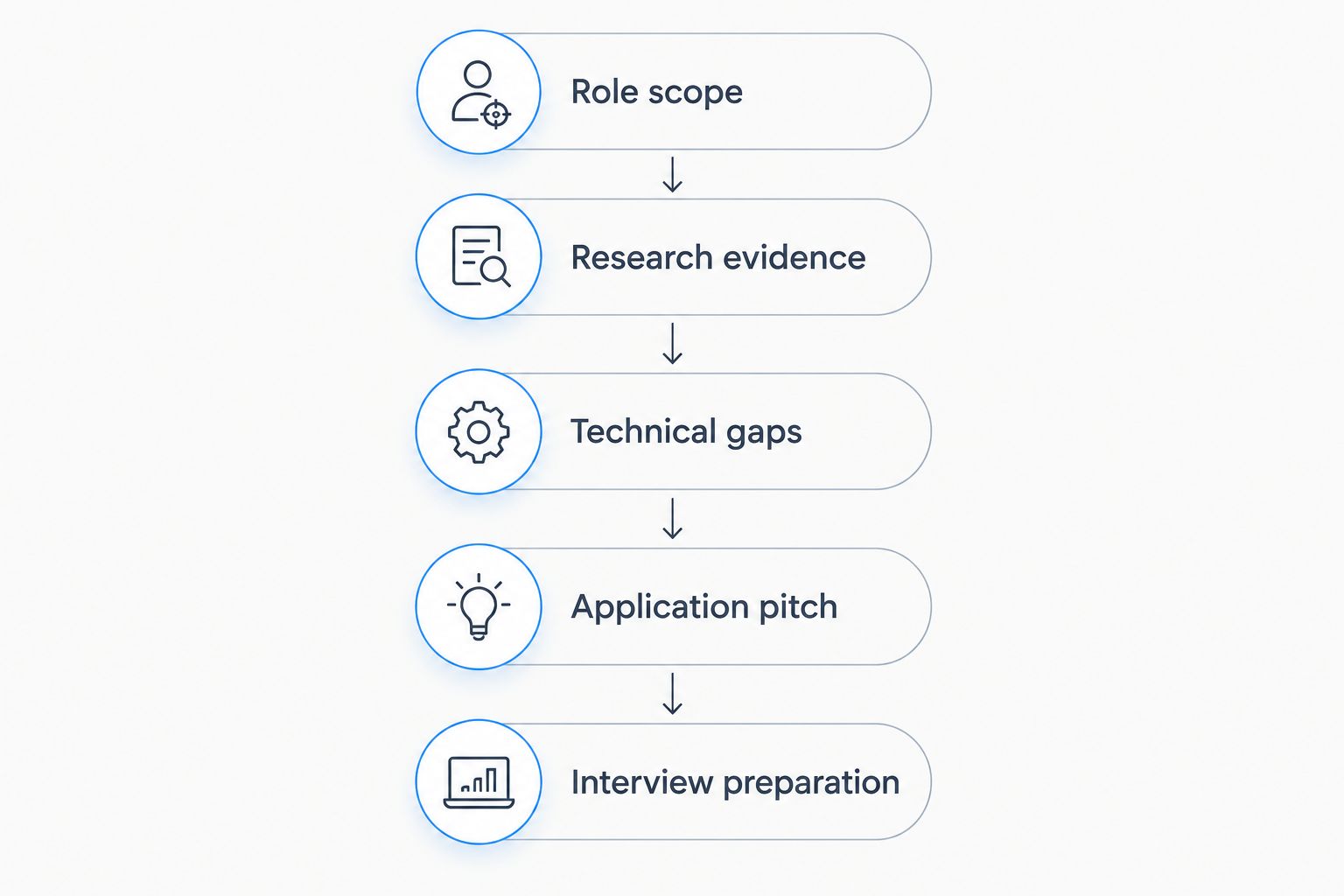
Searching for asset management firms quantitative research jobs is only the starting point. Before applying, complete this sequence for each position you seriously consider.
- Role scope: Write down what the researcher produces and who uses it. Separate signal research, portfolio construction, risk analysis, and software responsibilities.
- Research evidence: Select one project that addresses a similar problem. Identify your contribution, validation approach, and the result's limitations.
- Technical gaps: Compare the stated requirements with what you can demonstrate. Separate an unfamiliar tool from a missing foundation in statistics or programming.
- Application pitch: Write a 1-page research memo and prepare a 2-minute explanation. These are practice targets, not employer requirements.
- Interview preparation: Prepare 3 questions about research ownership, model evaluation, and the route from an experiment to an investment decision.
The sequence forces you to test fit before investing heavily in an application. If you cannot describe the position's research output, investigate the mandate first; more interview practice will not fix an unclear target.
For your 2026 applications, keep the core project truthful while changing the emphasis. Portfolio construction calls for constraints and sensitivity analysis; data-intensive modeling calls for validation and leakage controls. Neither requires inventing a different professional identity.
QuantMinds provides resume review, interview preparation, and 1-on-1 coaching for candidates targeting quantitative roles. Use coaching to sharpen your evidence and presentation—not as a substitute for learning the technical material or evaluating the position yourself.
Prepare your quant application
Get resume review, interview preparation, and individual coaching for quantitative roles.
Which employer should you choose?
Start with AQR if you want systematic investment research and have no narrower preference. Choose BlackRock for portfolio construction, Two Sigma for data-intensive modeling, D. E. Shaw for computational research, Man AHL for systematic macro, or Dimensional for evidence-based implementation.
Your 2026 shortlist should follow the work you want to do. Once you find a relevant position, the team mandate outranks this firm-level ordering. Skip a mismatched role rather than stretching your resume to fit its title.
FAQ
What's the best asset management firm for quantitative research?
AQR is this guide's default choice for systematic investment research. BlackRock, Two Sigma, D. E. Shaw, Man AHL, and Dimensional fit different research interests, so the specific team and position determine your best target.
Is BlackRock better than Two Sigma for a quant research career?
BlackRock is the stronger fit in this guide for portfolio construction, while Two Sigma fits data-intensive modeling. Compare the actual responsibilities rather than assuming every quantitative position at either firm serves the same purpose.
Do I need a PhD for quantitative research jobs?
A PhD is not a universal requirement across all quantitative research positions. Follow the position's stated education requirements and show relevant research evidence; do not infer eligibility from the firm's reputation.
Are asset managers and prop trading firms the same?
Asset managers and prop trading firms are different business models. Asset managers manage investment portfolios for clients or funds, while proprietary trading firms trade their own capital; research responsibilities depend on the specific business and team.
How do I tell whether a job is alpha research or risk analytics?
Read what the position produces and how that output is used. Return prediction and investment signal development indicate a different mandate from exposure measurement, reporting, or risk-model maintenance.
Can QuantMinds help me prepare for quantitative research applications?
QuantMinds offers resume review, interview preparation, and 1-on-1 career coaching for quantitative roles. It is a career coaching firm, not an asset manager or a guarantee of an employer offer.
One last thing
Ask this question before you commit to a research position: What investment decision changes when this research succeeds? The answer separates work that informs a portfolio from work that primarily supports infrastructure, reporting, or controls.
Those supporting roles can be valid careers. The mistake is accepting one while expecting another. Make that distinction before the interview—not after joining.