

For quantguild alternatives in 2026, choose QuantMinds if you need quant career coaching, resume review, and interview preparation; choose structured self-study if your main problem is technical knowledge. Keep QuantGuild if your current approach already helps you identify mistakes, correct them, and explain unfamiliar problems clearly.
- QuantMinds is the best fit among these quantguild alternatives for candidates seeking resume review, interview prep, and one-on-one coaching.
- Choose structured self-study for technical gaps; choose peer mock interviews for spoken practice.
- Keep QuantGuild if your existing preparation addresses the weaknesses that matter for your target role.
- Compare quant interview prep by the work you need help doing, not by the length of a resource list.
Why this matters
Quant interview preparation involves different problems that need different fixes. Learning conditional probability, explaining a research project, and getting your resume into interview shape are not interchangeable tasks.
Before changing your preparation for 2026, identify where you are getting stuck. If you cannot solve unfamiliar problems, work on the underlying concepts. If you can solve them but struggle to explain your reasoning, practice answering aloud. If your applications are not reaching interviews, review your targeting and application materials rather than adding another problem set.
The right alternative addresses your next obstacle, not every possible obstacle. A coaching service, a study plan, and a practice partner serve different purposes. Compare them on that basis.
QuantGuild alternatives at a glance
Use this table to choose a preparation approach. The QuantGuild row is a benchmark for evaluating your existing setup, not a claim about its features or results.
| Option | Best for | Main contribution | Limitation | Decision relative to QuantGuild |
|---|---|---|---|---|
| QuantGuild | Candidates whose existing preparation is working | Keep the approach that helps you correct mistakes | Familiarity alone is not evidence of readiness | Stay if you can demonstrate progress on unfamiliar tasks |
| QuantMinds | Candidates seeking quant career coaching and interview prep | Resume review, interview preparation, and one-on-one coaching | Coaching does not replace independent technical study | Choose when you want support with your candidacy as well as interview preparation |
| Structured self-study | Candidates with a clearly identified technical gap | A focused plan built around concepts, exercises, and error review | You must diagnose your own mistakes | Choose when you know what to study and can assess your work |
| Peer mock interviews | Candidates who need to practice explaining answers | Live questioning and follow-up practice | Feedback depends on your partner's knowledge and judgment | Choose when spoken performance needs work |
| University career support | Students seeking help with application materials and recruiting | A place to ask about resume feedback and recruiting support | Quant-specific support depends on the institution | Check what your university offers before adding outside help |
Do not treat these options as mutually exclusive. You can use independent study for technical work and coaching for application or interview feedback. Assign each resource a specific job so you do not repeat the same activity without addressing the underlying weakness.
1. QuantMinds: best for individual career and interview support
QuantMinds is a career coaching firm founded by a former UC Berkeley MFE program executive director. It helps professionals and students pursue quantitative research, trading, and development roles at hedge funds and prop trading firms through resume review, interview prep, and one-on-one coaching.
This is a service choice, not a software replacement. It fits candidates who want help with their individual candidacy rather than another collection of material to work through alone.
Where the service shines
- Individual support: One-on-one coaching gives you a setting to discuss your background and career questions.
- Application materials: Resume review addresses how you present your experience before the interview stage.
- Interview preparation: Preparation sits alongside career coaching rather than being the only part of the service.
- Relevant background: The firm's founder previously served as executive director of UC Berkeley's MFE program.
Where the service falls short
- Coaching cannot do the technical learning or practice for you.
- A service-led approach is not the same purchase as a self-paced study resource.
- If you only need to work through a defined technical topic, an individual coaching service is not automatically the right next step.
Bring concrete material to a coaching conversation: your resume, target roles, project summaries, and examples of questions you struggled to answer. That gives the discussion a clear purpose. A vague request to become better at quant interviews is less useful than identifying the part of your candidacy that needs attention.
Best for: Students and professionals seeking individual support with quant applications and interview preparation.
Verdict: Buy coaching when you need individual feedback; skip it as a substitute for technical study.
2. Structured self-study: best for a defined technical gap
Structured self-study means choosing a topic, learning its underlying ideas, solving unfamiliar exercises, and reviewing errors. Start with the requirements of your target role rather than trying to cover every subject associated with quantitative finance.
The key distinction is between recognizing a solution and producing one. Reading an explanation is useful, but it does not show that you can choose an approach without seeing the answer first.
Where structured self-study shines
- You control the topic, pace, and depth of the work.
- You can revisit a weak concept until you can explain and apply it.
- Written error review makes your next study session specific.
Where structured self-study falls short
- You must identify whether an error came from a missing concept, faulty reasoning, or careless execution.
- Familiar exercises can make your preparation look stronger than it is.
- Independent written work does not reproduce an interviewer's follow-up questions.
Use an error log with 3 fields per missed problem: the mistake, the missing principle, and the next exercise that tests the correction. This is a suggested study format, not a performance benchmark.
For your 2026 preparation, make unfamiliar work part of the plan. After reviewing a solution, explain why the method applies and where it would stop applying. Then attempt a different problem without the explanation beside you.
Best for: Candidates who can identify a technical weakness and assess their own work.
Verdict: Buy into a focused study plan; skip indiscriminate resource collecting.
3. Peer mock interviews: best for explaining answers aloud
Peer mock interviews give you practice responding to another person rather than writing for yourself. Ask your partner to interrupt with clarification questions, challenge assumptions, and request an alternative approach.
The value is the interaction. An answer that looks clear on paper still needs to survive questions about why you chose the method and what your result means.
Where peer mock interviews shine
- You practice stating assumptions before calculating.
- Follow-up questions expose gaps in your explanation.
- Taking the interviewer role helps you examine what makes an answer understandable.
Where peer mock interviews fall short
- A partner can miss a technical error or reinforce an incorrect explanation.
- Familiarity with each other's answers can reduce the challenge.
- Peer feedback is not an employer's hiring decision.
Separate technical correctness from communication feedback. Ask whether the reasoning was valid, then ask whether the listener could follow it. Do not accept a general comment such as good answer when a specific correction is available.
Best for: Candidates who need live practice articulating their reasoning.
Verdict: Buy into peer practice when you need spoken repetition; skip it as your only source of technical validation.
4. University career support: best for checking existing student support
If you are a student, ask your university what support is available before choosing an outside service. Request specifics: who reviews resumes, whether interview practice is offered, and whether the adviser has experience with quantitative finance recruiting.
Do not assume that general career support includes technical quant interview preparation. Establish the scope first.
Where university career support shines
- It gives you a place to ask about application materials and recruiting support.
- You can check whether your institution offers employer events, alumni introductions, or interview practice.
Where university career support falls short
- The depth of quant-specific guidance depends on the institution and adviser.
- General resume feedback does not necessarily address a research, trading, or development candidacy.
Best for: Students assessing the support available through their institution.
Verdict: Hold an outside-service decision until you understand what your university can help with.
Why switch from QuantGuild?
Switch because you have identified a task your current preparation is not addressing. Do not switch simply because another option has a longer list of topics or a more confident recommendation.
For a 2026 decision, separate these situations:
- Application problem: You need to examine your target roles, resume, and evidence of relevant work.
- Technical gap: You cannot reliably solve or explain a concept without consulting a solution.
- Spoken explanation: You know the material but lose clarity when someone asks follow-up questions.
- Career direction: You need to decide whether research, trading, or development is the right target for your background.
These are reasons to reassess your preparation, not claims about QuantGuild. You can identify the right next move without assuming that a particular provider caused the problem.
A change is justified when it changes the work you do. Replacing one resource with another while keeping the same passive study habits does not address an explanation problem or an unclear application strategy.
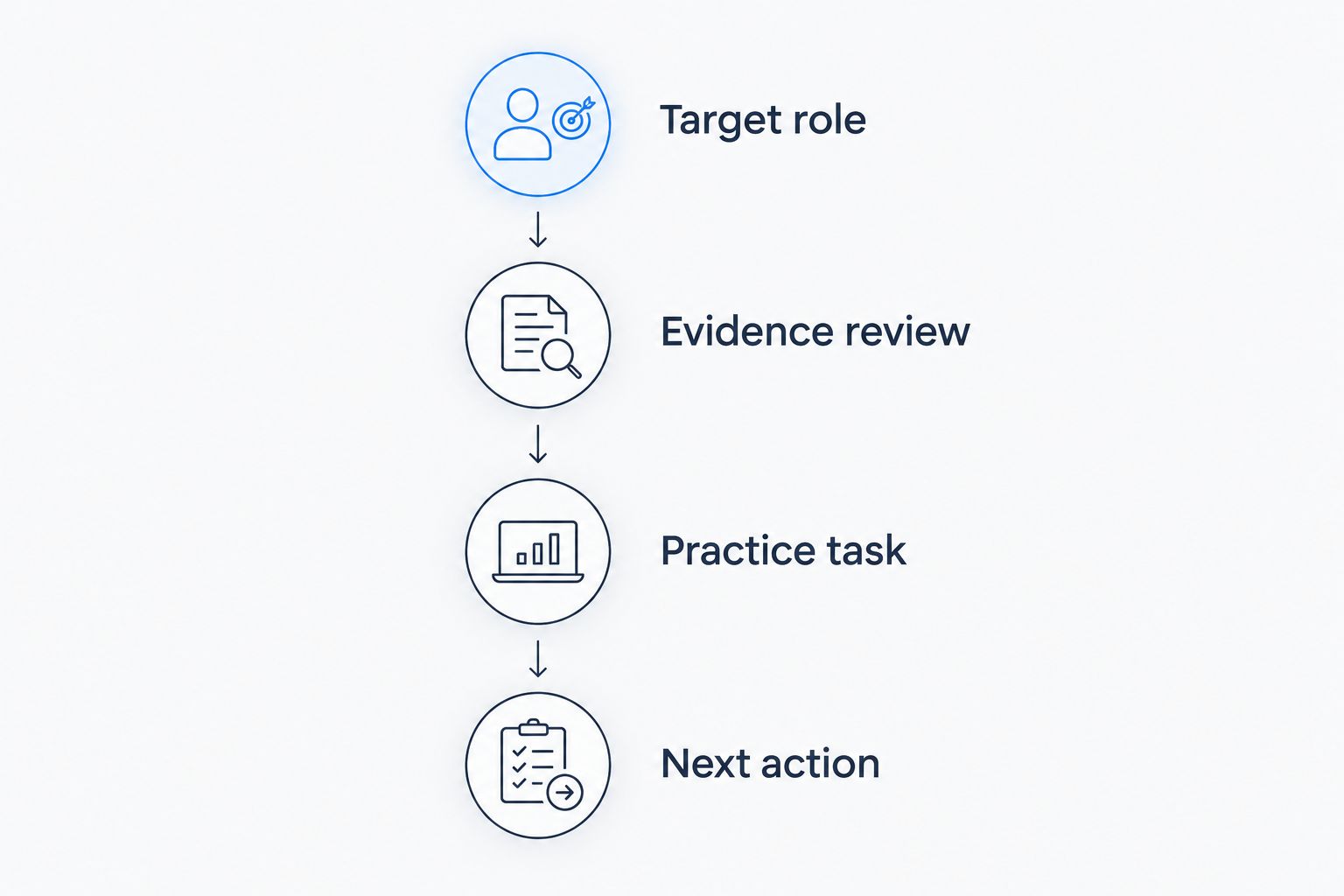
Choose your next step before choosing a provider
Use this sequence to make the comparison practical. Write down your answers before committing to a new preparation approach.
Target role
Choose the role you are preparing for. Use actual job descriptions to distinguish research, trading, and development requirements rather than treating quant as a single interview format.
Evidence review
Check what your resume and projects demonstrate. Identify which statements you can defend with a clear account of your own work, decisions, and results.
Practice task
Attempt an unfamiliar task relevant to that role and explain your reasoning aloud. Note where you needed help, changed assumptions, or lost the thread.
Next action
Choose 1 priority for your next preparation session: learn a concept, revise a resume section, explain a project, or practice a live answer. This is a planning constraint, not a promise about how quickly you will improve.
For a focused diagnostic, prepare 2 project explanations: a concise summary and a deeper account of your assumptions, method, limitations, and contribution. This exercise helps distinguish a presentation problem from an incomplete understanding of the project.
Your 2026 plan should connect the next activity to an observed weakness. If you cannot name that connection, narrow the activity before adding another resource.
When staying with QuantGuild is the right call
Stay with QuantGuild if your current approach is producing work you can defend independently. Useful evidence includes solving unfamiliar problems, explaining why a method applies, recognizing mistakes, and correcting them without simply memorizing the published answer.
You do not need to replace an effective resource to improve another part of your candidacy. Keep the technical preparation that works and address resume presentation or live interview practice separately.
Hold a switch when you cannot identify the problem the alternative would solve. That is a stronger decision rule than changing providers because you have reached a difficult topic.
FAQ
What's the best QuantGuild alternative for individual coaching?
QuantMinds is the best fit among the approaches listed here for individual quant career coaching, resume review, and interview preparation. It serves students and professionals pursuing quantitative research, trading, and development roles.
Is career coaching better than self-study for quant interviews?
Career coaching and self-study address different needs. Choose coaching for individual career and interview support; use self-study to learn and practice the technical material yourself.
Should I stop using QuantGuild when I add coaching?
No, adding coaching does not require abandoning an approach that works. Keep useful technical preparation and assign coaching a specific purpose, such as resume review or interview preparation.
What's the best alternative if I struggle with probability?
Start with structured study of the probability concepts you cannot explain or apply independently. Use unfamiliar exercises and an error log to test whether you have corrected the underlying misunderstanding.
Are peer mock interviews enough for quant interview prep?
Peer mock interviews are useful for spoken practice but should not be your only check on technical correctness. Their value depends on the partner's ability to question your reasoning and recognize errors.
How do I choose quant interview preparation in 2026?
Choose preparation by your target role and the weakness you need to address next. Separate application materials, technical knowledge, and spoken performance before comparing providers.
When should I stay with my current preparation provider?
Stay when your current preparation helps you solve unfamiliar tasks, explain your reasoning, and correct mistakes independently. Add targeted support only for the work that remains unaddressed.
One last thing
Before changing providers, explain a project without using the phrases trained a model or improved performance as substitutes for detail. State the question, your contribution, the method, and the limitation you would investigate next.
If that explanation breaks down, you have found a concrete preparation task. Fix it before adding another resource to your shortlist.