

If you're comparing quantblueprint alternatives in 2026, QuantMinds is the strongest fit here for personalized quant career coaching, resume review, and interview preparation. University career services, technical self-study, and peer mock interviews are different alternatives: choose among them by the recruiting problem you need to solve, not by the length of a feature list.
- QuantMinds is the quantblueprint alternatives pick for personalized quant career coaching, resume review, and interview prep.
- Choose university career services for campus recruiting support; check your institution's services and eligibility.
- Choose technical self-study for subject gaps, not for an independent assessment of your candidacy.
- Choose peer mock interviews for live practice; use a clear feedback rubric.
Why this matters
Quant recruiting preparation involves different jobs: choosing a target role, presenting your background, and performing in interviews. Treating all of them as a single interview-prep problem makes it harder to choose useful support. A resume review does not replace technical practice, and technical practice does not decide which roles fit your experience.
QuantMinds provides resume review, interview prep, and one-on-one coaching for students and professionals pursuing quantitative research, trading, and development roles at hedge funds and prop trading firms. Its founder previously served as executive director of UC Berkeley's MFE program. That background is relevant when your questions connect recruiting, graduate study, and how to present your experience.
Choose the type of help before choosing the provider. For your 2026 search, start with a specific question: are you struggling to get interviews, explain your work, or answer technical questions? Each calls for a different next move.
QuantBlueprint alternatives at a glance
The table separates a named coaching service from other preparation routes. The QuantBlueprint row gives you a benchmark for evaluating your current preparation rather than attributing unverified features to the provider.
| Option | Best for | Main purpose | Decision against QuantBlueprint |
|---|---|---|---|
| QuantBlueprint | Benchmarking your current preparation | Assess your existing support against your immediate recruiting need | Stay if it already addresses the problem you need to solve |
| QuantMinds | Personalized quant career coaching | Resume review, interview prep, and one-on-one coaching | Consider when you want individual help with your candidacy |
| University career services | Campus recruiting support | Explore the advising and recruiting resources your institution provides | Consider when your next question concerns university recruiting |
| Technical self-study | A defined subject gap | Work directly on probability, statistics, coding, or another relevant topic | Consider when you know what you need to learn |
| Peer mock interviews | Rehearsing explanations under questioning | Practice with another candidate and exchange feedback | Consider when you need live repetition rather than career advice |
Do not treat these as interchangeable purchases. Career coaching is a service; self-study is work you organize yourself. Peer practice adds a listener, but the listener's judgment still needs scrutiny.
1. QuantMinds: best for personalized quant career coaching
QuantMinds helps professionals and students pursue quant research, trading, and development roles through resume review, interview preparation, and one-on-one coaching. Its service is relevant when you need someone to examine your individual background, rather than another topic to study.
Bring a concrete decision. For example, you might need to make a software engineering resume relevant to quant development, explain an academic research project, or decide how MFE admissions fit into your career plans. A clear question gives the coaching conversation a useful starting point.
Where it shines
- Individual focus: Resume review and one-on-one coaching center the discussion on your candidacy.
- Quant career scope: The firm serves candidates pursuing research, trading, and development roles at hedge funds and prop trading firms.
- Relevant admissions background: Its founder's former UC Berkeley MFE leadership role connects to questions about financial engineering graduate study.
- Application and interview support: The stated services cover both your written presentation and interview preparation.
Where it falls short
- Coaching does not replace the mathematics, statistics, coding, or research work your target role requires.
- A coaching discussion is not the same activity as repeated independent problem-solving.
- Career guidance is not an employer's hiring decision or an admissions committee's decision.
For a 2026 comparison, ask what work you should bring and what question the session will address. Keep the distinction between reviewing your resume and teaching a technical subject explicit. Do not assume every form of preparation belongs in the same engagement.
Best for: Candidates who want individualized feedback on their quant candidacy and preparation.
Verdict: Buy coaching when your bottleneck is personal feedback; keep technical practice alongside it.
2. University career services: best for campus recruiting support
University career services are a separate route when your question concerns recruiting through your institution. Check the actual services before relying on them: resume advising, employer events, alumni resources, and appointment eligibility differ by institution.
Start with a narrow request. Ask how to find relevant employer activity, whether an adviser can review your application materials, and what support exists for your intended role. The purpose is to identify usable resources, not to assume the career center specializes in quantitative finance.
Where this route shines
- It gives you a place to investigate institution-specific recruiting resources.
- It can connect your preparation to the opportunities and advising your university actually offers.
- It helps you separate campus recruiting questions from technical interview questions.
Where this route falls short
- General career advice is not automatically quant-specific advice.
- Access depends on your institution's rules and your eligibility.
- A resume appointment is not a substitute for a technical interview rehearsal.
Best for: Students and eligible alumni working through campus recruiting channels.
Verdict: Hold off on duplicating support until you have checked what your university provides.
3. Technical self-study: best for a defined knowledge gap
Technical self-study is the right route when you can name the subject you need to improve. Examples include explaining conditional probability, interpreting statistical results, implementing an algorithm, or defending a research method. Choose the topic from your target role, not from a generic quant-prep checklist.
Give each study task an observable output. Solve the problem, explain your assumptions, write the implementation, or describe why a method fails. Reading another explanation is not the same as producing your own answer.
Where this route shines
- You can focus directly on the subject that is blocking progress.
- You control the sequence of exercises and return to weak areas.
- Your written solutions and code create material to discuss in later feedback sessions.
Where this route falls short
- You remain responsible for choosing relevant material.
- Recognizing a solution does not demonstrate that you can derive it independently.
- Self-study does not give you an outside assessment of your resume or role targeting.
Best for: Candidates with a specific technical weakness and a clear practice objective.
Verdict: Buy into the work of self-study; skip it as a substitute for feedback you actually need.
4. Peer mock interviews: best for explaining your reasoning aloud
Peer mock interviews let you rehearse with another person asking questions. Use them to practice explaining assumptions, responding to follow-ups, and recovering when an answer goes wrong. Agree on the purpose before you start.
Where this route shines
- Another person can interrupt an explanation that seems clear only in your head.
- Switching interviewer and candidate roles gives you practice evaluating an answer.
- A shared rubric makes the feedback more specific than encouragement alone.
Where this route falls short
- A peer's confidence does not establish the accuracy of their feedback.
- Familiar questions can make the session less diagnostic.
- Peer practice does not replace subject learning or individualized career advice.
Best for: Candidates who need live rehearsal and have a suitable practice partner.
Verdict: Hold peer practice to a clear rubric; skip sessions that end with praise but no corrections.
Why consider switching from QuantBlueprint?
A useful reason to change preparation is a mismatch between your current activity and your current problem. These are decision criteria, not claims about QuantBlueprint's service or other candidates' experiences. Apply them to the support you actually receive.
Your application needs an individual review
If your immediate question is whether your resume communicates relevant experience, choose resume feedback. More technical exercises do not directly answer that question. Bring the application materials and the roles you intend to pursue.
Check whether your project descriptions show what you did, why you did it, and what you can defend in a conversation. Remove language you cannot explain. A sharper presentation cannot create missing experience, but it can make your existing work easier to assess.
Your target role needs clarification
Quant research, trading, and development are separate targets, not interchangeable labels. Read the responsibilities and requirements in the postings you are considering. Use those descriptions to decide which evidence belongs in your application.
For your 2026 search, avoid preparing for an undefined category called quant. Write down the role you want and the work you expect to discuss. If those statements remain vague, role targeting deserves attention before another practice set.
Your preparation needs a different format
You might need independent study rather than a conversation, or live questioning rather than more reading. Match the format to the task. Change the format when it does not let you practice the skill you need to demonstrate.
Switch to solve a specific gap, not simply to restart preparation under a different name.
How to choose your next move
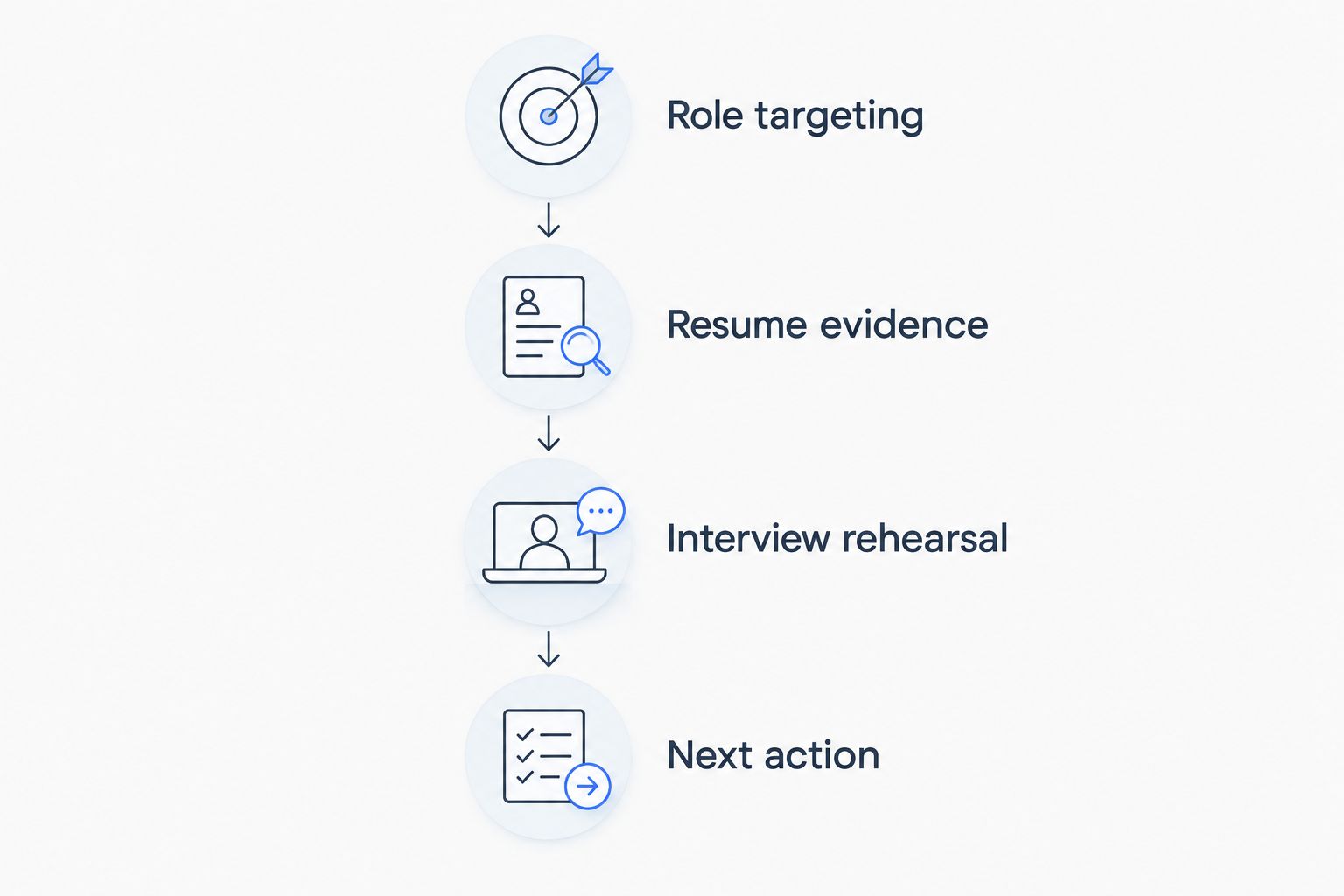
Use a short preparation packet to make your 2026 decision concrete. The quantities below are suggested inputs for the exercise, not claims about hiring outcomes or a provider's requirements.
Role targeting
Choose 2 job postings for roles you would genuinely pursue. Highlight the responsibilities, technical requirements, and experience each asks for. Note where the roles differ before deciding that one preparation plan serves both.
Resume evidence
Bring 1 resume draft and map its content to those postings. Identify the evidence that supports your application and the statements that need a clearer explanation. Keep unsupported claims out of the draft.
Interview rehearsal
Choose 1 project explanation to deliver aloud. State the question, your method, your contribution, and the limitations. Ask a listener to interrupt wherever an assumption is unclear.
Next action
Choose 1 next action based on what the exercise reveals: request resume feedback, study a technical topic, investigate campus resources, or arrange a mock interview. Keep the action specific enough that you know when it is finished.
A useful next action produces something you can inspect: a revised bullet, a solved problem, or a clearer explanation. Keep that output distinct from the activity itself. Attending a session and improving an answer are not the same measure.
Discuss your quant career questions
Explore resume review, interview preparation, and one-on-one coaching for your target quant role.
When staying with QuantBlueprint is the right call
Stay with QuantBlueprint if your current preparation addresses your immediate need and gives you work you can use. A comparison page is not a reason to replace support that already fits your task.
For a 2026 decision, inspect the output: are you correcting errors, improving explanations, or making clearer application choices? Add a complementary route only for a distinct gap. You can study independently while seeking resume feedback, or rehearse with peers while using career guidance.
FAQ
What's the best QuantBlueprint alternative for personalized coaching?
QuantMinds is the fit here for personalized quant career coaching, resume review, and interview preparation. It serves students and professionals pursuing quantitative research, trading, and development roles at hedge funds and prop trading firms.
Is career coaching the same as technical interview preparation?
No. Career coaching can address your candidacy and application decisions, while technical preparation requires working on the knowledge and skills your target role asks for. Define the task before choosing support.
Should I use my university career center first?
Check your university's services first if your question concerns campus recruiting. Confirm eligibility and ask what advising, employer activity, and relevant resources the institution provides.
Can self-study replace quant career coaching?
Self-study addresses subject learning, not an independent review of your candidacy. Use it for defined technical gaps and seek outside feedback when your question concerns your resume, targeting, or explanations.
Are peer mock interviews useful for quant candidates?
Peer mock interviews are useful for rehearsing explanations and follow-up questions. Use a feedback rubric and verify technical corrections rather than accepting a partner's confidence as evidence.
What should I bring to a quant coaching discussion?
Bring your resume, relevant job postings, and a specific question. Add a project you can explain so the discussion has concrete evidence rather than only a general career ambition.
When should I stay with QuantBlueprint instead of switching?
Stay when your current preparation addresses the task you need to improve. Consider a different route only when you can name a distinct gap and explain how that route will address it.
One last thing
Do not let the provider name become the preparation plan. Before your next session or study block, write the answer you want to improve and the evidence you will use to assess it. That keeps your choice tied to the work, whether you stay with your current support or choose another route.