

There is no single offer timeline you should assume for a prop trading firm in 2026: ask the recruiter for the decision date for your specific role and interview stage. Completing a final interview is not the same as receiving an offer, and positive feedback is not written confirmation. Use the firm's stated next step to plan your follow-up, while keeping other applications and interviews moving.
- For how long prop trading firm to make offer, use the recruiter's stated decision date—not an assumed average.
- Separate interview feedback, an offer decision, and written terms before making career commitments.
- QuantMinds quant career coaching fits candidates seeking individual preparation; it cannot establish a firm's internal decision date.
- If a promised update does not arrive, request a revised timeline and continue your search.
How long does it take a prop trading firm to extend an offer?
The useful answer is a confirmed next step and date, not a universal waiting period. Ask whether the firm is still evaluating your candidacy, arranging another conversation, or preparing written terms. Those are different stages, even when each arrives with encouraging language.
For wording you can adapt to your situation, see the guide to following up after a hedge fund interview. Keep the request focused on your status and the next expected update.
| What the firm has communicated | What you can safely conclude | What to ask next |
|---|---|---|
| Another interview is being arranged | Your interview process is continuing | What will the next conversation cover? |
| Your interviews are complete | You have finished the interviews communicated so far | Is anything else needed before a decision? |
| Feedback was positive | Someone has expressed a favorable assessment | Has an offer decision been made? |
| An offer has been communicated verbally | You have a verbal offer to clarify | When should I expect the written terms? |
| Written terms have arrived | You have a document to review | What conditions and response deadline apply? |
Do not assign an offer probability to each row. The table separates what you know from what you still need to confirm; it does not predict the firm's decision.
Why this matters
Waiting becomes expensive when you let an uncertain outcome control the rest of your search. You stop preparing, postpone another interview, or start planning a resignation before you have terms to evaluate. None of those decisions makes the pending process clearer.
For your 2026 recruiting plan, keep two records separate: the firm's confirmed communications and your own interpretation. A recruiter saying that a conversation went well belongs in the first record. Your belief that an offer is imminent belongs in the second.
That distinction gives you a practical rule: act on confirmed information, not on the story you build around silence. You can remain interested without treating the role as secured.
Separate the interview clock from the offer clock
Start by identifying what you are measuring. Time since application, time since an assessment, and time since a final interview answer different questions. A candidate who has not completed the stated process is not simply waiting for paperwork.
Record the last completed stage and the recruiter's exact description of what follows. Avoid rewriting an ambiguous update into a stronger promise.
After an assessment or early interview
Ask whether another evaluation remains and who will coordinate it. If you have not been told that your interviews are complete, do not describe yourself as waiting for an offer.
Use the waiting period to maintain relevant preparation. Review the reasoning behind your answers, revisit coding mistakes, and prepare clear explanations of your research or trading projects. Do not assume the next conversation will repeat the last one.
After a final interview
Confirm that the interview process is complete and ask when you should expect a decision or status update. The distinction matters: an update can report that a decision is still pending.
If the recruiter gives you a date, record what that date refers to. A promised check-in is not necessarily a promised offer decision, and treating it as one creates avoidable confusion.
After a verbal offer
Ask for the written terms, any stated conditions, and the response deadline. Express enthusiasm without implying that you have reviewed details you have not received.
Keep a record of the conversation. If the written document differs from your understanding, ask for clarification before committing rather than relying on memory.
Why offer timing varies: what to clarify
Do not diagnose a delay from outside the firm. Instead, identify which part of the process remains unresolved. These questions help you replace guesses with information:
- Interview completion: Has the firm confirmed that all required conversations are finished?
- Decision status: Is the hiring decision pending, or has an offer already been communicated?
- Outstanding information: Does the recruiter need anything further from you?
- Written terms: Are you waiting for a decision or for documentation of a verbal offer?
- Deadline alignment: Does the recruiter know about a genuine competing response deadline?
These are clarification points, not explanations you should assign to every delay. For example, do not tell yourself that paperwork is holding things up unless the recruiter has actually said so.
The same discipline applies to your 2026 application tracker. Write down the explanation the firm provides, not a theory about headcount, interview performance, or other candidates.
What should you do while waiting for an offer?
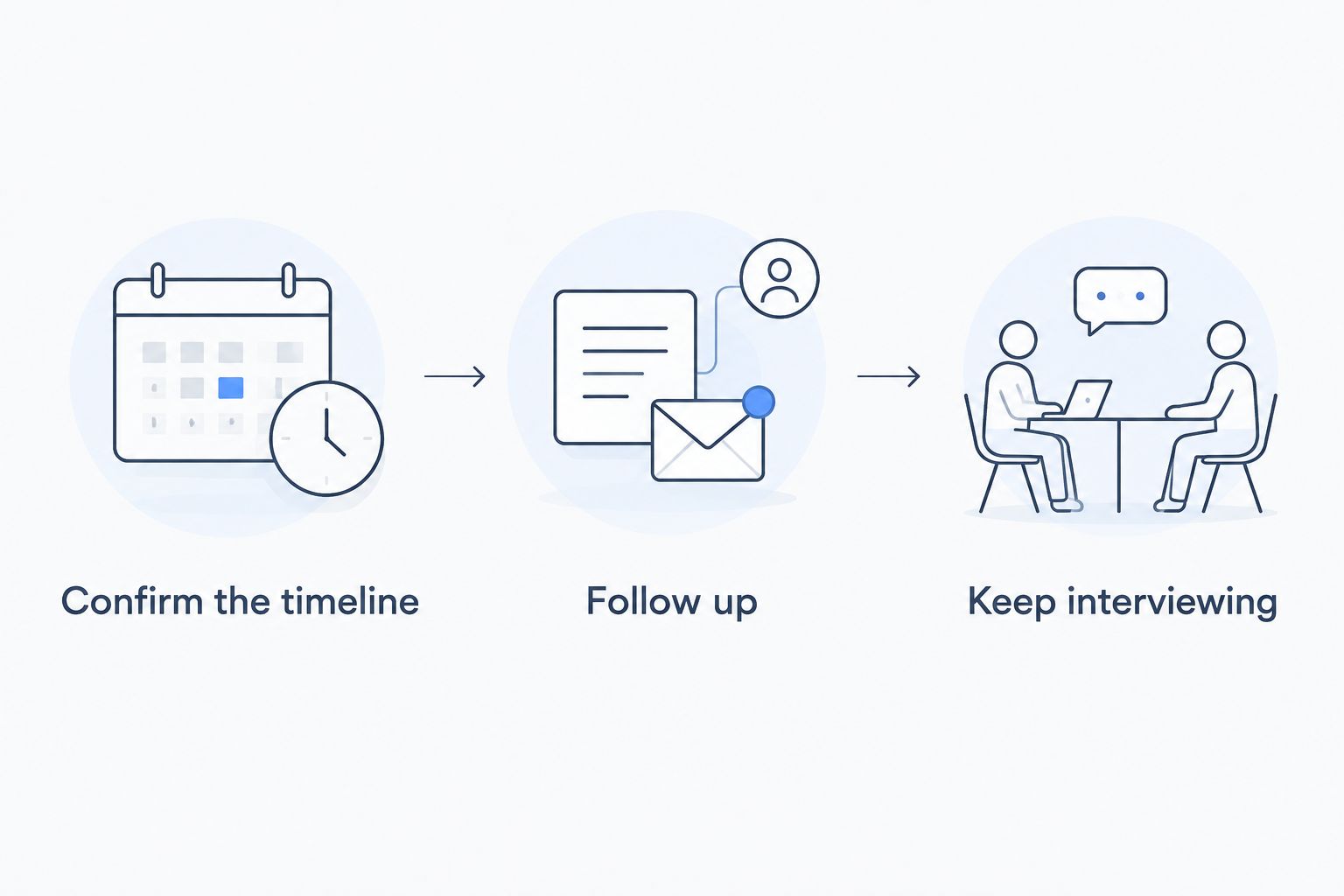
Use a simple sequence: establish the timeline, follow up against it, and protect your other options. The purpose is to get an actionable update without making the recruiter manage a stream of repeated requests.
Confirm the timeline
Before ending the final conversation, ask what happens next and when you should expect to hear from the recruiting contact. If you leave without that information, send a concise message asking for it.
Include the role and interview stage so the recipient can identify the process quickly. You do not need to repeat your resume or argue that your performance deserves an offer.
Follow up
If a stated update date passes, refer to that date and ask for the current status. If no date was given, ask the recruiter to establish one rather than selecting an arbitrary countdown from online anecdotes.
Keep the request narrow. Ask whether the process remains active, whether anything is needed from you, and when you should next check in. Use the existing recruiting thread unless you have been directed elsewhere.
Keep interviewing
Continue preparing for and attending other interviews while the outcome remains unresolved. That is not a statement about your confidence in the pending firm; it is a way to avoid making your entire search depend on an unconfirmed decision.
Do not manufacture urgency or imply that another offer exists when it does not. Accurate information gives the recruiter something useful to respond to; invented pressure creates a credibility problem.
How should you write the follow-up message?
A useful follow-up contains context, a status question, and a request for the next update. Thank the recipient briefly, identify the role, and refer to the most recent conversation. Then make the question easy to answer.
Choose wording that matches what has actually happened:
- No timeline provided: Ask what the next step is and when you should expect an update.
- Update date missed: Refer to the expected update and ask whether a revised timeline is available.
- Verbal offer received: Ask when the written terms and response deadline will be provided.
- Another deadline exists: State the actual deadline and ask whether the firm can clarify its position before then.
These are drafting instructions, not messages to send unchanged. Add the real role title and relevant context, then remove anything the recruiter already knows or does not need.
For 2026 recruiting, keep a dated record of your outreach and the replies. That record prevents contradictory follow-ups and helps you distinguish a missed commitment from a timeline you never confirmed.
What if another firm needs an answer first?
Tell the pending firm about the genuine deadline as soon as it affects your decision. State that you remain interested, explain when your response is due, and ask whether the firm can provide a decision or meaningful status update beforehand.
Separately, ask the offering firm whether an extension is possible. Treat that as a request, not an entitlement, and do not assume it has been granted until you receive confirmation.
A competing deadline is information, not a guarantee of acceleration. If the pending firm cannot meet it, make your decision using the offer you actually have and your own priorities. Do not treat an unresolved process as an equivalent alternative.
Avoid sharing confidential documents or unnecessary details about the other employer. Communicate enough to explain the timing issue without turning the exchange into a bidding story.
Does silence after a final interview mean rejection?
Silence alone does not establish either rejection or an offer. It tells you that you have not received a decision. Request an update rather than converting the absence of information into a verdict on your performance.
If the recruiter confirms that the process remains open, ask when to expect the next communication. If the recruiter closes the process, record the outcome and redirect your effort to active opportunities.
When no substantive update arrives, stop making plans that depend on the role. You do not need to label the process a rejection to keep applying elsewhere, and you do not need repeated reassurance to continue preparing.
Can a career coach help while you wait?
QuantMinds quant career coaching is best for students and professionals seeking individual preparation for quantitative research, trading, and development roles. The firm offers resume review, interview preparation, and individual coaching, and was founded by a former UC Berkeley MFE program executive director.
The useful coaching question is not whether someone can predict an unseen hiring decision. It is whether your resume, project explanations, interview answers, and recruiting approach need work before the next opportunity.
QuantMinds fits that preparation need. The limit is equally clear: career coaching is not confirmation of a prop firm's decision or a substitute for the recruiter's timeline. Choose it for work on your candidacy, not for certainty about an employer's internal process.
FAQ
How long should I expect a prop trading firm to take to make an offer in 2026?
Use the recruiter's stated decision timeline rather than assuming a standard waiting period. Confirm whether you are awaiting another interview, a hiring decision, or written terms.
Should I follow up after the recruiter misses an update date?
Yes, follow up by referring to the expected update and asking for the current status. Request a revised timeline and check whether anything is needed from you.
Does positive interview feedback mean an offer is coming?
Positive interview feedback is not an offer. Ask whether a hiring decision has been made and what the next step is.
Should I stop interviewing after a verbal prop trading offer?
Do not stop interviewing solely because you have a verbal offer. First obtain and review the written terms, stated conditions, and response deadline.
Can I ask a prop trading firm to decide before another offer expires?
Yes, explain the genuine competing deadline and ask whether the firm can clarify its position before then. Do not assume that it can accelerate the process.
Is a delayed response proof that I failed the final interview?
A delayed response is not proof that you failed the final interview. Ask for your status and keep other applications moving instead of assigning a reason to the silence.
Can QuantMinds tell me when a prop firm will make its decision?
The prop firm's recruiting contact is the source for its decision timeline. QuantMinds offers career coaching, resume review, and interview preparation—not confirmation of an employer's internal decision.
One last thing
Ask what the next promised date actually means. A date for feedback, a date for a decision, and a date for written terms are not interchangeable.
Before closing your next recruiting conversation, confirm the expected deliverable as well as the date. That small clarification makes your follow-up more precise and stops you from mistaking a scheduled update for a promised offer.