
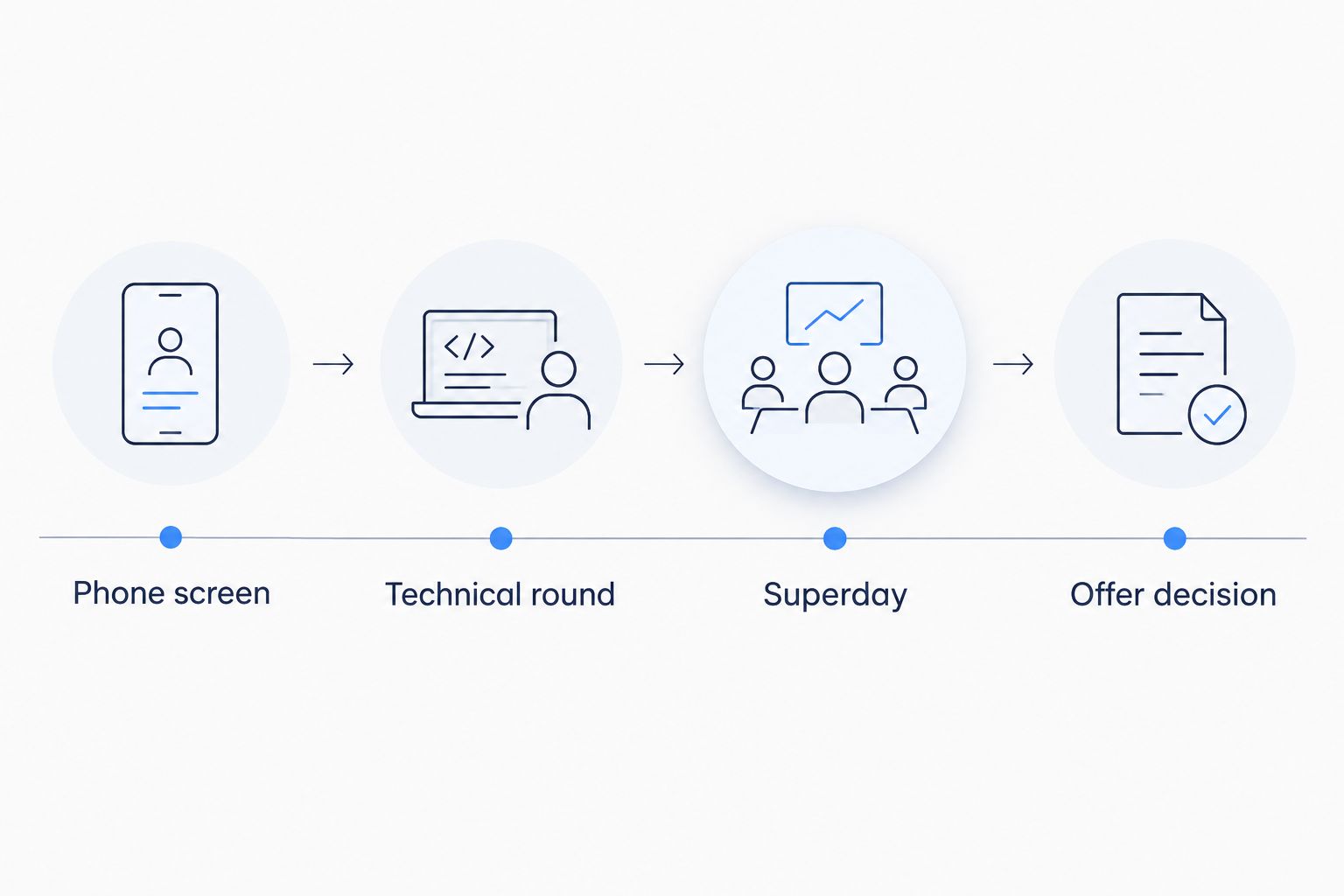
Quant trading interviews run about 6 weeks from first contact to offer in 2026, spread across 4 to 7 separate rounds rather than one conversation. The part most candidates don't plan for is that each round has its own length — a 30-minute phone screen and a 6-hour superday are both "the interview," and treating them the same way is why prep runs out of gas halfway through.
- Quant trading interviews take about 6 weeks start to offer in 2026, across 4 to 7 rounds.
- Phone screens run 30 to 45 minutes; superdays stretch 4 to 6 hours across back-to-back sessions.
- Prop trading firms move faster than hedge funds — some compress the full process into 2 to 3 weeks.
- Round count and length vary more by firm type and seniority than by candidate strength alone.
Why this matters
Candidates who prep for "an interview" show up ready for a 45-minute call and get blindsided by a superday that runs six hours with five different interviewers. Knowing the shape of the timeline before you start applying changes how you pace prep — you don't cram everything into the week before the first call, you spread it across the full quant interview prep cycle. QuantMinds builds coaching schedules around this exact timeline because the failure mode isn't usually knowledge, it's stamina and sequencing.
How long do quant trading interviews last?
The process has three distinct stages, each with its own typical duration:
| Stage | Typical length | Format |
|---|---|---|
| Phone/video screen | 30-45 minutes | 1 interviewer, probability and quick math |
| Technical or quant round | 45-60 minutes | 1 interviewer, coding or pricing problems |
| Superday / onsite | 4-6 hours | 3-6 interviewers, back-to-back rounds |
Most candidates who get an offer sit through the screen, one or two technical rounds, and then a superday — that's the 4 to 7 rounds referenced above. Firms that skip the superday and go straight from technical rounds to an offer call tend to be smaller prop shops running leaner processes; large hedge funds and banks almost always keep the superday format.
Phone screen: 30 to 45 minutes
The first round is usually a single 30 to 45 minute call, often over video, covering probability puzzles, quick mental math, and a short walkthrough of your resume. It's designed to filter fast — recruiters are screening for obvious gaps, not depth. Verdict: treat this round as a speed test, not a depth test.
Technical or quant round: 45 to 60 minutes
The second stage runs 45 to 60 minutes and goes deeper into coding, statistics, or derivatives pricing depending on the desk. Expect one interviewer, a shared screen, and problems that build on each other rather than standalone questions. Verdict: this is where prep time should concentrate — it's the longest single-topic round.
Superday (onsite): 4 to 6 hours across multiple rounds
The superday is the marathon stage: 4 to 6 hours on-site or over video, with 3 to 6 interviewers rotating through 30 to 45 minute sessions each. Some firms mix in a lunch or informal chat, but the technical bar doesn't drop for those slots. Verdict: candidates who haven't rehearsed under fatigue lose points in round 5, not round 1.
Full process timeline: 4 to 8 weeks
From the first recruiter email to a signed offer, the full process typically runs 4 to 8 weeks, with 6 weeks being the common midpoint. Prop trading firms with smaller headcounts sometimes compress this into 2 to 3 weeks when they're filling a seat quickly; large hedge funds and banks with structured recruiting cycles tend to stretch closer to 8 weeks because of scheduling across multiple interviewers.
Why interview length varies
- Firm type — prop shops run leaner, faster processes; hedge funds and banks add more rounds and more scheduling friction.
- Seniority level — internship and entry-level processes tend toward the shorter end; experienced-hire roles add extra rounds with senior staff.
- Take-home assignments — some technical rounds get replaced or supplemented with a multi-day take-home project, which adds calendar time without adding interview hours.
- Remote vs. onsite — remote superdays sometimes compress to fewer back-to-back hours than in-person versions with travel built in.
- Number of open seats — a firm hiring for one seat moves faster than one running a class-wide internship cycle with dozens of candidates.
- Negotiation stage — an offer call and comp discussion can add another 1 to 2 weeks after the last technical round, even though it's not technically "interview" time.
Get your interview timeline mapped out
1-on-1 coaching sessions built around each round of your process.
How many rounds does a quant trading interview have?
Most quant trading candidates go through 4 to 7 rounds before an offer: one phone screen, one or two technical rounds, and a superday with multiple interviewers. Fewer rounds usually means a smaller firm moving fast; more rounds usually means a hedge fund or bank layering in extra technical or cultural-fit sessions.
How long is a quant trading superday?
A quant trading superday runs 4 to 6 hours, split into 30 to 45 minute rounds with 3 to 6 different interviewers. Some firms build in a short break or informal lunch, but the technical questioning continues at the same intensity through the last round.
How long does the full quant recruiting process take from application to offer?
The full process takes 4 to 8 weeks from application to offer in 2026, with 6 weeks as the typical midpoint across prop shops and hedge funds. The range depends heavily on firm size — smaller prop trading firms move faster, larger institutions take longer to coordinate multiple interviewer schedules.
For candidates prepping resume and story material well before rounds start, Glassdoor research into a prop trading interview workflow is worth working through alongside timeline planning — knowing what's coming changes how you sequence practice.
FAQ
How long does a quant trading interview last?
A single quant trading interview round lasts 30 to 60 minutes, but the full process from screen to offer runs about 6 weeks in 2026. Superday rounds are the exception, stretching 4 to 6 hours in one sitting.
How many interview rounds does quant trading recruiting involve?
Quant trading recruiting typically involves 4 to 7 rounds: a phone screen, one or two technical rounds, and a superday with several interviewers. Prop shops sometimes compress this to fewer rounds when filling a seat quickly.
Is a quant trading superday longer than a regular interview?
Yes — a superday runs 4 to 6 hours compared to the 30 to 60 minutes of a single phone or technical round. It's structured as back-to-back sessions with different interviewers, not one long conversation.
How long does it take to hear back after a quant trading interview?
Turnaround varies by stage, but candidates typically hear back within 1 to 2 weeks after each round, faster after a superday since firms want to move before candidates accept elsewhere.
Do quant trading interviews take longer at hedge funds than prop trading firms?
Hedge funds tend to run closer to the 8-week end of the 4 to 8 week range, while prop trading firms with leaner teams sometimes finish in 2 to 3 weeks. The difference comes from scheduling across more interviewers, not from harder questions.
What happens during the 45 to 60 minute technical round?
The technical round covers coding, probability, or pricing problems with one interviewer over 45 to 60 minutes. It's the round most candidates should spend the most prep time on, since it's the longest single-topic session before the superday.
Can a quant trading interview process move faster than 4 weeks?
Yes, smaller prop trading firms filling one seat sometimes complete the full process in 2 to 3 weeks. Larger institutions running structured internship or graduate cycles rarely move that fast because of coordinating multiple interviewer calendars.
One last thing
The stage candidates underestimate isn't the technical round — it's the superday's back half. By hour 4 of a 4 to 6 hour superday, fatigue shows up as slower mental math and shorter answers, and interviewers notice the drop-off even when the content is still correct. Rehearsing under time pressure for the last round, not just the first one, is the detail that separates candidates who get the offer call from those who get a polite pass. QuantMinds structures mock sessions to hit that same fatigue point on purpose, because that's where most candidates actually lose ground in 2026 recruiting cycles.