

Best overall for broad financial engineering work: J.P. Morgan quantitative finance internships. Best for empirical research: Citadel quantitative research internships. Best for trading decisions: Jane Street quantitative trading internships. This 2026 guide ranks internship routes by the work you want to do after your MFE, not by employer prestige alone.
- Financial engineering internship programs: MFE students should shortlist J.P. Morgan for pricing, modeling, and broader quantitative finance exposure.
- Citadel quantitative research internships fit candidates who can defend empirical research and statistical choices.
- Jane Street quantitative trading internships fit candidates interested in probability, markets, and decisions under uncertainty.
- Two Sigma software engineering internships suit software-focused candidates; Goldman Sachs quantitative strategists internships suit desk-facing modeling interests.
- QuantMinds helps MFE candidates prepare resumes and interviews; coaching is not an internship program.
Why this matters
An MFE does not point to one job. Pricing derivatives, researching signals, making trading decisions, and building production software demand different evidence from a candidate.
Your internship shortlist should reflect that distinction. A recognizable employer name does not establish that a particular team, project, or eligibility requirement fits your background.
QuantMinds provides quant finance career coaching, resume review, interview preparation, and individual coaching. QuantMinds is best for MFE students who need help translating their background into a targeted quant recruiting strategy. It belongs in your preparation plan, not in a ranking of employers offering internships.
For 2026 applications, read the actual position description before investing in preparation. Confirm degree eligibility, expected graduation date, location, work authorization requirements, and the internship's relationship to your academic calendar.
What makes the best financial engineering internship program?
Use these criteria before comparing firms:
- Role alignment: The work connects directly to your intended research, trading, development, or pricing career.
- Technical relevance: The position uses skills you can demonstrate, rather than subjects listed only on your transcript.
- Project substance: You can identify the kind of problem the team solves and ask how interns contribute.
- Learning access: You can ask who reviews your work, how feedback happens, and what collaboration looks like.
- Eligibility fit: The specific position accepts your degree level and matches your graduation and authorization circumstances.
- Interview alignment: Your preparation addresses the actual role, not a generic collection of quant puzzles.
Do not assume these criteria are satisfied because a firm is well known. Use them to question recruiters, alumni, and interviewers. A useful answer describes the work; a vague answer repeats the employer's reputation.
Financial engineering internships at a glance
These are employer-and-role combinations to investigate, not a statement that every position accepts every MFE student in 2026. Confirm the current listing's requirements directly with the employer.
| Internship route | Best for | Standout focus | Key limitation |
|---|---|---|---|
| J.P. Morgan quantitative finance internships | MFE students targeting pricing and financial modeling | Quantitative work connected to bank products and risk | Responsibilities differ substantially across teams |
| Citadel quantitative research internships | Candidates with strong empirical research evidence | Statistical research connected to investment decisions | Coursework alone does not demonstrate research judgment |
| Jane Street quantitative trading internships | Candidates drawn to probability and trading decisions | Reasoning about uncertainty and markets | Mathematical knowledge is not the same as trading judgment |
| Two Sigma software engineering internships | Candidates targeting software-intensive quant careers | Engineering in a quantitative investment setting | Software engineering is not automatically a research role |
| Goldman Sachs quantitative strategists internships | Candidates targeting desk-facing quantitative work | Modeling and programming connected to financial businesses | The team's remit matters more than the broad title |
1. J.P. Morgan: best for pricing and financial modeling
J.P. Morgan's quantitative finance internship route is a practical starting point when your MFE interests center on mathematical finance, valuation, and risk. Bank quantitative work connects models to financial products and business decisions; the specific team determines the balance.
This is the default shortlist choice for an undecided MFE student whose strongest evidence is coursework and projects in financial engineering. It is not automatically the best choice for someone already committed to systematic investment research.
J.P. Morgan quantitative finance internship pros:
- Aligns with pricing, numerical methods, and financial modeling interests.
- Connects quantitative analysis to identifiable financial products and risks.
- Gives you a focused reason to explain why you chose an MFE.
J.P. Morgan quantitative finance internship cons:
- A broad quantitative title does not reveal the team's daily work.
- Pricing or risk experience is not interchangeable with investment research.
Best for: MFE students pursuing derivatives, valuation, or bank quantitative roles.
For your 2026 application, prepare a project explanation that connects the model, its assumptions, the implementation, and its limitations. Ask whether the position emphasizes model development, analysis, implementation, or another function.
Verdict: Buy — prioritize this route when financial modeling is your strongest fit.
2. Citadel: best for empirical quantitative research
Citadel quantitative research internships belong on the shortlist when you want to investigate data, test hypotheses, and connect research to investment decisions. The relevant preparation is empirical reasoning, not simply knowing the vocabulary of finance.
Choose this route when you can explain a research question and defend the choices behind your answer. A sophisticated model without a credible evaluation process is weak evidence.
Citadel quantitative research internship pros:
- Aligns directly with a buy-side quantitative research goal.
- Gives statistical research and programming a clear application.
- Lets you position substantive research projects as relevant preparation.
Citadel quantitative research internship cons:
- An MFE credential alone does not establish research readiness.
- A project built around a headline result is difficult to defend without sound validation.
Best for: MFE students with defensible statistical, machine learning, or empirical research projects.
Prepare to discuss data construction, baselines, leakage, evaluation, and failed approaches. Explain what changed your mind during the project. Use the guide to explaining a research project in a quant interview to organize that discussion around decisions rather than software names.
Verdict: Buy — prioritize Citadel quantitative research when your evidence demonstrates research judgment.
3. Jane Street: best for probability and trading decisions
Jane Street quantitative trading internships are a relevant route for candidates interested in markets, probability, and decisions under uncertainty. The fit is different from a role centered on producing a long research study or implementing a pricing library.
Choose this route because the work interests you, not because you enjoy collecting difficult puzzles. Your preparation should make your reasoning visible and show how you respond when assumptions change.
Jane Street quantitative trading internship pros:
- Aligns with a quantitative trading career goal.
- Gives probability and uncertainty a direct decision-making context.
- Provides a clear application narrative for candidates interested in markets.
Jane Street quantitative trading internship cons:
- Strong academic mathematics does not automatically establish trading judgment.
- Memorized answers do not demonstrate how you reason through an unfamiliar problem.
Best for: MFE students who prefer probabilistic decisions and trading problems to longer-form research or software development.
For 2026 preparation, practice stating assumptions, checking extreme cases, and updating an answer after receiving new information. Explain why a decision follows from your estimate, rather than stopping at the calculation.
Verdict: Buy — prioritize Jane Street quantitative trading when uncertainty and trading decisions genuinely interest you.
4. Two Sigma: best for software-intensive quant careers
Two Sigma software engineering internships are worth investigating when your strongest skill is building software and your career goal sits close to quantitative investment technology. Treat software engineering as its own discipline, not as an easier substitute for quantitative research.
The distinction matters. A software internship at a quantitative investment firm does not automatically mean you will design investment signals, and the team assignment determines the work.
Two Sigma software engineering internship pros:
- Aligns with a software-first application narrative.
- Gives engineering skills a quantitative investment context.
- Makes substantial coding projects relevant evidence for your candidacy.
Two Sigma software engineering internship cons:
- The role is not equivalent to a quantitative research internship.
- Financial engineering coursework does not replace software engineering preparation.
Best for: MFE students with strong programming backgrounds who want development or research-engineering work.
Prepare to discuss testing, interfaces, data structures, and design choices. Show that someone else can run and understand your code. Ask about the team's responsibilities before describing the opportunity as a quant developer internship.
Verdict: Buy — prioritize Two Sigma software engineering when building systems is your strongest contribution.
5. Goldman Sachs: best for desk-facing quantitative work
Goldman Sachs quantitative strategists internships belong on your shortlist when you want modeling and programming connected to a financial business. Quantitative strategists work across different functions, so the team description is essential to evaluating fit.
This route suits candidates who want to connect technical analysis with the needs of traders, investment professionals, or other business users. It should not be treated as a single standardized job across the firm.
Goldman Sachs quantitative strategists internship pros:
- Connects mathematical and programming skills with financial applications.
- Supports a clear narrative around solving business-facing quantitative problems.
- Fits candidates interested in explaining models as well as building them.
Goldman Sachs quantitative strategists internship cons:
- The broad title does not specify the balance of modeling, coding, and analysis.
- Experience in one team does not establish exposure to every financial product.
Best for: MFE students interested in quantitative work close to a desk or financial business.
For 2026 applications, connect your project to its intended user. Explain the decision it supports, the assumptions it depends on, and the consequences of getting those assumptions wrong.
Verdict: Buy — prioritize Goldman Sachs quantitative strategists when business-facing modeling is your target.
How we ranked these internship routes
The ranking follows role alignment, technical relevance, and the evidence an MFE candidate can present. J.P. Morgan is the default for broad financial engineering interests; the other routes take distinct research, trading, software, and desk-facing slots.
This is a fit ranking, not a measured ranking of acceptance rates, intern outcomes, mentoring quality, or return offers. Those factors require position-specific evidence. Ask about them during recruiting rather than treating employer reputation as the answer.
Build a shortlist you can defend
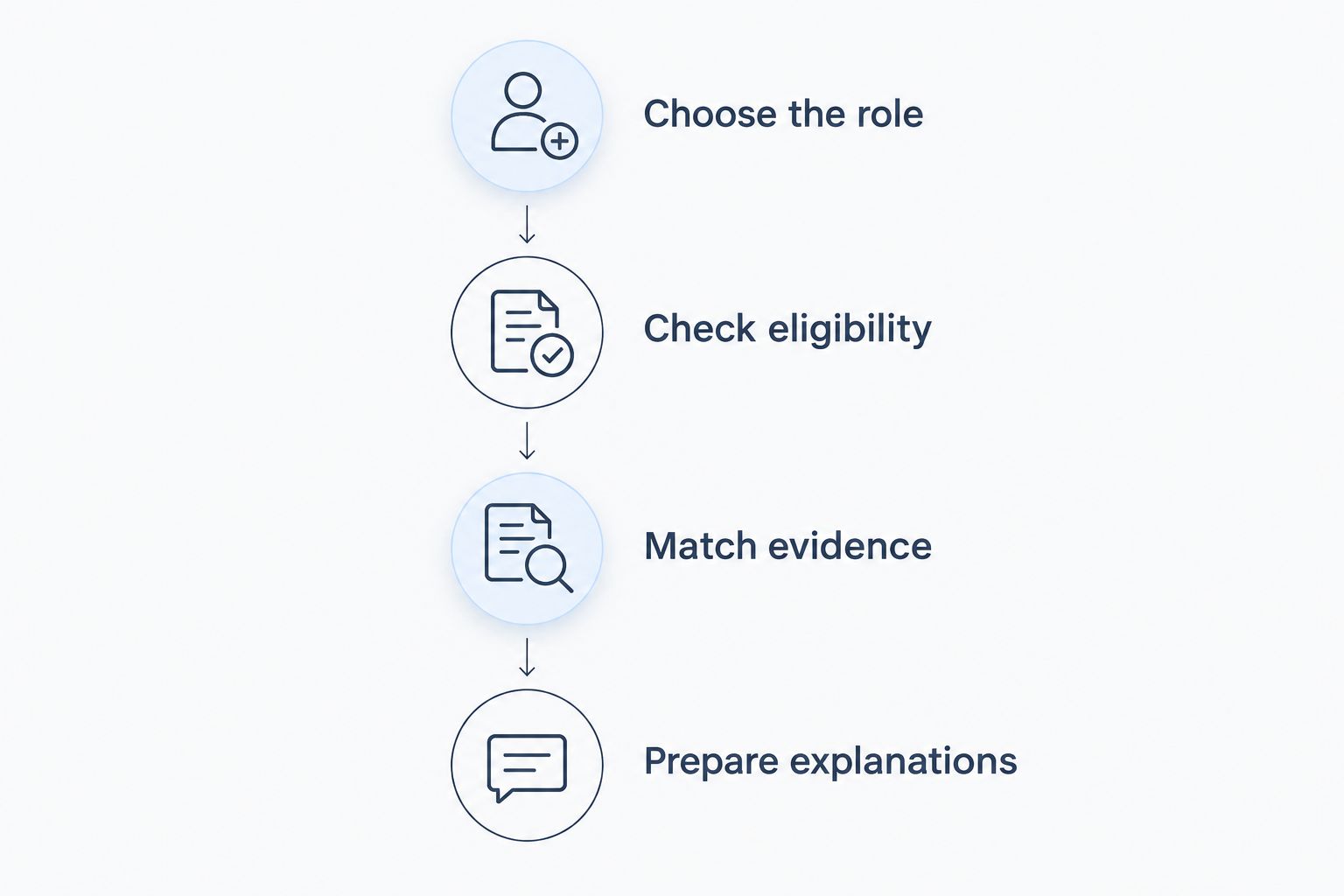
Start with the job you want after graduation. Then work backward to the internship responsibilities and application evidence that support it.
Choose the role
Pick a primary direction: research, trading, development, or financial modeling. Keep a secondary direction only if you can explain why it fits your skills and interests.
Check eligibility
Read each position's degree, graduation, location, and work authorization requirements. If your MFE calendar creates a conflict, ask the employer and your program before assuming you can participate.
Match evidence
Map 3 role requirements to evidence you already have: a project, relevant experience, or a technical explanation. This is a shortlist exercise, not an employer scoring system.
Prepare explanations
Write a 1-page project brief covering the question, method, evaluation, and limitation. Practice a 2-minute explanation before expanding into technical detail; these are preparation targets, not interview format claims.
The same project can support different applications, but the explanation must change. A researcher needs to hear about validation; an engineer needs to hear about implementation; a desk-facing team needs to understand the decision your model supports.
QuantMinds provides resume review and interview preparation for candidates targeting quantitative research, trading, and development. The firm was founded by a former UC Berkeley MFE program executive director, connecting its coaching focus directly to the MFE-to-career transition.
Build your quant internship application
Get help with your resume, interview preparation, and quantitative career positioning.
Which financial engineering internship should you choose?
Choose J.P. Morgan quantitative finance as your default research starting point if you want pricing and financial modeling. Choose Citadel quantitative research for empirical investment research, Jane Street quantitative trading for trading decisions, Two Sigma software engineering for systems work, or Goldman Sachs quantitative strategists for business-facing modeling.
For your 2026 shortlist, put the team's responsibilities ahead of the firm's name. Do not send identical project descriptions to roles that ask for fundamentally different capabilities.
FAQ
What's the best financial engineering internship for an MFE student?
J.P. Morgan quantitative finance is the default shortlist choice in this guide for MFE students interested in pricing and financial modeling. Citadel, Jane Street, Two Sigma, and Goldman Sachs serve different research, trading, software, and desk-facing interests.
Can MFE students apply to quantitative research internships?
MFE students should apply when the specific quantitative research position accepts their degree level and graduation timing. Eligibility is position-specific, and a strong application needs research evidence beyond the degree title.
Is a quantitative trading internship better than a research internship?
A quantitative trading internship is better for candidates who want trading decisions, while a research internship better matches empirical investigation. Choose based on the daily work you want, not a general claim that one route outranks the other.
Does a software engineering internship count as quant experience?
A software engineering internship at a quantitative investment firm provides engineering experience in that setting, but it is not automatically quantitative research experience. Describe the actual systems, responsibilities, and problems you worked on.
What should I check before applying for an internship in 2026?
Check degree eligibility, expected graduation date, location, work authorization requirements, and compatibility with your academic calendar. Read the specific position description rather than relying on a firm's general internship reputation.
Do international MFE students need to check work authorization?
International MFE students need to confirm that an internship meets their work authorization requirements. Consult the employer and your university's international student office about your individual circumstances before committing.
Can QuantMinds help me prepare for financial engineering internships?
QuantMinds offers resume review, interview preparation, and individual coaching for quantitative research, trading, and development careers. Its services support application preparation; QuantMinds is not an employer internship program.
One last thing
Ask this before accepting an internship: What problem would I work on, and who would review my work? The answer gives you something concrete to evaluate beyond the employer name.
Your eventual resume must describe your contribution, not just where you spent the summer. Keep a record of the methods you used, the decisions you made, and the feedback you acted on. Respect confidentiality; useful evidence does not require disclosing proprietary models or data.