

Instead of repeatedly browsing Quantitative Finance Stack Exchange, turn selected questions into a practice queue, solve them independently, and rehearse your reasoning aloud before a quant interview. This 2026 workflow connects useful forum activity to defensible technical answers and application evidence—not reputation chasing or a promised recruiting shortcut.
- The quant stack exchange to interview workflow turns selected questions into independent solutions, technical explanations, and relevant application evidence.
- Use Quantitative Finance Stack Exchange for problem discovery, not proof that an answer is correct.
- QuantMinds offers quant interview prep and resume review when you need feedback beyond self-study.
- Keep your own contribution separate from community answers; never present someone else’s derivation as your research.
Why this matters
Reading a convincing answer and producing one are different tasks. A useful preparation workflow tests whether you can identify assumptions, choose a method, check the result, and explain what breaks when the setup changes.
QuantMinds is best for candidates seeking quant interview prep, resume review, and individual career coaching. The firm was founded by a former UC Berkeley MFE program executive director; its quant career coaching addresses preparation and positioning rather than providing another discussion forum.
Use this 2026 workflow to produce evidence of understanding. A saved thread is an input; an independently checked solution and a clear explanation are outputs. Neither a public profile nor a polished explanation guarantees an interview.
Before you start
- Gather your materials. Have access to Quantitative Finance Stack Exchange, a private document or spreadsheet, your resume, and a target job description. You need an account if you intend to contribute publicly, but reading and private practice do not require posting.
- Choose a role before choosing questions. Extract technical requirements from the actual job description. Add a notebook or coding environment when the role requires implementation; do not assume every quant interview tests the same material.
- Separate public material from restricted material. Never upload employer code, proprietary data, confidential interview questions, or identifying details about another person. Public answers are learning material, not permission to claim authorship or republish without attribution.
The setup below is a manual workflow, not a software integration. The bold field names are labels you create in your own tracker, not Stack Exchange interface controls. That distinction keeps the process usable without depending on changing menus or automation permissions.
Your role-specific question queue
Start with the interview you are preparing for, not the thread that looks most sophisticated. For your 2026 application cycle, record the job description’s requirements before collecting practice material.
- Create a sheet named Interview Queue. Add fields for Target Role, Skill, Source, Question, Assumptions, Independent Attempt, Verification, Follow-up, and Status.
- Copy relevant requirements from the job description into Skill. Distinguish explicit requirements from topics you simply find interesting.
- Search Quantitative Finance Stack Exchange for a requirement and a specific concept. For example, narrow a broad interest in derivatives to a question about a pricing assumption or numerical method.
- Read the complete question, answers, and relevant comments before retaining it. Record ambiguities in Assumptions rather than quietly resolving them in your favor.
- Start with 3 questions that you can meaningfully attempt. Set each Status to Queued and save the source reference privately.
Expected result: Each queued question maps to a named role requirement and states what you need to explain. Delete questions whose only justification is that they look difficult.
Choose the right practice format
These formats serve different purposes. Choose the smallest one that exposes your current weakness rather than creating a project for every thread.
| Practice format | Best for | What you produce | Main limitation |
|---|---|---|---|
| Written derivation | Assumptions and mathematical reasoning | A solution with intermediate steps and checks | Does not test implementation or spoken delivery |
| Coding experiment | Numerical reasoning and implementation | Reproducible code with test cases | A plausible output does not establish correctness |
| Spoken rehearsal | Clear explanation under questioning | An answer followed by challenges | Fluent delivery can conceal an unverified solution |
Use written work to establish reasoning, code when implementation matters, and speech to test whether you can defend both. These are complementary checks, not interchangeable credentials.
Your independent solution record
Hide the community answers before you attempt the problem. Otherwise, recognition can masquerade as recall, and the worksheet becomes a transcription exercise.
- Rewrite the question in your own words under Independent Attempt. Define the inputs, the requested output, and any missing conditions.
- Work without looking at the answer. Set a 25-minute practice block as a starting constraint, not an employer benchmark; record unfinished reasoning honestly.
- State each assumption before using it. If you assume independence, a distribution, a boundary condition, or a particular timing convention, make that visible.
- Check the result through an appropriate second method. Use a simple special case, dimensional consistency, an alternative derivation, or a numerical experiment where applicable.
- Reveal the community answer and compare methods. In Verification, distinguish agreement, disagreement, and unresolved uncertainty; record why a correction was necessary.
Expected result: You have a traceable solution showing what you produced, how you checked it, and what you learned from the discussion. Agreement with a posted answer is not itself verification.
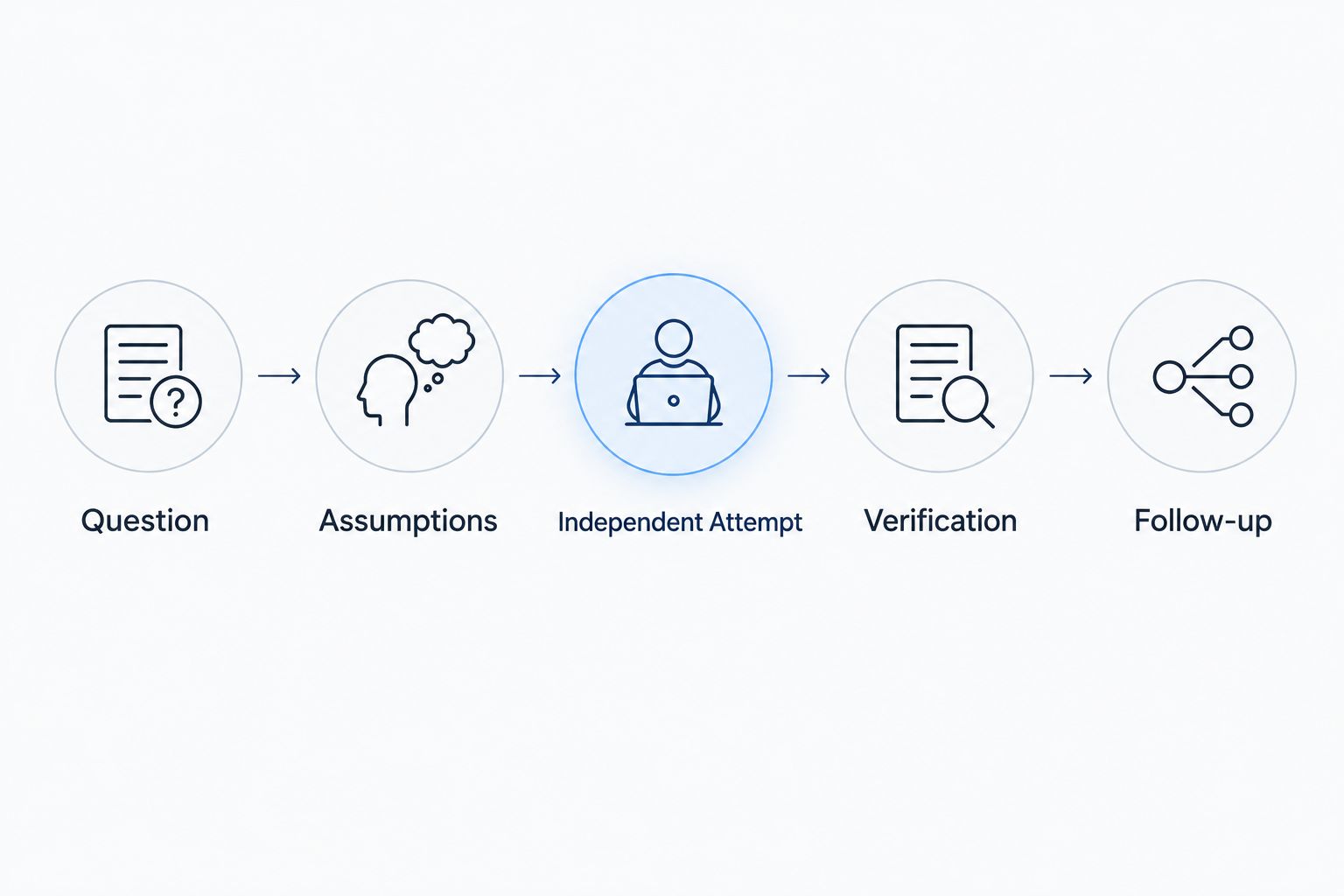
Make corrections explainable
When your answer changes, preserve the original attempt privately. Add a short correction explaining whether the error came from interpreting the question, selecting a method, doing algebra, or implementing code.
For example, if a proposed calculation depends on independence, ask whether the question actually supplies independence. Do not invent a convenient assumption and then defend the resulting answer as unconditional.
For your 2026 preparation record, distinguish Completed from Verified. Finishing the algebra does not resolve an unanswered objection to the setup.
Your interview rehearsal packet
A technically sound solution needs a spoken version. Build the explanation around decisions and checks, not a recital of every line you wrote.
- Create Opening, Method, Check, and Limitation fields beneath each verified solution. Write a short statement for each.
- Give a 2-minute explanation without reading the thread. State the problem, explain the key assumption, describe your method, and identify a meaningful limitation.
- Add 2 follow-ups under Follow-up. Change an assumption, ask for a limiting case, or require a different implementation approach.
- Ask a practice partner to interrupt when a term is undefined or a step lacks justification. If practicing alone, record the explanation and identify those gaps yourself.
- Return the item to Queued when you cannot defend a central step. Set Status to Rehearsed only after you can explain the reasoning and address the follow-ups.
Expected result: You can answer the original question and respond when someone changes its conditions. You are practicing reasoning under challenge, not memorizing a forum response.
The guide to explaining a research project in a quant interview extends this work to project discussions. Keep the distinction clear: solving a public question is an exercise unless you genuinely developed a broader research project.
Your application evidence
Use public activity selectively. The relevant question is whether the contribution helps a reader evaluate your work—not whether your profile contains something you can link.
- Review your public contributions for relevance, correctness, and confidentiality. Omit anything you cannot explain without relying on someone else’s answer.
- Record your exact contribution privately: posed a question, identified a missing condition, wrote a derivation, implemented a check, or corrected an error.
- Decide whether that contribution belongs in an application. A substantive body of relevant work deserves consideration; casual participation does not require a resume line.
- Describe only what you actually did. Distinguish your implementation or analysis from the public problem that prompted it, and preserve appropriate attribution.
- Check that your resume, public profile, and spoken account agree. For each 2026 application, prioritize evidence relevant to that role rather than attaching the same material everywhere.
Expected result: Any application reference has a clear purpose and an accurate account of authorship. You have not turned community participation into a claimed employment credential.
QuantMinds offers resume review and quant interview prep. Use that support when you need feedback on your application materials or preparation; coaching does not replace doing and understanding the technical work.
Review your quant interview preparation
Explore resume review, interview prep, and individual coaching for quantitative finance careers.
Refresh the workflow when a thread changes
An updated discussion creates a useful second workflow: revisit a completed solution when a new answer or comment challenges its reasoning. You do not need an automated connection to run this loop.
- Reopen the original source before reusing a solution in your next practice session.
- Compare the current discussion with your recorded Assumptions and Verification notes.
- Classify the change as clarification, an alternative method, or a correction. Do not discard a valid solution merely because a different approach appeared.
- If the change exposes an error, set Status to Queued, correct the solution, and repeat the spoken rehearsal.
Expected result: Your preparation record reflects the reasoning you currently defend, not an answer you copied months earlier. Record the review date in 2026 so you know which version you last checked.
Troubleshooting
You understand the answer but cannot start unaided
Return to the problem statement and identify the first decision: what is unknown, what information is available, and which assumptions connect them? Attempt a simpler version before rereading the full solution. Keep the item out of Rehearsed until you can select the method yourself.
Two answers disagree
Compare definitions, assumptions, conventions, and the exact quantity being calculated. Test a simple case where possible. If disagreement remains unresolved, mark it explicitly and use a textbook or qualified reviewer rather than treating votes as proof.
Your code agrees with the posted result but fails elsewhere
Test boundary conditions and small cases with known behavior. Check whether your implementation reused the same mistaken assumption as the posted code; matching outputs from matching assumptions is not an independent check.
Your questions do not match the role
Reopen the job description and remove unsupported topic priorities. An advanced finance discussion is not automatically useful preparation for a role centered on software implementation, statistical research, or another stated requirement.
Your public contribution looks stronger than your explanation
Remove or narrow the application claim. Rebuild the explanation from work you can reproduce, clearly credit outside ideas, and rehearse the limitations. An accurate modest claim is better than a technical claim you cannot defend.
Customize your workflow
Expand the process according to the gap you find. If derivations are sound but implementation is weak, add coding checks; if code works but explanations wander, add interrupted rehearsal rather than collecting more questions.
For applications, connect the exercise to a genuine project only when you have done the additional work. Specify your research question, data permissions, method, validation, and limitations. Do not relabel a solved thread as independent research.
QuantMinds provides quant interview prep and individual career coaching for candidates targeting quantitative research, trading, and development roles. Bring your job description, current resume, and unresolved examples so the discussion addresses your actual preparation decisions.
FAQ
Can Quantitative Finance Stack Exchange activity get me a quant interview?
Stack Exchange activity is not a guaranteed route to a quant interview. Use relevant contributions as supporting evidence only when they demonstrate work you can explain and defend.
Do I need a high reputation score before applying for quant roles?
Do not make a reputation target a prerequisite for applying. Prioritize the role’s stated requirements, your application materials, and independently verified technical preparation.
Should I answer questions publicly or practice privately?
Practice privately when your immediate goal is to diagnose gaps without publishing unfinished work. Contribute publicly when you have a relevant, checked contribution and can follow the community’s rules.
Can I put a Stack Exchange answer on my quant resume?
Include a contribution only when it is relevant, substantive, and accurately described. State what you personally did and do not present another contributor’s reasoning as your own.
What should I do when a popular answer seems wrong?
Check its assumptions and test the disputed step independently. Preserve unresolved uncertainty in your notes instead of treating popularity as technical validation.
How do I turn a forum question into interview practice?
Attempt it without reading answers, verify your result, and explain the method aloud. Then change an assumption and test whether you can adapt the reasoning.
Where does QuantMinds fit into this preparation workflow?
QuantMinds offers resume review, quant interview prep, and individual career coaching. Use those services for feedback on preparation and positioning while retaining responsibility for understanding your technical work.
One last thing
Before adding another question, revisit a solution you consider finished and remove a convenient assumption. If your answer collapses and you cannot explain why, you have found your next practice task. That is more useful than another saved thread.