

Instead of rereading an arXiv paper and improvising your explanation for every application, build an evidence-to-interview workflow: verify the preprint, reproduce a defensible result, document your contribution, and rehearse the research discussion. This 2026 guide takes you from an arXiv preprint to quant research interview preparation without confusing a paper citation with proof of research ability.
- The arxiv preprint to quant research interview workflow needs reproducible evidence, clear attribution, and a defensible research explanation.
- QuantMinds suits candidates seeking quant career coaching on resumes, interview preparation, and research positioning.
- Separate the paper's findings from your own implementation, experiments, and conclusions.
- Practice assumptions, baselines, data leakage, and failure cases—not just the abstract.
Why this matters
An arXiv preprint gives you a research starting point, not an interview script. You still need to show which problem you investigated, why your method fits, and what the evidence actually supports.
QuantMinds is best for candidates seeking quant career coaching on resume positioning and interview preparation. QuantMinds offers resume review, interview prep, and 1-on-1 coaching; those services support how you present your work, not whether a research claim is correct.
For your 2026 applications, treat the project as an argument you must defend. A technically impressive method does not excuse an unsuitable baseline, an unexplained data transformation, or a result you cannot reproduce.
The useful output is not a longer reading list. It is a research packet that connects the original claim to your implementation, your checks, and the explanation you will give under questioning.
Before you start
- Materials: Have the exact preprint version, its supplementary material, any released code, and data you are permitted to use. An arXiv account is not required to read publicly accessible papers.
- Working environment: Use a programming environment you can run, a place to save experiment settings and outputs, and your current resume. Choose a project that matches the technical work in your target role descriptions.
- Permission check: Confirm that you can share the code, data, and results before building a public portfolio. Public access to a paper does not give you unrestricted permission to redistribute its data or code, and an employer or university project can carry separate restrictions.
The other gate is scope. If the central result requires inaccessible data or resources you cannot supply, choose a narrower experiment before writing a resume bullet.
Source record and research question
Establish the evidence boundary
- Record the source. Save the paper title, authors, arXiv identifier, version, and the date you accessed it. Keep the manuscript used for your experiment separate from later revisions so your notes always identify the actual source.
- Write the research question in plain English. Identify the input, the output, and the decision the method supports. If you cannot explain the question without repeating the abstract, return to the problem formulation before implementing anything.
- Separate attribution. Create notes headed Paper claims, Author implementation, and My work. Put every planned resume claim into the appropriate category before you begin coding.
Expected result: You can identify the exact paper version, explain the question, and distinguish the authors' contribution from your own.
For a 2026 research packet, record publication status separately from the arXiv posting. Posting on arXiv is not itself peer review; if you describe the work as peer-reviewed, verify the relevant publication rather than assuming it from the repository.
Choose the paper for its research question, not its title. A project involving estimation, optimization, time-series analysis, or experimental design can give you a useful discussion without containing a trading strategy.
Do not invent a financial application to make unrelated work sound closer to a hedge fund. Explain the transferable method, then state where its relevance ends.
Reproduction setup and validation
Build the smallest defensible experiment
- Select a bounded result. Choose a figure, table, proposition, or experimental comparison that you can investigate with accessible materials. Write down what would count as agreement and which differences would prevent a direct comparison.
- Record the configuration. Save the data source, preprocessing, package versions, random seeds where relevant, model settings, and evaluation procedure. Keep the code that produces the result alongside the saved output rather than relying on notebook state.
- Run a baseline and a challenge test. Compare against a simpler appropriate method, then change an assumption that matters. For time-dependent prediction, check that training and feature construction do not use information unavailable at the prediction time.
Expected result: You have a rerunnable experiment and can explain what the comparison establishes—and what it does not.
Use a 1-page experiment brief as a recommended limit for your summary, not as a recruiting requirement. Include the question, setup, baseline, main observation, and limitation; keep technical details in the supporting material.
A baseline should test the value of the proposed method. Making the baseline unnecessarily weak gives you an easier result but a less defensible research argument.
If you explore several configurations, keep that history. Repeatedly choosing settings against the same held-out data compromises its role as an independent evaluation set.
For a finance-specific experiment, distinguish predictive accuracy from an executable strategy. If you have not modeled trading costs or implementation constraints, say that the experiment evaluates prediction rather than realized trading performance.
Choose an honest project scope
| Project scope | Best for | Advantage | Limitation |
|---|---|---|---|
| Bounded reproduction | Candidates building implementation evidence | Gives you a clear reference result to investigate | Does not establish an original research contribution |
| Research extension | Candidates able to defend a new hypothesis | Shows how you design and interpret an additional experiment | Adds choices that need separate justification and validation |
Start with bounded reproduction before adding a research extension. Completing a smaller investigation gives you evidence to discuss; attaching an ambitious hypothesis to an unreliable implementation does not.
Research packet and resume positioning
Convert the experiment into interview evidence
- Write the experiment brief. State the question, the source method, your implementation choices, and the observed result. Include discrepancies with the paper instead of smoothing them out; a mismatch is part of the evidence, not something to hide.
- Draft an attributable resume bullet. Lead with what you actually did: implemented, reproduced, evaluated, compared, or extended. Name the method and evaluation task, then include a result only when your saved experiment supports it.
- Prepare a shareable research packet. Include the brief, readable code where permitted, reproduction instructions, and a limitations note. Remove credentials, restricted data, and anything you lack permission to distribute before sharing it.
Expected result: Every statement on your resume points to work you can explain and evidence you can inspect.
Use the verbs precisely. Reading a paper is literature review; running released code is not the same as independently implementing the method; changing a parameter is not automatically a research extension.
Keep your 2026 resume aligned with the completed project rather than the project you intend to finish. If the extension is unfinished, describe the completed reproduction and reserve the proposed extension for discussion.
QuantMinds quant career coaching can help with resume positioning and interview preparation. The limitation is straightforward: coaching does not replace your technical work, validate your experiment, or turn someone else's result into your contribution.
Keep the evidence chain visible as you assemble the packet. The source establishes what you investigated; the experiment supports your claims; the resume summarizes only the work you can defend.
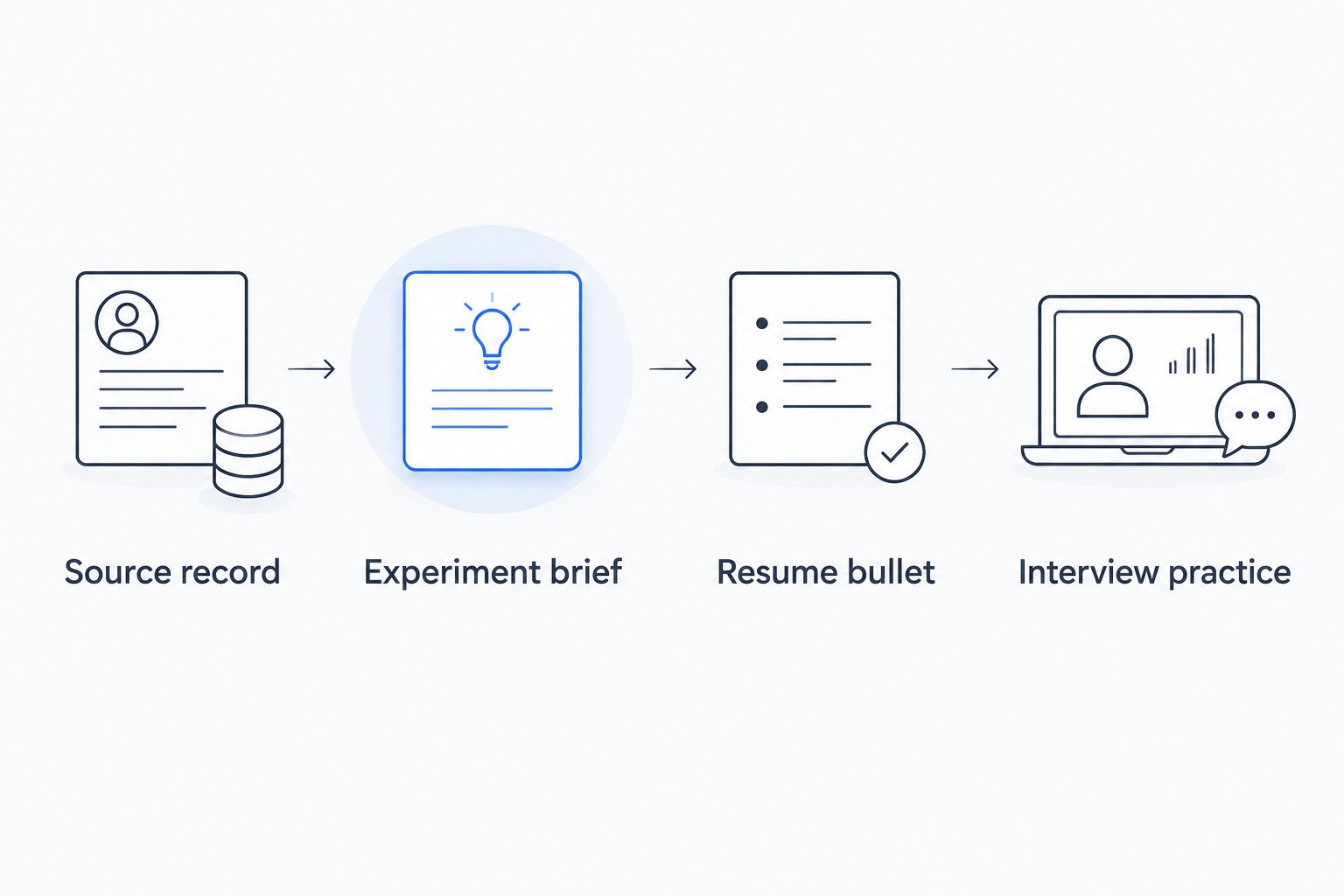
Interview practice and application handoff
Rehearse the research defense
- Build a 90-second opening. As a practice constraint, cover the problem, why you chose the method, your contribution, the result, and the main limitation. Do not spend the opening retelling the paper's introduction.
- Prepare a 5-minute technical explanation. Choose a derivation, design decision, or experiment you understand deeply. Explain the assumptions and the alternatives you rejected, then practice answering interruptions without losing the research question.
- Challenge the claim before sharing it. Ask a practice partner to question attribution, data handling, baseline selection, and failure cases. Revise the packet wherever your spoken explanation goes beyond the recorded evidence.
Expected result: You can give a concise overview, defend the technical details, and state an honest boundary when a question exceeds your work.
These durations are rehearsal targets, not predictions of interview length. Practice switching depth when asked; a memorized speech is not a substitute for answering the question in front of you.
For a deeper explanation structure, use the guide to explaining a research project in a quant interview. Keep probability, statistics, and coding preparation separate from the project story rather than assuming the project covers every assessment.
When an application permits supporting links, include the permitted research material in the relevant field. Follow the application's instructions and make the resume understandable without requiring the reader to open the packet.
When the arXiv preprint is updated
A revised preprint creates a second workflow: assess the change before updating your project claims. Do not overwrite your original evidence record.
- Save the revised manuscript and compare the parts relevant to your experiment: assumptions, theorem statements, datasets, method details, and reported results.
- Classify the change as editorial or technically relevant to your work. A revised experimental setting deserves investigation; a wording change does not require rerunning unrelated code.
- Rerun affected experiments and record whether your interpretation changes. Update the brief and resume only after checking the new evidence.
Expected result: Your packet distinguishes the original reproduction from any work based on the revised manuscript.
For a 2026 application already submitted, correct a materially inaccurate claim rather than treating every paper revision as a reason to contact a recruiter. Keep the correction factual and limited to what changed.
Troubleshooting
Your result does not match the paper
Check dataset versions, preprocessing, parameter settings, evaluation definitions, and implementation differences. If the discrepancy remains, label the work as an attempted reproduction and explain the checks you completed; do not report the authors' result as your own.
The required data is inaccessible
Choose a permitted substitute and explain why it changes the research question or comparison. If substitution removes the central claim you wanted to investigate, select another experiment instead of calling it a faithful reproduction.
You cannot explain the central method
Reduce the project scope and derive the part you actually use. Remove claims of method development or mastery until you can explain the relevant assumptions, objective, and failure cases without relying on the abstract.
Your backtest looks convincing, but the timing is unclear
Trace when every feature and label becomes available. Rebuild the evaluation so preprocessing and model selection respect the information boundary; discuss a trading interpretation only after addressing the relevant execution assumptions.
Your explanation lists tasks but shows no judgment
Choose a decision you made and explain the alternatives. Describe why you selected the evaluation, what evidence challenged your expectation, and which next experiment would distinguish competing explanations.
Customize your workflow
Choose the next task from the gap in your evidence. If the implementation is incomplete, work on reproducibility; if the experiment is sound but the explanation is unclear, work on the research discussion.
For your next 2026 application, tailor the emphasis to the role description without changing the underlying facts. Emphasize experimental design where relevant, or implementation and debugging where those skills match the work advertised.
Bring QuantMinds the actual resume and a concise account of the project when seeking coaching. Specific material gives the discussion a concrete focus; a paper title alone does not show what you contributed.
FAQ
How do I go from an arXiv preprint to a quant research interview?
Build a reproducible project from a clearly defined paper claim, document your contribution, and practice defending the research choices. Present it accurately in applications; completing the workflow does not guarantee an interview.
Do I need to publish my own arXiv paper first?
No, this workflow does not require you to publish a paper. You can reproduce or extend existing work, provided you attribute the source and describe your own contribution accurately.
Does an arXiv preprint count as peer-reviewed research?
An arXiv posting does not by itself establish peer review. Check the paper's publication status separately before describing it as peer-reviewed.
Can I put a paper reproduction on my quant resume?
Yes, describe it as a reproduction or implementation and state what you actually completed. Include numerical results only when your own recorded experiment supports them.
What if I cannot reproduce the main result?
Present the work as an attempted reproduction and explain the discrepancy. Document the settings and checks rather than claiming that you achieved the authors' result.
How long should my research explanation be?
Prepare a short opening and a deeper technical explanation, then follow the interviewer's questions. This guide recommends a 90-second opening and a 5-minute technical rehearsal as practice constraints, not interview requirements.
Can QuantMinds verify my research results?
QuantMinds offers resume review, interview preparation, and 1-on-1 career coaching. Technical verification requires checking your code, data, assumptions, and experiments; do not treat career coaching as research validation.
One last thing
Prepare the strongest objection to your own result. Identify the assumption whose failure would most change your conclusion, then describe the experiment you would run to test it. That makes your judgment visible without pretending the research is finished.