

Best overall: research engineering. Best for software-first candidates: trading-platform backend development. Best for math-heavy candidates: pricing and risk model development. This 2026 guide ranks entry-level fintech job types by the work you would do and the evidence you need to show—not by employer name or job-title prestige.
- For entry level quant developer jobs fintech searches, prioritize research engineering when you want both coding and quantitative work.
- Trading-platform backend development fits software-first candidates; confirm the role includes market-facing systems rather than general product features.
- Pricing and risk model development fits candidates who can explain numerical methods, assumptions, and implementation tests.
- QuantMinds provides quant career coaching, resume review, and interview prep—not employer hiring or job placement.
Why this matters
A fintech label does not make a software job quantitative. You need to inspect what the team builds, which models or market data the code touches, and who uses the output. A payments interface and a portfolio simulation engine are different preparation targets.
QuantMinds is a quant career coaching firm for professionals and students targeting quantitative research, trading, and development roles at hedge funds and prop trading firms. Its resume review, interview prep, and 1-on-1 coaching support candidate preparation; they are not substitutes for technical competence. Explore QuantMinds if that is your intended destination.
For your 2026 fintech search, start with the job description rather than the company category. The strongest fit is a role whose core tasks match both your present skills and the work you want to learn.
What makes the best entry-level quant developer job?
Use these criteria before deciding which role deserves an application:
- Quantitative ownership: Your code implements, tests, or supports models, research, execution, or portfolio decisions—not merely a financial product interface.
- Engineering substance: The description identifies software responsibilities such as testing, data pipelines, APIs, numerical implementation, or system performance.
- Junior scope: The expected experience and ownership match a candidate still developing professional judgment. Read requirements, not just the entry-level label.
- Feedback access: Ask who reviews your code and who checks the financial or statistical assumptions behind it.
- Demonstrable fit: You can connect a project, internship, or coursework example to the team's actual work.
- Career direction: The experience builds skills relevant to your next target, whether that is research infrastructure, trading systems, or model implementation.
Treat these as application filters. A recognizable employer does not compensate for a role that teaches the wrong skills for your goal.
Entry-level fintech quant developer roles at a glance
These are job families to investigate, not claims about a particular company's hiring. Read each description against the responsibilities in an individual posting.
| Rank and job family | Best for | Standout work | Key limitation |
|---|---|---|---|
| 1. Research engineering | Candidates combining programming and statistics | Turning research ideas into repeatable software | Some roles emphasize tooling rather than original research |
| 2. Trading-platform backend development | Software-first graduates | Building market-facing services and trading workflows | Backend work can contain little model development |
| 3. Pricing and risk model development | Math-heavy candidates | Implementing valuation and risk calculations | Requires careful treatment of numerical assumptions |
| 4. Market-data engineering | Candidates strong in data quality and pipelines | Producing usable, traceable financial datasets | Can sit far from investment decisions |
| 5. Portfolio analytics development | Candidates interested in investment calculations | Building portfolio measurement and scenario tools | Analytics work is not necessarily trading research |
| 6. Execution-systems development | Systems-oriented candidates | Implementing order handling and execution logic | Performance-focused roles demand deeper systems preparation |
1. Research engineering: best for coding plus statistics
Research engineering is the default recommendation if you want programming to stay close to quantitative analysis. Look for responsibilities involving experiment tooling, simulation, backtesting, model implementation, and reproducible research workflows. The key question is whether you help turn an analytical idea into dependable code.
A useful portfolio project separates data preparation, model logic, evaluation, and tests. Explain how you prevent future information from entering a historical experiment. Also explain which results would make you reject the approach.
Research engineering pros:
- Connects software design with statistical reasoning.
- Gives you a clear way to demonstrate reproducibility.
- Builds experience relevant to research-support development.
Research engineering cons:
- Tooling responsibilities do not guarantee ownership of research ideas.
- An impressive-looking backtest is weak evidence without sound validation.
Best for: Candidates who enjoy both implementing code and questioning analytical results.
Verdict: Apply first when the description explicitly connects engineering to research.
2. Trading-platform backend: best for software-first graduates
Trading-platform backend development targets the software behind market-facing applications and workflows. Relevant responsibilities include handling orders, maintaining positions, integrating services, and testing state changes. Separate those duties from unrelated account-management or marketing features.
For your 2026 applications, build evidence around correctness before claiming performance expertise. An order-state simulator with clear behavior for invalid requests is easier to defend than a speed claim without a measurement method. Prepare to explain data structures, failure handling, and testing decisions.
Trading-platform backend pros:
- Lets you demonstrate existing software-engineering strengths.
- Provides concrete system behavior to discuss in interviews.
- Connects programming with trading operations when the remit is market-facing.
Trading-platform backend cons:
- A financial platform can offer little quantitative model exposure.
- General backend experience alone does not demonstrate financial understanding.
Best for: Computer science graduates and software engineers who want a trading-related development path.
Verdict: Apply when order, position, or market-facing responsibilities are central.
3. Pricing and risk models: best for math-heavy candidates
Pricing and risk model development involves implementing calculations used to value instruments or assess exposure. Search for numerical methods, model testing, scenario analysis, and documented assumptions. Do not treat a reporting dashboard as equivalent to implementing the calculation beneath it.
Build a small model you understand completely. Explain its inputs, assumptions, numerical method, and failure conditions; compare its output with an independently derived check where possible. Mathematical notation is not enough—you need to show that the implementation behaves correctly.
Pricing and risk model development pros:
- Makes mathematical understanding directly relevant to coding.
- Supports detailed discussion of numerical accuracy.
- Connects implementation choices with financial interpretation.
Pricing and risk model development cons:
- Coursework alone does not establish production-code quality.
- A model can produce plausible output while containing implementation errors.
Best for: Mathematics, physics, engineering, and financial-engineering candidates with strong programming foundations.
Verdict: Apply when you can defend both the model and its implementation.
4. Market-data engineering: best for data-quality specialists
Market-data engineering focuses on collecting, cleaning, organizing, and serving financial data. Quantitative relevance comes from the data's use in research, pricing, execution, or portfolio analysis. A generic business-reporting pipeline is a different career target.
Your project should make bad inputs visible. Demonstrate how you handle missing observations, duplicate records, timestamp inconsistencies, and schema changes. Explain what downstream users should do when the data fails a validation check.
Market-data engineering pros:
- Produces inspectable evidence of data-handling skill.
- Develops habits around traceability and reproducibility.
- Supports quantitative teams when their workflows depend on the dataset.
Market-data engineering cons:
- The role can remain distant from model development.
- Cleaning data does not by itself demonstrate research judgment.
Best for: Candidates who enjoy pipelines, SQL, validation, and careful debugging.
Verdict: Apply when the description identifies quantitative downstream users.
5. Portfolio analytics: best for investment-calculation interests
Portfolio analytics development builds software for measuring holdings, returns, exposures, and scenarios. Look for ownership of the calculations rather than presentation alone. The job should let you explain how inputs become a decision-relevant output.
A portfolio-analysis project should distinguish calculation logic from visualization. Document how cash flows, changing holdings, and missing data affect the result. A polished chart cannot rescue a calculation you cannot explain.
Portfolio analytics development pros:
- Connects code with recognizable investment questions.
- Offers clear opportunities to test calculation behavior.
- Suits candidates interested in applied finance rather than execution systems.
Portfolio analytics development cons:
- Reporting responsibilities can outweigh quantitative development.
- Portfolio measurement is not the same as generating trading signals.
Best for: Candidates who want to implement investment calculations and explain their meaning.
Verdict: Apply when calculation ownership is explicit; skip presentation-only roles.
6. Execution systems: best for systems-oriented candidates
Execution-systems development covers software that handles trading instructions and interacts with execution workflows. Relevant topics include concurrency, state management, network behavior, and recovery from failures. The depth required depends on the actual system—not the excitement of the title.
Choose this path because you enjoy systems reasoning. Prepare to explain an order lifecycle, conflicting events, and how the program preserves consistent state. Do not claim low-latency expertise solely because you implemented a basic trading simulation.
Execution-systems development pros:
- Gives systems knowledge a concrete financial application.
- Encourages precise reasoning about correctness and failures.
- Creates a distinct specialization from model-focused development.
Execution-systems development cons:
- Quantitative modeling can be peripheral to the role.
- Performance claims require reproducible measurement and technical context.
Best for: Candidates interested in systems programming, concurrency, and trading infrastructure.
Verdict: Apply when your systems preparation matches the stated responsibilities.
How these roles are ranked
Research engineering ranks first because it directly combines coding with quantitative investigation. The remaining roles occupy different use-case slots: software foundations, numerical models, data reliability, portfolio calculations, and execution systems. This is a fit-based ranking, not an employer league table.
For a 2026 shortlist, move a role up only when its description demonstrates the criteria above. A job with a less impressive title can be the better choice if you will write relevant code, receive technical review, and own work you can explain.
Turn the ranking into an application plan
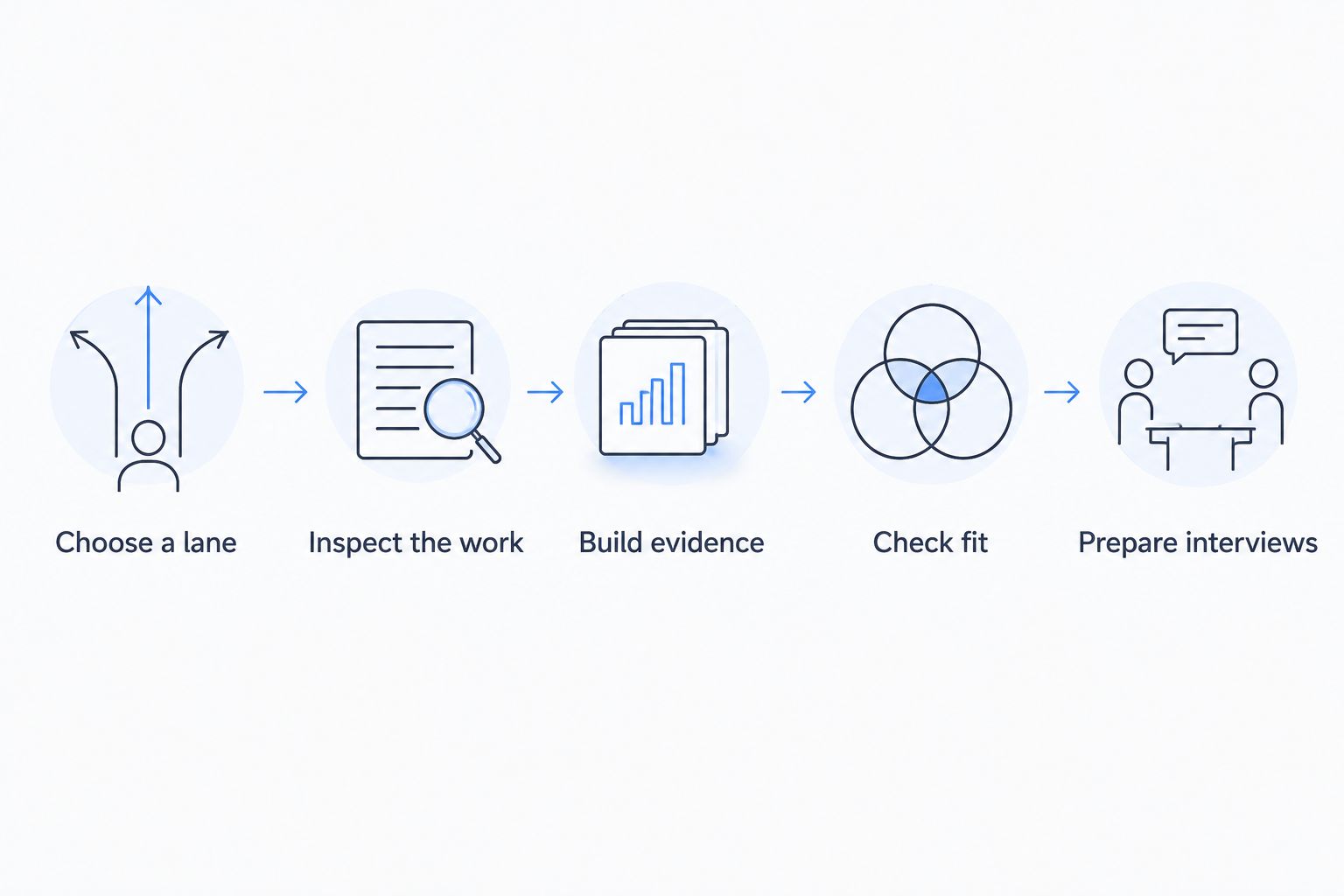
Use this sequence to convert broad searches into applications you can defend:
- Choose a lane: Select 2 role families that fit your strongest evidence. Avoid preparing equally for every job on the table.
- Inspect the work: Underline the actual responsibilities in each description. Separate required skills from optional preferences.
- Build evidence: Complete 1 focused project that resembles a core task. Make the code runnable and document its limitations.
- Check fit: Write 3 test cases covering normal behavior, invalid inputs, and a boundary condition. Add further tests according to the system's risks.
- Prepare interviews: Explain a design decision, a bug, and an assumption without reading your notes. Practice coding separately from project storytelling.
Your resume should make the connection obvious: what you built, what it did, how you checked it, and which responsibility it demonstrates. Use the quant developer coding interview guide to separate implementation practice from application positioning.
QuantMinds offers quant career coaching, resume review, and interview prep. Coaching fits candidates who need help presenting their background and preparing for target roles; it does not replace writing, testing, and understanding their own code.
Which fintech quant developer role should you choose?
Choose research engineering if you are undecided and genuinely enjoy both software and quantitative analysis. Choose trading-platform backend development if engineering is your strongest starting point. Choose pricing and risk model development if numerical reasoning is your strongest evidence.
Do not force yourself into the default. A well-matched market-data, portfolio-analytics, or execution role is better than a research-engineering application built on superficial statistics. Your 2026 target should be work you can discuss credibly—not a title you hope will impress someone.
FAQ
What's the best entry-level quant developer job at a fintech company?
Research engineering is the default recommendation for candidates who want both coding and quantitative analysis. Software-first candidates should compare trading-platform backend roles, while math-heavy candidates should examine pricing and risk model development.
Which companies should I target for entry-level quant developer jobs?
Target companies with teams whose stated work matches your chosen role family. Evaluate each job description for quantitative responsibilities, junior scope, technical review, and relevant engineering ownership rather than choosing by company name alone.
Is every software engineering job at a fintech a quant developer job?
No, working at a fintech does not make a software role quantitative. Look for responsibility involving models, research infrastructure, market data, execution, or portfolio calculations.
Do I need an MFE for a fintech quant developer role?
An MFE is not a universal requirement across these job families. Follow the individual role's degree requirements and demonstrate the programming, mathematical, and financial knowledge its responsibilities demand.
Should I learn Python or C++ first?
Choose the language required by your target role and learn it deeply enough to implement and test relevant work. Python suits many analytical projects; C++ preparation is relevant when the description calls for systems-oriented development.
What project should I put on my quant developer resume?
Use a project that demonstrates a core responsibility of your target role. A research workflow, tested pricing model, validated data pipeline, or order-state simulator serves different applications; explain assumptions and limitations alongside the implementation.
Can QuantMinds get me hired at a fintech?
QuantMinds provides resume review, interview prep, and 1-on-1 career coaching. Those services support your preparation; an employer makes its own hiring decision.
One last thing
A project that rejects an invalid input can reveal more engineering judgment than a chart with an attractive result. Before applying, add a short limitations section to your project documentation: what the system assumes, what it does not handle, and how you detect failure.
Then explain those limits aloud. If you cannot defend the boundaries of your own work, adding another project will not fix the underlying problem.