

The CFA Program costs roughly $3,600 all-in across three exam levels, with a realistic range of $2,900 to $5,000 depending on how early you register and whether you need a retake, while a full-time MFE program runs $60,000 to $120,000 or more in tuition alone in 2026. Neither figure tells the whole story: the CFA number leaves out prep materials and years of unpaid study time, and the MFE number leaves out a year or two of foregone salary in an expensive city.
- CFA Program costs roughly $3,600 total across three exam levels in 2026 — the cheaper credential by a wide margin.
- MFE programs run $60,000 to $120,000+ in tuition alone, before living costs.
- CFA cost vs MFE cost isn't really a fair fight — they signal different things to recruiters, not the same career bet.
- A CFA charter rarely substitutes for an MFE in quant research or trading recruiting; the two solve different problems.
Why this matters
Candidates comparing CFA cost vs MFE cost usually aren't choosing between two versions of the same thing. They're choosing between a self-funded certification you can finish while working and a full-time graduate degree that changes your resume, your network, and your recruiting pipeline in one move. QuantMinds works with candidates on both sides of this decision — people stacking a CFA onto a trading job and people deciding whether an MFE is worth the tuition bill.
The two paths get compared constantly because they show up in the same job postings. A quant research or trading role will sometimes list "CFA/MFE/PhD preferred" as if they're interchangeable. They aren't interchangeable in cost, in time, or in what a hiring manager reads into them.
How much does a CFA cost compared to an MFE?
Here's the direct breakdown for 2026:
| CFA Program | MFE Program | |
|---|---|---|
| Total cost | ~$3,600 (range $2,900-$5,000) | $60,000-$120,000+ tuition |
| Time commitment | 2-4 years, mostly self-paced | 1-2 years, full-time |
| What's excluded from the sticker price | Prep courses, retake fees, study time | Living costs, foregone salary |
| What it signals to recruiters | Analytical rigor, finance fundamentals | Quant coding, pricing theory, research depth |
| Best for | Working professionals staying in asset management or banking | Candidates targeting quant research, trading, or dev seats |
The CFA fee structure is a one-time enrollment charge plus a per-level exam registration fee, paid three separate times as you clear Level I, II, and III. The MFE number is a single tuition bill, but it's a bill you pay whether or not you land the job you went in for.
Most candidates weighing CFA cost vs MFE cost are really asking which one moves them closer to a specific seat. A CFA charter doesn't get you into a quant research interview at a systematic fund. An MFE, done at the right program, gets you into the room.
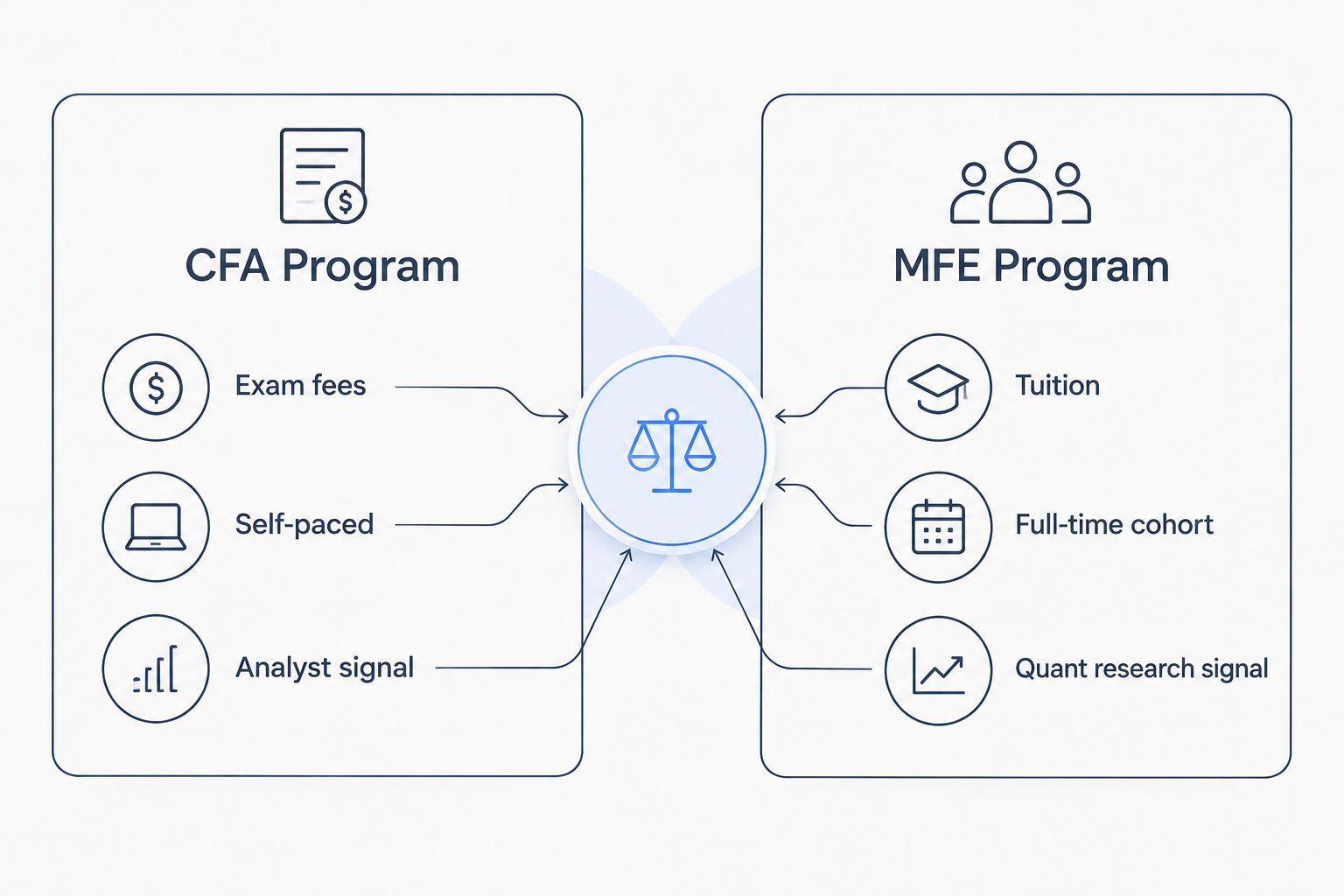
CFA Program: Roughly $3,600 Across Three Levels
The CFA charter's cost comes from three exam registration fees plus a one-time enrollment fee, not a single tuition payment. Budget roughly $900 to $1,200 per exam level depending on how far ahead of the deadline you register, on top of the enrollment fee you pay once at Level I.
What that number doesn't cover: prep course materials, which most candidates buy separately, and retake fees if you don't clear a level on the first attempt. CFA Institute's own pass-rate data has shown Level I and II pass rates well under 50% in recent cycles, so budgeting for one retake somewhere across the three levels is realistic, not pessimistic.
The charter is cheap relative to an MFE, but it's slow. Most candidates take 2 to 4 years to finish all three levels while working full-time, which is the real cost most people underweight: three to four years of career runway spent studying nights and weekends instead of building the coding portfolio or network a quant seat actually asks for. If you're deciding whether that trade makes sense for a quant-track role specifically, see whether a CFA is worth it for a quant finance career before you register for Level I.
Verdict: the CFA is the right spend for someone staying in traditional asset management, credit, or equity research — it's the wrong spend if the target is a systematic trading desk.
MFE Program: $60,000 to $120,000+ in Tuition
A Master of Financial Engineering runs $60,000 to $120,000 or more in tuition alone at most US programs, before rent, food, and a year or two without a full salary. That range covers the bulk of one-to-two-year, full-time STEM-designated MFE programs; part-time and online formats can undercut it, but they trade cost for a slower path to a full-time recruiting pipeline.
Tuition is the visible number. The number that actually determines return on the degree is placement into a quant research, trading, or development seat afterward — a $90,000 MFE that lands a six-figure quant researcher offer within a year of graduating is a different financial decision than the same $90,000 spent on a program with weak on-campus recruiting. See the full MFE program cost breakdown for 2026 before comparing sticker prices across schools.
Verdict: the MFE is the higher-cost, higher-signal path — it's the right spend when the target role explicitly screens for a master's, and the wrong spend if you can get the same interviews through a strong resume and network instead.
Why the Cost Gap Is Bigger Than the Sticker Price
The raw dollar gap between $3,600 and $100,000 undersells how different these two costs actually behave:
- Payment structure: CFA fees are paid in three installments over years; MFE tuition is due largely upfront, often financed with loans.
- Opportunity cost: CFA candidates usually keep working and earning through all three levels; MFE students give up a salary for the length of the program.
- Retake risk: CFA pass rates mean a meaningful share of candidates pay for at least one extra exam sitting; MFE tuition is fixed once you enroll.
- Career-stage fit: a CFA layers onto an existing job; an MFE typically requires leaving one.
- Signal specificity: the CFA signals broad investment analysis competence; an MFE from a program with strong recruiting ties signals quant-specific readiness to a narrower set of employers.
- Geography: MFE tuition and living costs both scale with the city the program sits in — New York and the Bay Area push the total well past the tuition line alone.
“The CFA is the cheaper credential; the MFE is the more direct route into a quant research seat.”
Is the CFA Cheaper Than an MFE for a Quant Career?
Yes — the CFA costs roughly $3,600 against $60,000 to $120,000+ for an MFE, but cheaper doesn't mean it does the same job. The CFA rarely opens quant research or trading interviews on its own; it's built for investment analysis and portfolio management roles, not the coding-and-probability screens quant desks run. Comparing pure cost without comparing what each credential unlocks is the mistake most candidates make on this question.
Can You Do Both a CFA and an MFE?
Yes, and it's common for candidates already working in finance who want to add analytical credibility without leaving their job for a full-time MFE. The combined cost lands around $65,000 to $125,000+ once you add the CFA's roughly $3,600 to MFE tuition, spread over several years rather than paid at once. If you're weighing the sequencing — CFA first, MFE first, or one without the other — a short session with a quant career coach is usually cheaper than guessing; see what a quant career coach costs before committing to either timeline.
Not sure which path fits your budget?
Map the CFA vs MFE decision to your actual target role before you spend on either.
FAQ
How much does the CFA Program cost in 2026?
The CFA Program costs roughly $3,600 total across three exam levels in 2026, with a realistic range of $2,900 to $5,000 depending on registration timing and retakes. That figure excludes prep course materials, which most candidates buy separately.
How much does an MFE program cost in 2026?
An MFE program costs $60,000 to $120,000 or more in tuition alone in 2026, not counting living expenses or the salary given up during the program. Part-time and online formats can bring the tuition figure down but stretch the timeline.
Is a CFA cheaper than an MFE?
Yes, the CFA is roughly 15 to 30 times cheaper than an MFE on raw fees, but the two credentials aren't interchangeable for quant recruiting. The CFA signals investment analysis skill; an MFE signals quant-specific technical depth.
Does a CFA replace the need for an MFE for quant roles?
No, a CFA does not replace an MFE for quant research, trading, or development roles that screen for graduate-level math and coding. It's built for portfolio management and equity research, not systematic trading desks.
What's included in the CFA's $3,600 cost besides exam fees?
The CFA's roughly $3,600 total covers a one-time enrollment fee plus registration fees across three exam levels. It does not include prep materials or the cost of a retake if you don't pass a level on the first attempt.
Are there cheaper ways to get MFE-level credibility?
Part-time and online master's programs in quant finance can cost less than the $60,000-$120,000 full-time range, though they trade cost for a slower path to on-campus recruiting. Whether that trade-off works depends on the target employer's hiring pipeline.
Which costs more over a career, the CFA or the MFE?
The MFE costs more upfront at $60,000 to $120,000+ against the CFA's roughly $3,600, but the MFE also tends to open higher-paying quant seats faster. Total career cost depends entirely on which roles each credential actually unlocks for you.
One Last Thing
The number candidates fixate on is tuition versus exam fees, but the number that actually decides this trade is time-to-offer. A CFA candidate stays employed through all three levels and pays as they go; an MFE candidate pays most of the bill before knowing whether the program's recruiting pipeline lands them the seat they wanted. Price the decision by what role you're targeting first, then price the credential — not the other way around.