

Best overall: eFinancialCareers. Best for student recruiting: Handshake. Best for connecting job discovery with professional networking: LinkedIn. These are the job boards for quant finance jobs to start with in 2026; use employer career pages to verify every role before applying.
- eFinancialCareers is the best starting point among job boards for quant finance jobs focused on financial services.
- Handshake suits student recruiting; LinkedIn connects quant job searches with professional networking.
- Verify entry-level requirements on employer career pages before submitting an application.
- QuantMinds provides quant finance career coaching, not job listings or employer placement.
Why this matters
A quantitative researcher opening is not automatically a graduate opportunity. Neither is a trading role automatically quantitative. Read the work, qualifications, and recruiting audience—not just the title.
Your 2026 search needs separate tracks for quantitative research, trading, and development. Combining everything under one broad search makes it harder to distinguish a suitable opening from a role that requires experience you do not have.
QuantMinds provides quant finance career coaching through resume review, interview preparation, and 1-on-1 coaching. QuantMinds is best for candidates who need help presenting their background for quantitative research, trading, or development roles—not another source of listings.
Once you find suitable roles, the next task is turning requirements into evidence. The eFinancialCareers application-to-interview workflow addresses that transition.
What makes the best job boards for quant finance jobs?
Rank the channels by how they support your search, not by how many results they display. For entry-level candidates, these criteria matter:
- Finance relevance: Can you find quantitative roles without sorting through unrelated occupations?
- Student relevance: Does the channel support internships, graduate hiring, or university recruiting?
- Role clarity: Can you distinguish research, trading, development, and adjacent positions?
- Employer context: Can you identify the hiring organization and investigate the team?
- Application traceability: Can you connect the listing to an identifiable employer opening?
- Search control: Can you narrow discovery by title, location, and career stage?
No board replaces the employer's requirements. A useful search result is a lead to investigate, not confirmation that you qualify.
Job-search channels at a glance
This 2026 ranking includes five job platforms and one essential verification channel. Employer career pages are not an aggregated job board; they belong here because you need them to check what you find elsewhere.
| Rank | Channel | Best for | Standout feature | Key limitation |
|---|---|---|---|---|
| 1 | eFinancialCareers | Finance-focused discovery | Financial-services recruiting focus | Finance relevance does not establish entry-level fit |
| 2 | Discovery plus networking | Job search alongside professional profiles | Broad searches mix roles and seniority levels | |
| 3 | Handshake | Students using university recruiting | Connection with university career services | Access and relevant results depend on your institution and account |
| 4 | Indeed | Broad searches for adjacent technical roles | General job-search coverage | Quant-specific searches need careful screening |
| 5 | Glassdoor | Employer research alongside job discovery | Employee reviews and interview reports | Anonymous accounts do not establish current hiring requirements |
| 6 | Employer career pages | Verifying a specific opportunity | Employer-authored role description and application route | You must check firms individually |
1. eFinancialCareers: best job board for finance-focused discovery
Best for: Candidates who want a financial-services starting point.
eFinancialCareers is a financial-services careers platform. It gives you a more focused starting point than a general employment search when you are investigating quantitative roles across banks, investment managers, hedge funds, and trading businesses.
Start with the function you want. Search quantitative research, quantitative trading, and quantitative development separately, then inspect the responsibilities and experience requirements.
eFinancialCareers pros:
- Financial-services focus matches the sector you are targeting.
- Useful for comparing quantitative and adjacent finance roles.
- Supports a role-first search rather than a single vague quant query.
eFinancialCareers cons:
- A relevant finance title does not establish graduate eligibility.
- Recruiter-posted openings require attention to who is actually hiring.
- Research, risk, and development responsibilities need separate screening.
For your 2026 search, record the employer, function, location, and experience requirement before deciding to apply. If the role describes experienced ownership of a trading system, do not treat a junior-sounding title as proof that it welcomes new graduates.
Verdict: Buy into eFinancialCareers as your primary finance-focused discovery channel, then verify each opening.
2. LinkedIn: best job board for discovery plus networking
Best for: Candidates who want to connect openings with people and teams.
LinkedIn combines job listings with professional profiles and company information. That makes it useful when your search includes both finding an opening and understanding the organization behind it.
Use job search to identify a role, then investigate the employer's business and relevant professional backgrounds. Keep outreach specific: ask about the function or team rather than requesting a referral from someone you have never spoken to.
LinkedIn pros:
- Job discovery and professional networking sit on the same platform.
- Professional profiles provide context about career paths.
- Company information helps you investigate an unfamiliar employer.
LinkedIn cons:
- Broad searches mix quantitative roles with unrelated analytical jobs.
- Titles and seniority labels require checking against the description.
- Sending a connection request is not an application or a referral.
Run separate searches for research, trading, and development. For development, inspect whether the work concerns trading infrastructure, research tooling, or general enterprise software; the same programming language can appear in very different jobs.
Verdict: Buy into LinkedIn when you will use both job discovery and targeted professional research.
3. Handshake: best job board for university-linked recruiting
Best for: Students whose university uses Handshake.
Handshake connects students, employers, and university career services. Its student-recruiting orientation makes it a sensible channel for internships and graduate opportunities when your institution provides access.
Start with your career center's instructions. Check relevant postings and employer events, then read each opportunity's degree, graduation-date, location, and work-authorization requirements.
Handshake pros:
- Student recruiting is central to the platform's purpose.
- University career services provide an additional source of guidance.
- Employer events offer another way to learn about recruiting.
Handshake cons:
- Your institution and account affect what you can access.
- Student relevance does not guarantee quant-specific relevance.
- University recruiting does not cover every firm you want to target.
Treat Handshake as a campus channel, not your entire search. If your results do not include the employers or functions you want, add direct employer research rather than repeatedly broadening the same query.
Verdict: Buy into Handshake if your university uses it; hold it as one part of a wider search.
4. Indeed: best job board for broad technical-role discovery
Best for: Candidates exploring adjacent roles as well as explicitly quantitative positions.
Indeed is a general employment search platform. Use it to investigate a wider set of titles, including research engineering, trading technology, and analytical roles whose responsibilities deserve a closer look.
Breadth is the point. It is also the reason you need a strict relevance check before adding a result to your application tracker.
Indeed pros:
- Useful for exploring titles beyond the word quant.
- Supports searches across employers and locations.
- Gives career changers a channel for investigating adjacent work.
Indeed cons:
- General analytical jobs are not necessarily quantitative finance jobs.
- A junior title does not remove experience requirements.
- A broad result set creates more screening work.
Read for actual responsibilities: statistical modeling, research implementation, trading systems, or another identifiable function. Do not assume that every analyst opening builds experience toward your target role. Compare the work with the skills you intend to develop.
Verdict: Hold Indeed as a secondary discovery channel, especially for adjacent technical roles.
5. Glassdoor: best job board for employer-context research
Best for: Candidates investigating employers before applying or interviewing.
Glassdoor combines job discovery with employee reviews and interview reports. Use those accounts to generate questions about an employer, not to predict your exact interview.
An interview report describes one person's experience. Check its date, location, function, and seniority before deciding whether it helps your preparation.
Glassdoor pros:
- Employee accounts offer topics to investigate further.
- Interview reports provide context for preparation questions.
- Job discovery and employer research are available together.
Glassdoor cons:
- Anonymous reports are not verified employer instructions.
- Experiences differ across teams, locations, and recruiting cycles.
- Older accounts do not establish the current interview process.
For a 2026 application, separate current role requirements from historical interview anecdotes. If a report mentions a technical topic, prepare the underlying skill; do not assume the same question will appear.
Verdict: Hold Glassdoor as a research supplement, not your primary source of eligibility information.
6. Employer career pages: best channel for verifying openings
Best for: Candidates checking a specific role before submitting an application.
Employer career pages are the direct recruiting channel maintained by the organization. They are not a single job board, but they give you the employer's own description and application instructions.
Build a target-firm list and check each employer's student, graduate, or professional recruiting sections as appropriate. Match the role title and location against the listing you discovered elsewhere.
Employer career pages pros:
- Provide employer-authored responsibilities and qualifications.
- Identify the employer's stated application route.
- Let you distinguish student recruiting from experienced hiring.
Employer career pages cons:
- Require separate checks across your target firms.
- Employers organize and label roles differently.
- A published description does not answer every eligibility question.
Read graduation requirements, technical expectations, and work-authorization language carefully. When a requirement is unclear, ask the employer rather than treating silence as permission.
Verdict: Buy into direct verification for every serious application; skip relying on a third-party summary alone.
How the channels are ranked
This ranking prioritizes finance relevance, student relevance, role clarity, employer context, application traceability, and search control. It is a channel-selection guide—not a ranking based on placement rates, application success, or measured listing volume.
QuantMinds is not ranked against job boards because quant finance career coaching serves a different purpose. Discovery finds opportunities; resume review and interview preparation help you address what those opportunities require.
Turn your search into an application workflow
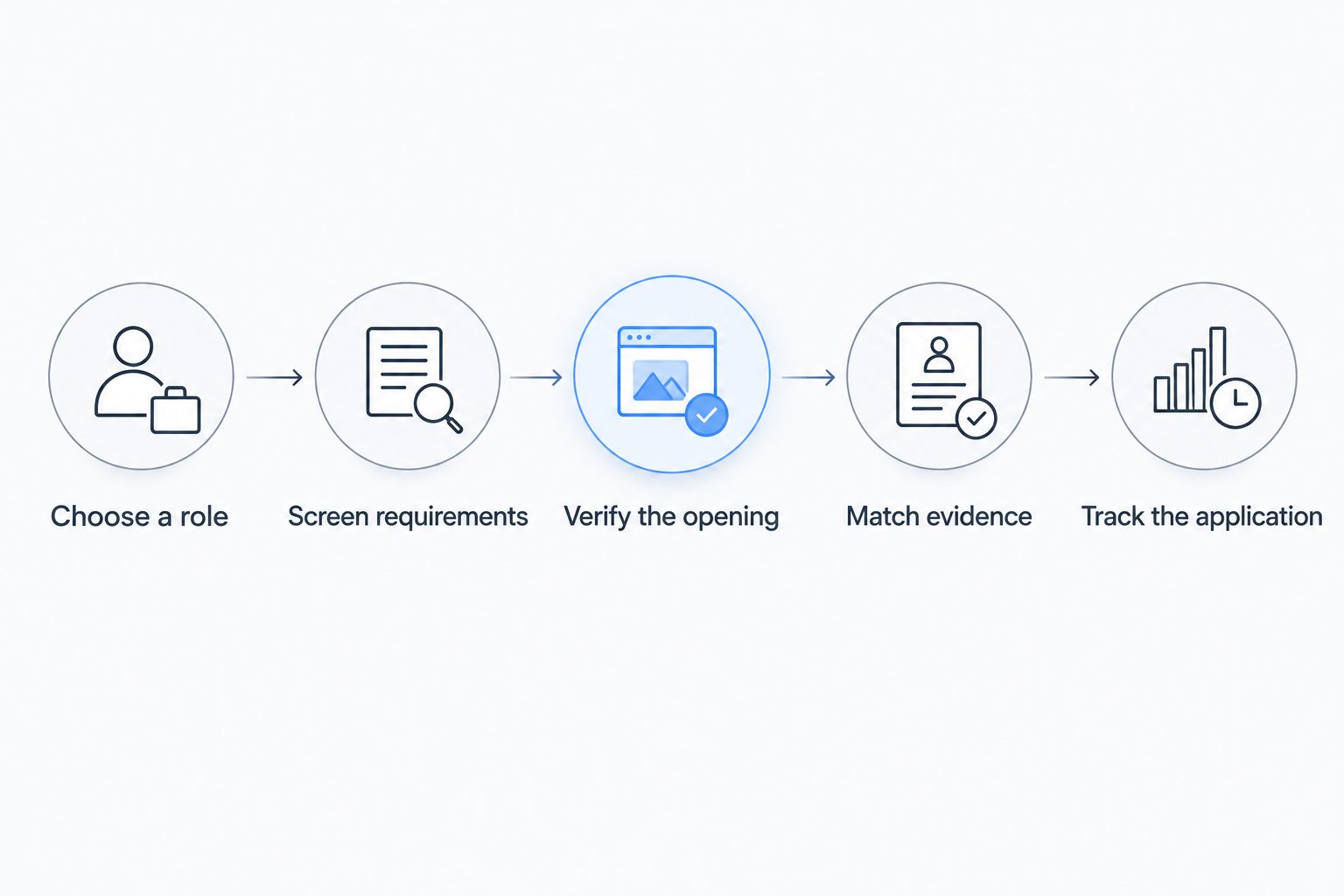
For 2026, use a repeatable process instead of collecting listings indefinitely. The following time limits are planning recommendations, not claims about how long recruiting takes.
- Choose a role. Pick research, trading, or development for the current search session. Create 3 separate saved searches, one for each function you are genuinely considering.
- Screen requirements. Spend 20 minutes reviewing descriptions for degree requirements, graduation timing, technical skills, and experience expectations.
- Verify the opening. Find the corresponding employer description and check the application instructions. Record discrepancies instead of guessing.
- Match evidence. Identify the resume project, coursework, research, or employment experience that supports each central requirement.
- Track the application. Record the role, employer, submission date, resume version, and next action. Schedule 2 review sessions per week to update the tracker.
A search session ends with a decision: apply, investigate, or reject the role. Saving another listing without deciding why it fits is not progress.
QuantMinds offers resume review, interview preparation, and 1-on-1 coaching for candidates targeting quantitative research, trading, and development. Use that support for application positioning and preparation—not as a substitute for reading the role description.
Which job-search channel should you choose?
Start with eFinancialCareers if you need a default. Add LinkedIn for employer and professional research, or Handshake if you are a student with university access. Verify suitable openings on employer career pages.
Use Indeed to investigate adjacent technical roles and Glassdoor to develop informed employer questions. You do not need to spend equal time on every platform. Choose a primary discovery channel, keep a supplementary channel, and make verification part of every application.
FAQ
What's the best job board for entry-level quant finance jobs?
eFinancialCareers is the best default in this guide for finance-focused discovery. Add Handshake for university-linked recruiting or LinkedIn for professional research, then verify requirements on employer career pages.
Is LinkedIn better than eFinancialCareers for quant jobs?
LinkedIn is better for combining job discovery with professional networking; eFinancialCareers is the stronger finance-focused starting point. Choose based on the task rather than treating either platform as a complete recruiting strategy.
Should I use Handshake to find quant internships?
Use Handshake if your university provides access and the platform includes relevant opportunities. Check your career center's guidance and supplement campus recruiting with employer career pages.
How do I tell whether a quant job is really entry-level?
Read the stated experience, degree, graduation, and technical requirements rather than relying on the title. A role requiring experienced ownership of research or trading systems is not made entry-level by a junior label.
Can I trust quant interview questions on Glassdoor?
Treat Glassdoor interview reports as individual accounts, not current employer instructions. Check their date, team, location, and seniority, then prepare the underlying skills rather than memorizing reported questions.
What should I search for if I want quant developer jobs?
Search quantitative developer and related trading-technology or research-engineering titles separately. Read the responsibilities to distinguish trading systems and research tooling from unrelated software work.
Do job boards tell me whether a firm will sponsor my visa?
Use only explicit employer work-authorization or sponsorship language to assess that requirement. If the description does not answer your question, ask the employer before treating the role as a match.
Is QuantMinds a job board for quantitative finance?
QuantMinds is a quant finance career coaching firm, not a job board. Its services include resume review, interview preparation, and 1-on-1 coaching for quantitative research, trading, and development candidates.
One last thing
Reject unsuitable listings deliberately. Keep a short reason beside each rejection: wrong seniority, wrong function, incompatible eligibility, or missing required evidence. That record helps you refine the next search instead of encountering the same mismatch again.
For your 2026 search, judge progress by suitable roles evaluated and applications prepared—not by how many tabs remain open.