

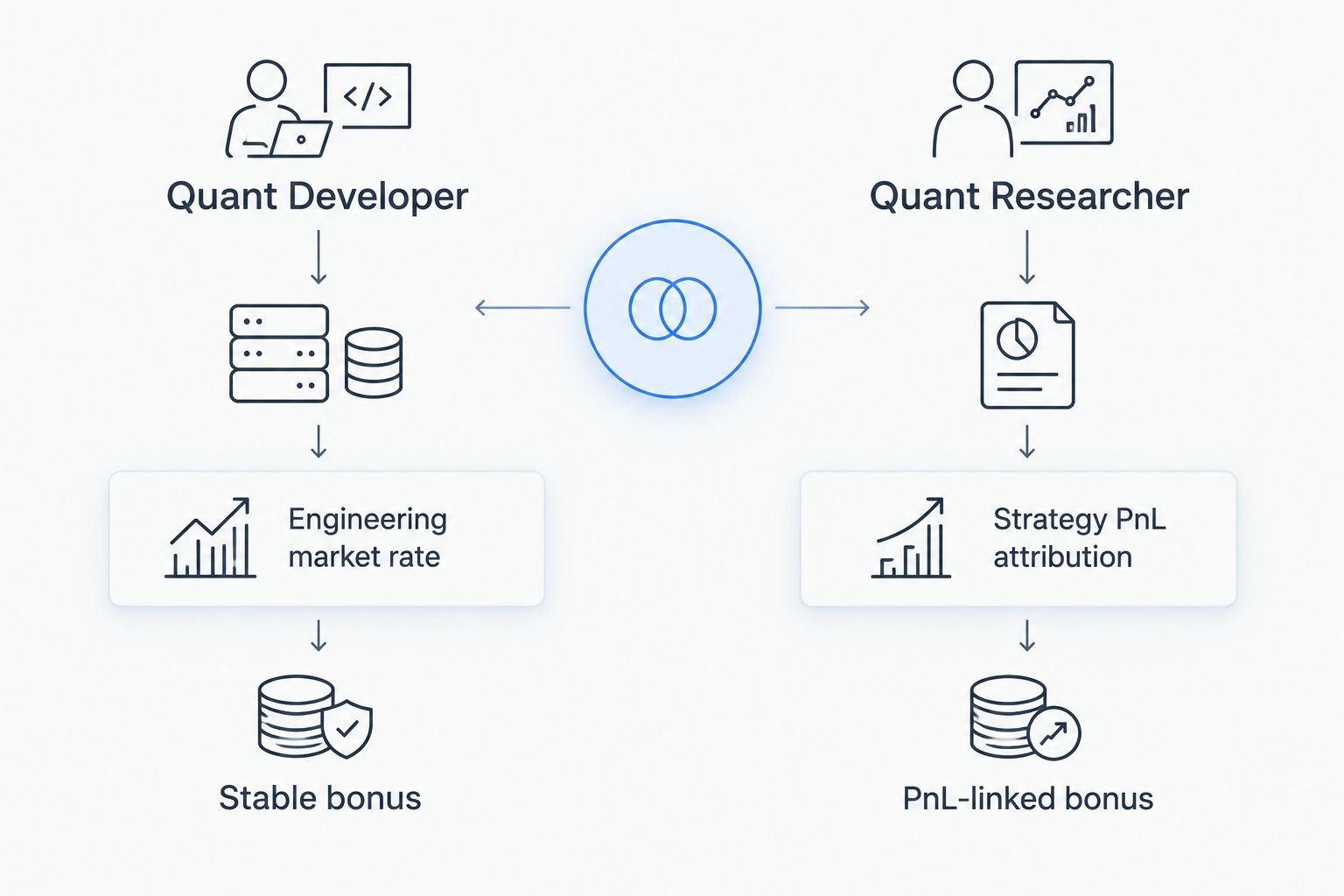
Quant researchers typically out-earn quant developers over a full career, mostly because researcher bonuses track strategy PnL while developer bonuses track engineering market rates. The base-salary comparison alone hides the real gap: in a strong year a researcher's PnL-linked bonus can dwarf base pay, while a developer's comp stays comparatively flat no matter how the desk performs. That structural difference, not the job title, is what actually separates quant developer salary vs quant researcher salary in 2026.
- Quant researcher pay usually outruns quant developer salary long-term because bonuses track strategy PnL, not headcount.
- Quant developer salary is steadier and less bonus-volatile, which favors candidates who want predictable comp.
- Firm type moves the quant developer salary vs quant researcher salary gap more than the job title alone.
- The gap widens after a few years once bonus formulas start crediting PnL to specific individuals.
Why this matters
Candidates chase the researcher title assuming it always pays more, and that assumption costs them leverage at the offer stage. The pay gap is real at prop trading firms and hedge funds running PnL-linked bonus pools, but it's much smaller — sometimes nonexistent — at banks and long-only shops where both roles sit on a flatter scale. Anyone comparing quant researcher pay at hedge funds against a developer offer needs to know which bonus model each firm actually runs before deciding which track to pursue in 2026.
Treating the two roles as interchangeable job titles instead of two different compensation structures is the mistake that costs candidates the most leverage in salary talks.
Quant developer salary vs quant researcher salary
The two roles diverge on how bonus gets calculated, not on how similar the base pay looks on paper. Here's the structural comparison that actually explains the gap:
| Dimension | Quant Developer | Quant Researcher |
|---|---|---|
| Primary comp driver | Engineering market rate | Strategy PnL attribution |
| Bonus volatility | Low to moderate | High — swings with desk performance |
| Hiring bar | Strong CS/systems background, coding-heavy interviews | Strong math/stats background, probability and modeling interviews |
| Career ceiling | Senior engineering lead or infra ownership | Portfolio manager or senior researcher track |
| Job stability | Higher, less tied to trading results | Lower in weak years, tied to desk PnL |
| Best for | Candidates who want predictable, engineering-driven pay | Candidates comfortable with bonus risk for higher upside |
Quant developer wins on stability. Quant researcher wins on upside — when the desk performs.
Quant developer compensation: what drives it
Quant developer salary is anchored to software engineering market rates, adjusted upward for finance-specific skills like low-latency systems, market data pipelines, and execution infrastructure. Bonus is a smaller share of total comp than it is for researchers, and pay progression looks closer to a senior software engineer's track than to a trader's. Firms hiring for entry-level quant developer roles typically benchmark against tech-industry engineering pay first and finance-premium second, which is why developer comp holds up even in a slow trading year.
Quant researcher compensation: what drives it
Quant researcher salary is anchored to PnL attribution — the desk assigns credit for the alpha the researcher's models generate, and the bonus formula at prop trading firms and hedge funds can dwarf base salary when a strategy performs. Base pay for researchers is frequently close to developer base pay; the separation happens almost entirely in the bonus pool, not the paycheck a researcher sees every two weeks. That's why two people with identical base salaries in January can end 2026 with very different total comp.
Why the pay gap varies
The quant developer salary vs quant researcher salary gap isn't fixed — it moves with a handful of specific factors:
- Firm type: market makers and multi-strategy hedge funds pay researchers on PnL; banks and asset managers pay both roles closer to a flat scale.
- PnL attribution model: some desks split credit between the researcher and the execution or infrastructure team, which narrows the gap.
- Seniority and track record: a researcher with a proven live PnL history negotiates from a completely different position than a first-year hire.
- Negotiating leverage: competing offers move both roles, but researcher offers swing wider because the upside case is larger.
- Firm size and desk structure: a large multi-strat platform benchmarks comp differently than a smaller independent shop.
- Degree and pedigree signals: strong math or stats credentials support researcher comp negotiations; strong systems and infra experience supports developer comp negotiations.
“Job title tells you almost nothing about pay in quant finance; the bonus formula does.”
Related questions
Do quant researchers always earn more than quant developers?
No, not always — at banks and many long-only asset managers the two roles sit on comparable pay scales, and the researcher premium only shows up once bonus formulas turn PnL-driven. The bigger the fund's reliance on a specific researcher's models, the bigger that researcher's earning edge over a comparable developer.
Should you switch from quant developer to quant researcher for the pay?
Switching tracks purely for pay upside is risky because researcher bonus is volatile and tied to a live PnL record you haven't built yet. A candidate with a strong developer track record and no research portfolio usually strengthens their case more by building modeling experience first than by simply retitling for a researcher role.
Which pays more long-term, quant trading or quant research?
Quant trading and quant research pay converge at senior levels because both roles eventually get compensated against the PnL they're credited with generating. Early in a career, the gap depends more on the firm's attribution model than on the trading-versus-research label itself.
Candidates preparing for either track get further by positioning their resume and interview story around the comp model they're actually targeting. QuantMinds works through quant developer resume review and researcher-focused prep to match candidates to the track that fits their background before they walk into an offer negotiation.
Target the right quant comp track
Get resume and interview feedback matched to developer or research roles.
FAQ
What's the base salary difference between quant developers and quant researchers?
Base salary is often close between the two roles because the real separation happens in bonus: quant researcher bonus tracks strategy PnL while quant developer bonus tracks engineering market rates. Judge the two roles by bonus structure, not base pay alone.
Do quant researchers always earn more than quant developers?
No. At banks and many asset managers the two roles sit on comparable pay scales, and the researcher premium only appears at prop trading firms and hedge funds running PnL-linked bonus pools.
Is quant trading pay higher than quant research pay?
Quant trading and quant research pay converge at senior levels because both are eventually credited against the PnL they generate, so the early-career gap depends more on the firm's attribution model than on the title itself.
Does a math PhD earn more than a computer science background in quant roles?
Not automatically. Pay follows the role and the firm's bonus structure more than the degree, though a math or stats PhD supports a stronger case for research-track roles where PnL attribution decides comp.
Should I switch from quant developer to quant researcher for higher pay?
Switching purely for upside is risky because researcher bonus is volatile and tied to a live PnL record you haven't built yet. Strengthening a modeling portfolio first is usually a better move than retitling.
Which quant role has better job security, developer or researcher?
Quant developer roles tend to have steadier job security because pay and headcount are less tied to a single desk's trading performance, while quant researcher roles can be more exposed in weak PnL years.
Do prop trading firms pay quant developers like quant researchers?
Some prop trading firms blur the line by giving senior quant developers PnL-linked bonuses similar to researchers, especially on infrastructure teams whose systems directly affect execution quality.
One last thing
Title-based salary comparisons are getting less reliable heading through 2026, because more firms now run hybrid "quant engineer" roles that carry PnL-linked bonus components previously reserved for researchers. Before you assume a title tells you the pay structure, ask the actual question in the interview: is the bonus tied to my code shipping, or to the strategy's PnL? That single answer predicts your comp swing more than the job title on the offer letter ever will.