

New graduates at prop trading firms take home roughly $190,000 in total first-year compensation on average, with a spread from about $110,000 at smaller regional shops to $400,000 or more at top-tier firms like Jane Street, Optiver, and Citadel Securities in 2026. That headline number is mostly bonus and signing money tied to firm and desk performance, not guaranteed base salary — the base alone can run as low as $60,000 to $90,000 at firms that pay through a profit-split model.
- How much prop trading firms pay new graduates ranges $110,000 to $400,000+ in 2026, tier-dependent.
- Top-tier prop firms like Jane Street and Optiver pay $250,000-$400,000+ in year one, base plus bonus.
- Smaller prop shops often run $60,000-$90,000 base with the rest tied to a profit split.
- Quant trading and quant dev roles at prop firms usually beat entry-level hedge fund research pay.
- QuantMinds coaches candidates through resume and interview prep aimed at the highest-paying prop firm tiers.
Why this matters
The number a firm posts as "starting salary" and the number that lands in a new hire's account are rarely the same thing at a prop trading firm. Base pay is only one piece; signing bonuses, discretionary year-end bonuses, and — at some firms — a direct cut of trading P&L do most of the heavy lifting.
Candidates who compare offers on base salary alone routinely misjudge which firm actually pays more. A detailed breakdown of prop trading firms ranked by starting pay shows how wide that gap gets between firms that look similar on a campus recruiting slide.
How much do prop trading firms pay new graduates in 2026?
Pay splits into three rough tiers by firm size and reputation. The table below breaks down total year-one compensation, typical base salary, and who each tier fits best.
| Firm tier | Total year-one comp | Typical base | Best for | |---|---|---| | Top-tier (Jane Street, Optiver, Citadel Securities, Akuna, DRW, SIG, HRT) | $250,000-$400,000+ | $100,000-$150,000 | Candidates with strong quant/coding backgrounds chasing the highest ceiling | | Mid-tier and regional firms | $130,000-$220,000 | $80,000-$120,000 | Candidates who want prop trading exposure with a steadier base | | Small shops and profit-split firms | $60,000-$150,000+ (wide variance) | $60,000-$90,000 | Candidates comfortable with performance-only upside and more risk |
Every tier pays a real base, but the ceiling — and the volatility — only shows up once bonus and profit-split math gets added in.
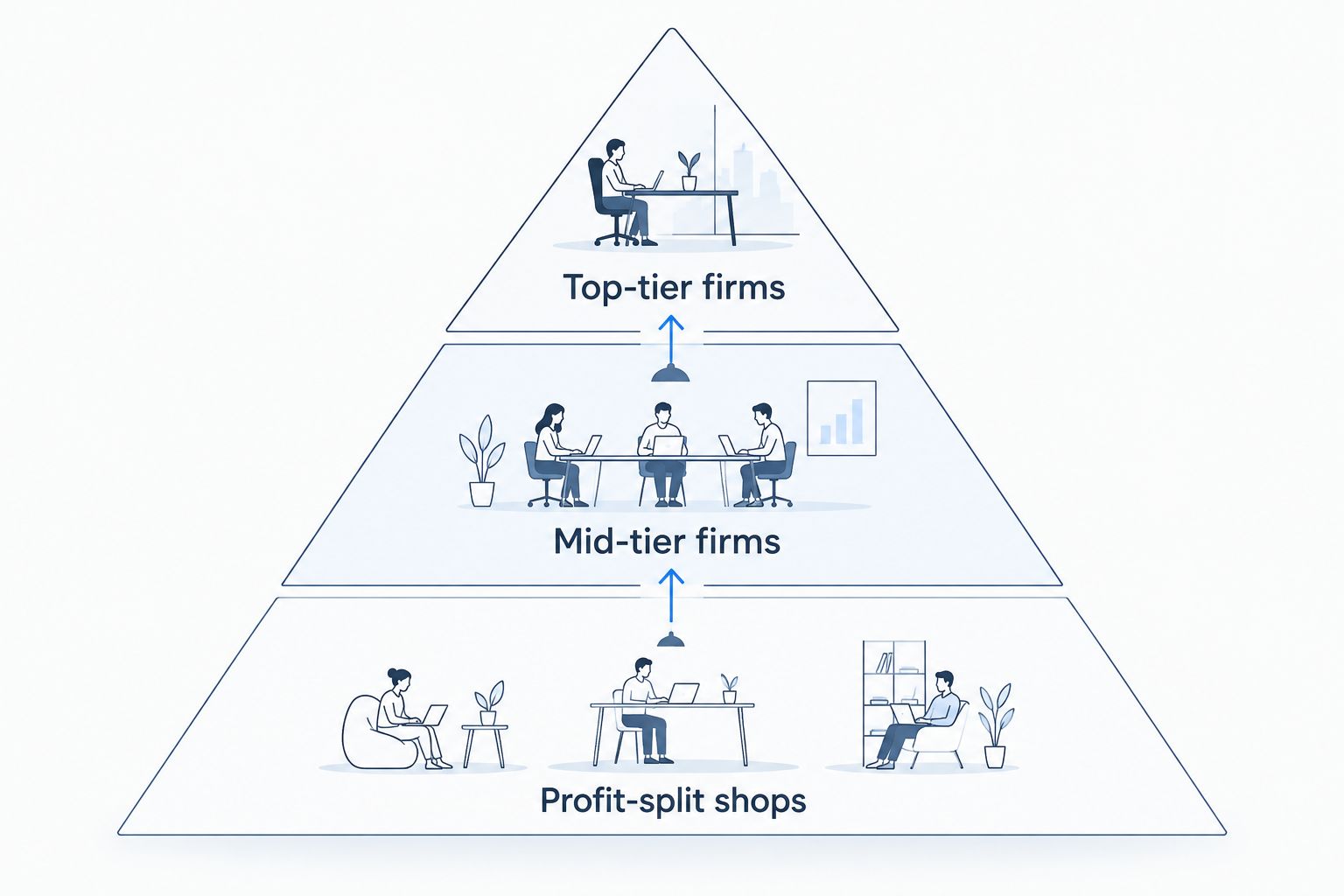
Top-tier prop firms: $250,000-$400,000+ in year one
Firms like Jane Street, Optiver, Citadel Securities, DRW, SIG, and Hudson River Trading pay a base in the $100,000-$150,000 range, then layer signing bonuses and performance bonuses on top. Year one total comp for a new grad trader or quant developer at these firms commonly lands between $250,000 and $400,000, and standout performers can clear that.
The catch: recruiting at this tier is brutally selective, and the bonus portion is not contractual — it moves with the firm's trading results and the individual's desk performance. Verdict: worth every hour of interview prep if the candidate's math and coding are already strong — Buy.
Mid-tier and regional prop firms: $130,000-$220,000 in year one
Mid-tier firms — smaller Chicago and Austin shops, futures-focused prop desks, and regional trading firms — typically pay a base of $80,000-$120,000 with a bonus structure that brings total year-one comp to $130,000-$220,000. The bonus swing is smaller than at the top tier, which means less upside but also less risk of a thin year.
These firms often recruit outside the handful of target schools that dominate top-tier pipelines, which widens the door for candidates without an Ivy League or MIT résumé line. Verdict: a solid landing spot for candidates who want prop trading experience without betting the whole year on a bonus pool — Buy.
Small prop shops and profit-split firms: $60,000-$150,000+ in year one
Small shops and firms built entirely around a profit-split model pay a low guaranteed base — often $60,000-$90,000 — and hand the rest of comp directly to the trader as a cut of realized P&L. Total comp here can technically exceed $150,000 for a trader who performs well out of the gate, or sit near the base number for a trader who doesn't.
This structure rewards fast, confident risk-taking and punishes a slow ramp. Verdict: high variance, only right for candidates who understand the profit-split math before signing — Hold and read the contract closely.
Aim your prep at the right firm tier
Resume review and interview coaching built around quant and prop trading roles.
Why prop trading pay varies
A handful of variables explain most of the spread between a $110,000 offer and a $400,000 offer for the exact same job title:
- Firm tier and brand. Top-tier firms pay more across every component — base, signing bonus, and year-end bonus — because they can afford to and because recruiting competition demands it.
- Role type. Trading roles, quant research roles, and quant developer roles at the same firm often carry different bonus formulas; trading seats tend to have the widest bonus range.
- Compensation structure. Salary-plus-bonus firms smooth out year-to-year swings; profit-split firms concentrate all the upside and downside in the individual's own performance.
- Location. Chicago, New York, and Austin prop hubs price differently, and remote or satellite offices sometimes pay below headline numbers for the same seat.
- Firm and desk performance. A strong trading year across the firm lifts every new hire's bonus pool; a flat year compresses it, even for a candidate who performed well individually.
- Negotiating position. Multiple offers, strong internship performance, or a standout technical interview round change the signing bonus a firm is willing to offer before day one.
Is prop trading pay higher than hedge fund pay for new graduates?
Prop trading pay for new graduates is generally comparable to or higher than entry-level hedge fund research pay, with top-tier prop firms often out-earning mid-tier hedge fund research seats in year one. The comparison flips at the very top of the hedge fund world, where established multi-strategy funds can match or exceed top prop firm comp — a fuller look at what quant researchers make at hedge funds breaks down that side of the market.
Do prop trading firms pay signing bonuses to new graduates?
Most top-tier and mid-tier prop trading firms pay a signing bonus to new graduate hires, layered on top of base salary and separate from year-end performance bonus. Signing bonuses are typically one-time and do not repeat in year two, which is why a strong first-year total comp number can look smaller the second year even without a pay cut.
How is prop trading pay structured differently from bank trading desks?
Prop trading pay leans harder on bonus and profit-participation than bank trading desk pay, which tends to run a higher guaranteed base with a comparatively smaller bonus swing. Banks also spread bonus pools across larger trading floors, while prop firms concentrate bonus dollars on a smaller headcount, which is part of why prop firm upside can run higher for the same seniority level.
Most of the offers that go wrong at this stage go wrong on the interview, not the negotiation — a candidate who never gets past the first-round brain teaser never sees a comp number to evaluate. QuantMinds works through resume framing, mock interviews, and offer comparisons with candidates targeting these roles, and the cost of that kind of coaching is laid out here for anyone weighing it against a prop trading offer.
FAQ
How much do prop trading firms pay new graduates in 2026?
Prop trading firms pay new graduates $110,000 to $400,000+ in total first-year compensation in 2026, depending on firm tier. Top-tier firms sit at the high end; small profit-split shops carry the widest variance.
What is the starting salary at a top-tier prop trading firm?
Starting base salary at top-tier prop firms like Jane Street and Optiver typically runs $100,000-$150,000, with total year-one comp reaching $250,000-$400,000+ once bonus is added. The base alone understates the real offer.
Do prop trading firms pay more than hedge funds for new grads?
Prop trading firms generally pay comparable to or higher than mid-tier hedge fund research seats for new graduates. The gap narrows or reverses only at the very top of the hedge fund market.
What is a profit-split pay structure at a prop trading firm?
A profit-split structure pays a low guaranteed base, often $60,000-$90,000, plus a direct percentage of the trades a person generates. Total comp can exceed $150,000 in a strong year or stay near the base in a weak one.
Which prop trading firms pay the highest starting salaries for new grads?
Jane Street, Optiver, Citadel Securities, Akuna, DRW, SIG, and Hudson River Trading sit at the top of the pay range, commonly reporting $250,000-$400,000+ in year-one total comp for new graduates.
Is prop trading pay guaranteed or performance-based?
Base salary at prop trading firms is guaranteed, but signing bonuses, year-end bonuses, and any profit-split component are performance-based and can vary year to year. The performance-based portion is usually the larger share of total comp.
Does location affect prop trading pay for new graduates?
Location affects prop trading pay, with Chicago, New York, and Austin hubs generally pricing higher than smaller satellite offices for the same role. Remote seats at some firms pay below the headline numbers quoted for headquarters roles.
One last thing
Most candidates fixate on the top-tier headline number and skip the mid-tier firms entirely — which is a mistake, because mid-tier offers carry far less bonus volatility for a pay gap that's often smaller than expected. If the goal is a predictable first two years rather than a lottery-ticket bonus, a mid-tier prop firm at $130,000-$220,000 total comp can be the better financial decision, not the fallback.